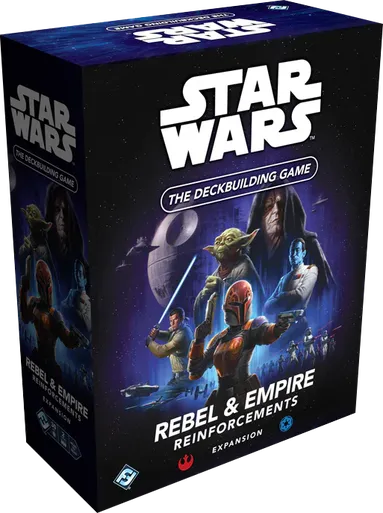
Welcome to this week’s review! This week I’m taking a look at the latest expansion to Star Wars: The Deckbuilding Game. So, without further ado, let’s jump into it.
Disclosure: A review copy of this game was provided to The Meeple Digest in exchange for an honest, unbiased review. This review is not intended to be an endorsement.
Star Wars: The Deckbuilding Game – Rebels & Empire Reinforcements
- Designer: Caleb Grace
- Publisher: Fantasy Flight Games
- Complexity: Light – Medium
- Time: 30-90 Minutes
- Players: 2
- Main Mechanisms: Deck Building
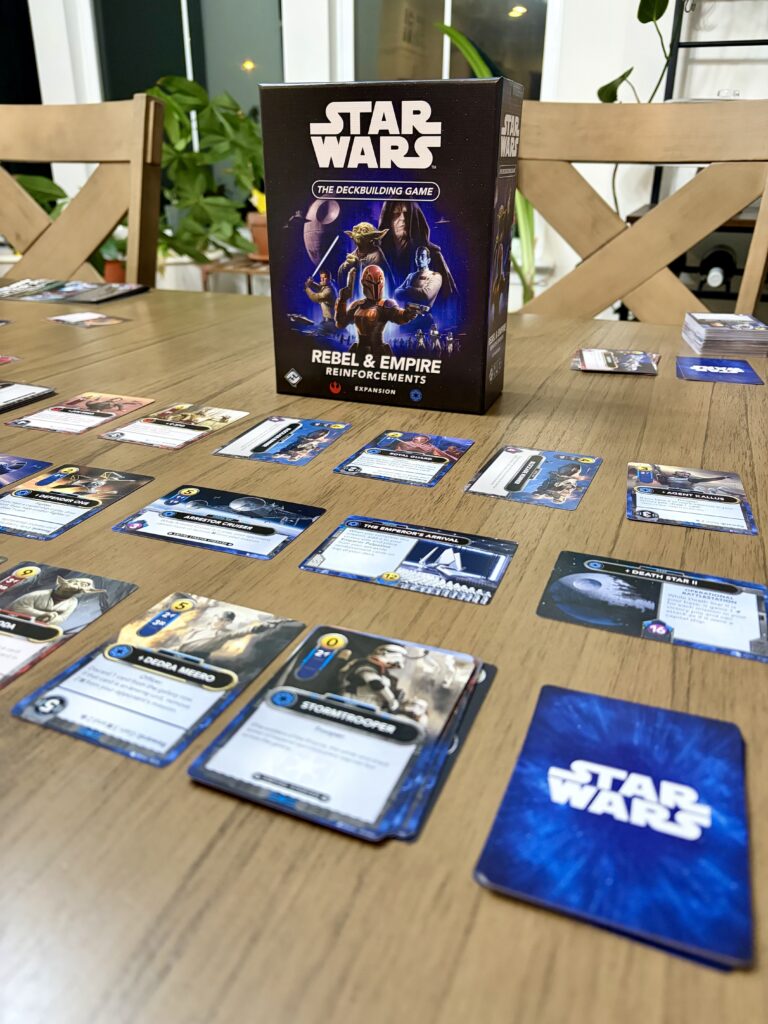
Rebels & Empire Reinforcements is the latest expansion to Star Wars: The Deckbuilding Game. Unlike the Clone Wars Edition and the Mandalorian Faction Pack, which adds new factions to play as, this expansion expands to the two original factions from the base game.
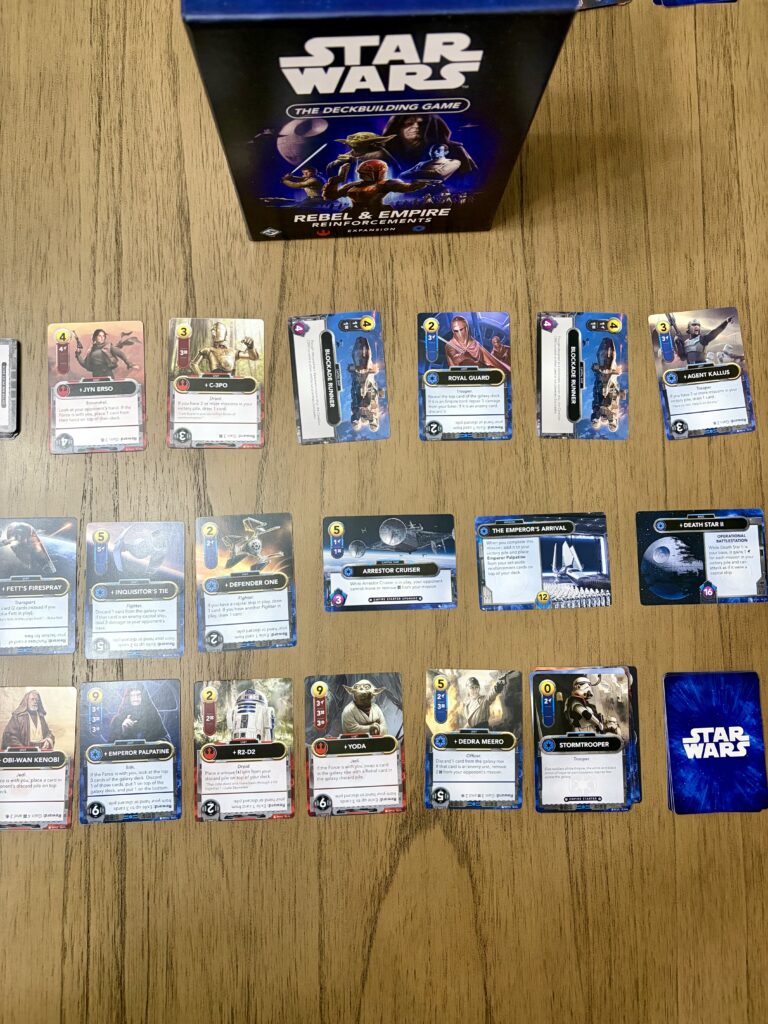
My favorite part of this expansion are the new faction cards. Each faction gets 25 reinforcement cards, bringing iconic characters like Yoda, Emperor Palpatine, Obi-Wan, and more to the game. Considering that Andor is probably my favorite Star Wars content since the original trilogy, it was cool to see iconic characters like Deedra and Luthen included as well.
When playing with missions, these reinforcement cards are not automatically added to the galaxy deck. Instead, each player has a deck of mission cards that are shuffled during setup. If a player doesn’t currently have an outstanding mission, that player gets to draw the top two mission cards from their deck and choose one to target. To complete a mission, players have to add resource cubes equal to the cost of the mission in order to complete it, with stronger characters like Yoda and Palpatine requiring more resources than others. When a player completes a mission, they get to add the associated reinforcement card to the top of their deck.
I liked how the missions offered another way to spend resources. With the base game, you could end up in a situation where none of the cards in the galaxy row were appealing or you might not be able to afford the ones you want, so gaining resources could feel like a waste. Now, the missions provide a way to spend leftover resources without having to discard them. In addition, I found that it was easier to acquire strong cards earlier in the game. Instead of buying a few lower cost cards over the first few turns, you can instead bank those resources towards a strong reinforcement card that won’t clog your deck.
There are a few tradeoffs with the missions though. First off, while it was fun to acquire these strong cards, it does create a bit of a balancing issue. I found that I rarely went after cheaper cards in the galaxy row, opting instead for the stronger reinforcement cards. Additionally, while you get to choose between two missions each time, you could end up a situation where one player gets a much stronger reinforcement card than the other. This makes it easier to snowball, and I rarely found that the other player was able to catch up for the rest of the game.
This expansion also comes with a campaign mode that spans five games. After each game, players get to upgrade their starting deck of cards based on how many missions and bases they collected at the end of the game. Additionally, players also get to swap out their faction cards in the galaxy deck with those claimed through completed missions. I particularly enjoyed this dual deck-building system, as you’re not only building your starter deck, but also the galaxy deck as well.
Another highly thematic mechanism with the campaign is that each base can only be used once during the campaign. In other words, once a player destroys a base, it can no longer be used again. This gives added weight to your decision on which base to deploy and when. Even though a base might be quite strong, I had to pick and choose when the optimal point to deploy it was.
One issue I had with the campaign is that it does have a bit of a “rich get richer” problem. This is a common occurrence with most competitive campaign games, and while it’s not quite as punishing here as the difference between the winner and loser each game is likely only a few points, there really isn’t any catchup mechanism present.
That said, if you don’t want to play the campaign, you can also play with just the upgraded starter cards (with or without missions). Additionally, if you don’t want to play with missions, you can customize the galaxy deck by swapping out a number of each faction’s cards with reinforcement cards.
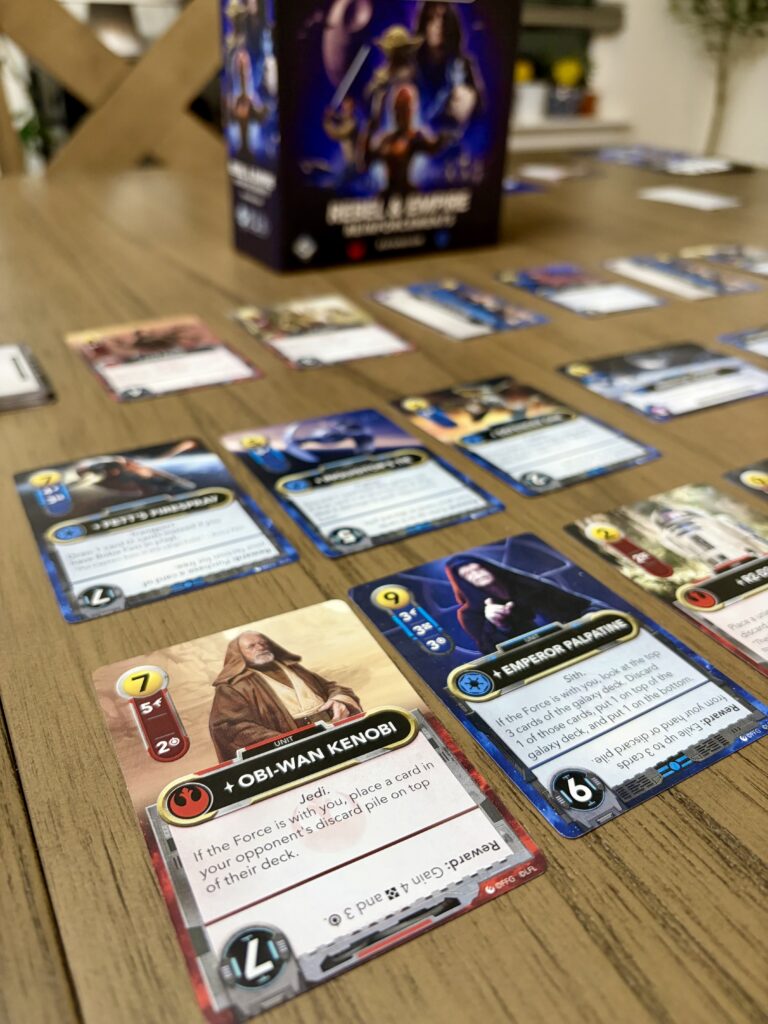
Overall, I’ve enjoyed what the Rebels & Empire Reinforcements expansion includes. My favorite part is likely the mission and iconic reinforcement cards, even if they do lead to some balancing concerns. Although, I could always opt to add the reinforcement cards without using the missions. While I’m not sure how often I will want to play through a full campaign again, I do like the dual deckbuilding options, and with bases as one-time use only, it gives your decisions some weight. For someone that already enjoys Star Wars: The Deckbuilding Game and is a fan of Star Wars, this is an easy recommendation just for the iconic characters alone.
With that, I’ll wrap up this week’s review! If you’ve played Star Wars: The Deckbuilding Game or any of the expansions, I’d love to hear your thoughts in the comments below. And what are your favorite Star Wars characters? Happy gaming!
If you liked this post and want to be notified when new content is released, then follow me on Instagram @themeepledigest.
Leave a Reply