Welcome to this week’s review! This week I’m taking a look at a game that unfortunately turned out to be a big letdown. So without further ado, let’s jump into it.
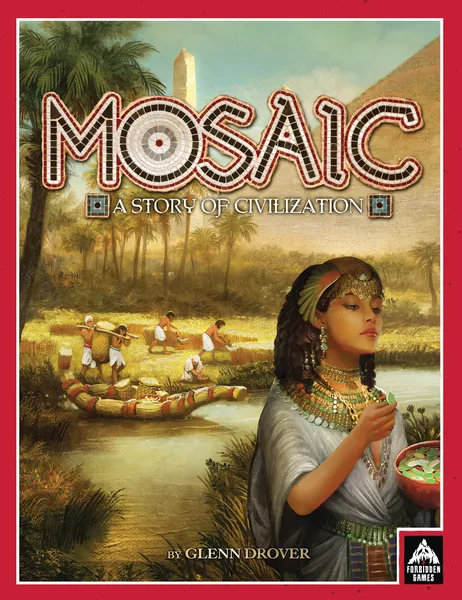
Mosaic: A Story of Civilization
- Designer: Glenn Drover
- Publisher: Forbidden Games
- Complexity: Medium
- Time: 120 Minutes
- Players: 2-6
- Main Mechanisms: Action Selection
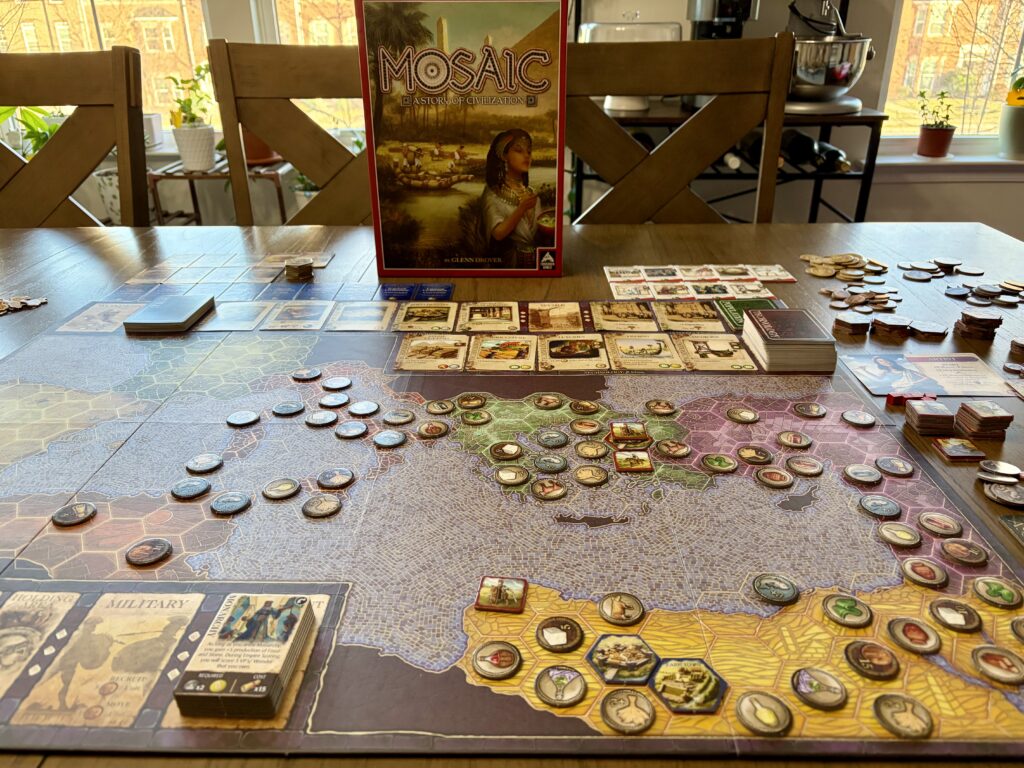
I’m a huge fan of Civilization-themed games. I’ve played every iteration of the Sid Meier’s Civilization video game series prior to latest game – Civilization VII. Aka I’m always eager to try a board game with a Civilization theme, and Nations is likely my current favorite. I’ve yet to find a board game that can capture the same magic as the video games as I often find them either too fiddly or abstract. This is why when I saw a deal for Mosaic: A Story of Civilization, I had to give the game a look. Note, these thoughts are based entirely on the retail version of the game, not the Colossus edition.
Mosaic is designed by Glenn Drover, who in addition to codesigning Railways of the World (a game that is still in my top 40 of all time), also designed Sid Meier’s Civilization: The Boardgame. Being a massive Sid Meier’s Civilization fan, I even owned the Civilization board game growing up. However, while that board game had some interesting ideas, it was still deeply flawed and didn’t fully capture the same Civilization feeling the video games offered.
Mosaic is an action-selection, civilization-building game where on a player’s turn, they can take one of eight different actions. The actions themselves are fairly straightforward and largely consist of paying resources to claim a card. There are multiple card decks, each with their own display, and while there are some differences, most will either boost a player’s production of one type of resource and/or provide a one-time injection of resources. In addition to boosting production, most of the cards also have icons that operate as a set collection mechanic, of which there are nine in the game. Some of these icons are prerequisites for other cards, and once players have collected six of one type, they are awarded victory points.
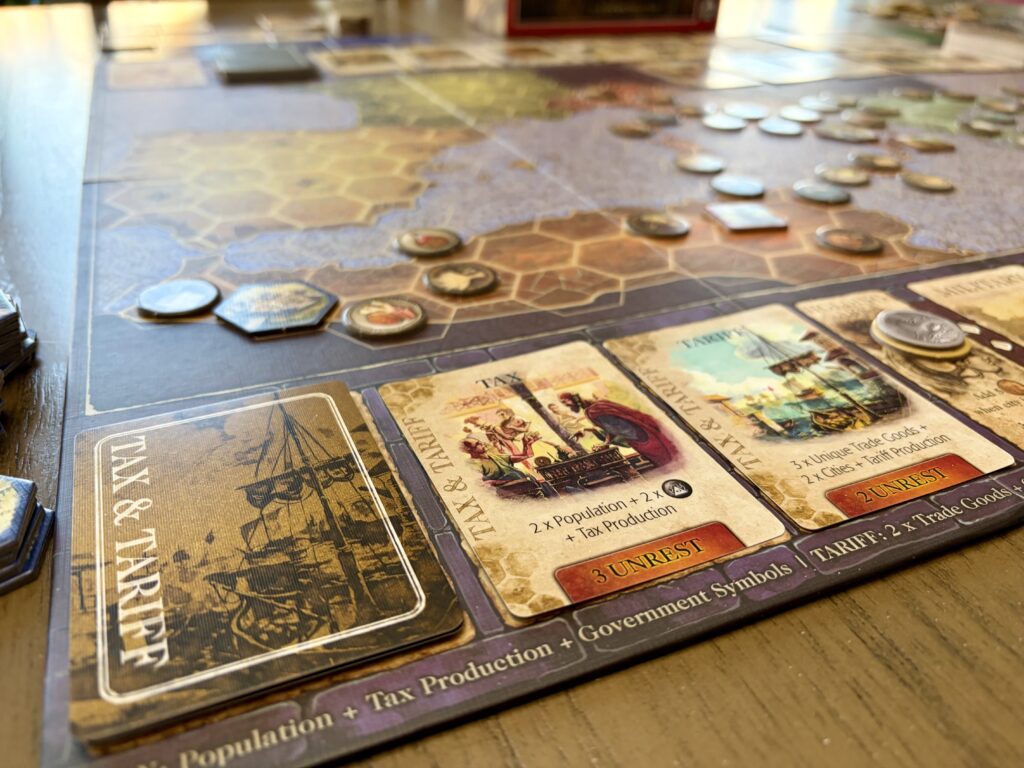
Starting off with the positives for the game – while there are eight different actions, most of them involve gaining a card. Tom Vasel has referenced this game as having “quick, snapping turns” and for the most part, the card system makes the turns relatively simple and quick.
Unfortunately, that’s where the positives for me end – minor rant incoming. Starting off, while the actions are simple, they’re also quite uneventful and downright boring. For example, in one game I focused on increasing my production of food, which in turn allowed me to increase my population, which also increased my production of food. I kept increasing my population, which in turn allowed me to produce more food, but after a certain point, I had no idea why I needed to keep doing so other than it felt like the thing I should do. I understand that most euro games are designed around increasing tracks or collecting different tags, but in Mosaic, it felt extremely dry and repetitive.
The same feeling translates to most aspects of the game. Players want to acquire technology cards because they are a key way to increase production, as well as collect the different icons needed to claim victory points. However, after a certain point, the game starts to drag. Some of this could have been offset if the game was more thematic, especially given that the Civilization theme was almost entirely window dressing. While some of the technologies attempt to be somewhat thematic (for example, the Fertilizers technology increases food production), after a point, I wasn’t paying attention to the names of the technologies rather only which production they increased and which icons they provided. In addition, whereas other Civilization themed games, like Nations or Through the Ages, have separate age decks, all technologies in Mosaic are in one large deck; even the starting technologies get shuffled back in after setup. I would have preferred the technologies be separated, as I think it could have allowed for some nice progression throughout the game that would keep the cards from feeling too similar.
There are also some downright questionable production decisions. First off, playing a six-player game of Mosaic seems about as much fun as playing a six-player game of Caverna or Viticulture. I love both of those games, but I might have to reconsider my friendship with someone if they suggested playing either of those games at that player count. It would be one thing if this game had a lot of player interaction, but the only interaction in the game largely consists of claiming cards or achievements before other players, as well as an odd area control mechanism that feels out of place.
Speaking of the map, I’m not sure why it even needs to exist in this game. Nations and Through the Ages proved that you could make a Civilization game without a map, so I’m not sure why it’s necessary here. All it does is greatly lengthen setup as you have to randomly assign resources to every hex on the map, and then remove all of the ‘X’ tokens, of which there are over half. Instead of the map, players could have randomly drawn tokens from a bag every time they built, which would have made the game less of a table hog and drastically shortened setup. It’s also not entirely clear which are valid hexes, and the results I found on BGG appear to contradict the rules which state that “only hexes with all 6 sides are valid hexes”. In addition, it’s not clear from just looking at the map which regions/hexes are adjacent to one another.
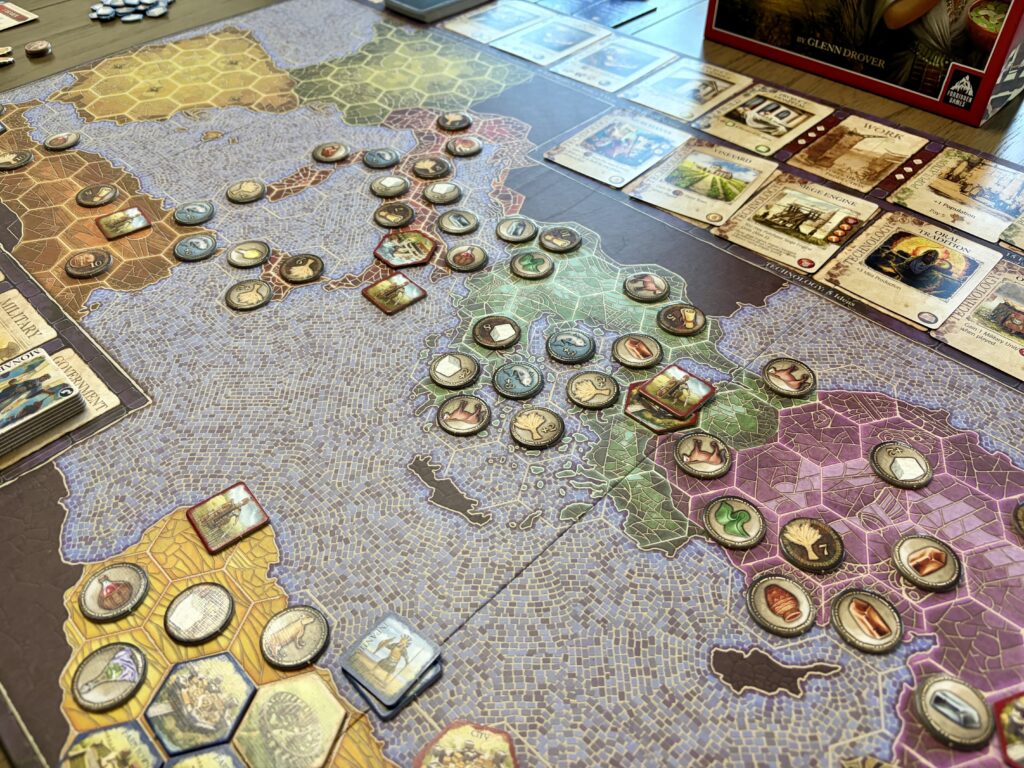
There’s also an area control mechanism that requires players to place units in regions, except the units don’t occupy hexes. This meant that we just placed them wherever we could fit them, and I feel like there had to be a better solution for this. Speaking of units, maybe it’s buried somewhere in the rules, but I have yet to understand what the difference between infantry and cavalry is.
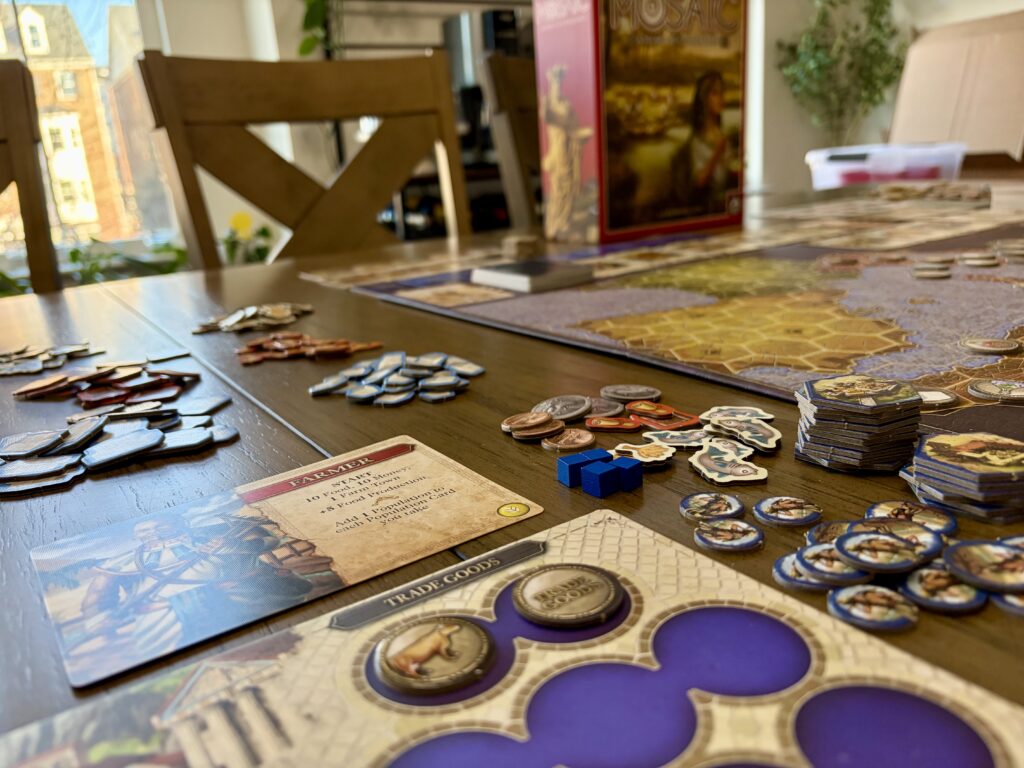
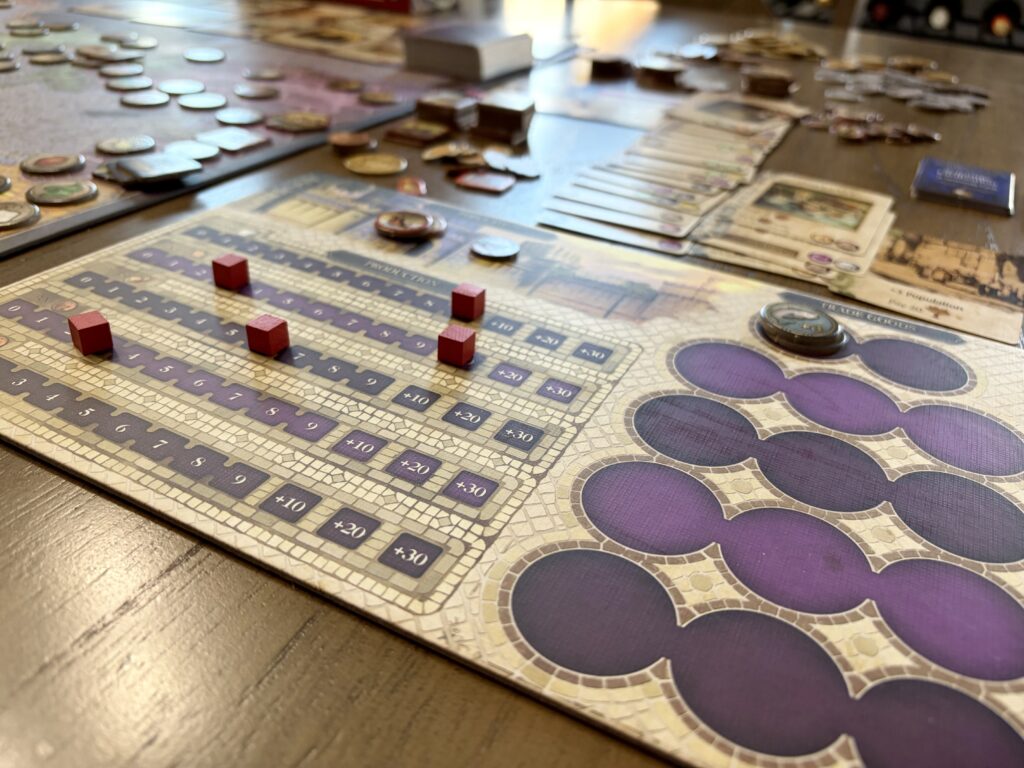
I also don’t understand why it’s necessary to have individual components for all six players, which took ages to punch out. I guess each player can have their own buildings and units, but why does each player need to have their own population tokens? Could they not have been another resource token? Speaking of odd production decisions, the game has intermittent scoring, yet the board doesn’t have a score tracker. And while the tokens that represent five stone and five ideas are similar to their respective one value token, with food, grain is the one value token while fish are the five value token which doesn’t make much sense. Even the money denominations are difficult to tell the difference since the number is only printed on one side.
Lastly, the rulebook is also one of the worst that I’ve come across in quite some time. For context, setup doesn’t begin until page nine, the rulebook is almost devoid of pictorial examples, and key rules are buried in walls of text. There’s also a ton of “fluff” where the rulebook attempts to make thematic tie-ins that only make the rules more cumbersome to digest. While there is a reference aid, some key rules can only be found in the rulebook. For example, players may only recruit up to two new units each turn.
Overall, I am extremely disappointed with Mosaic. While the game has some interesting ideas and the card play is relatively simple, this game desperately feels like it needed more time in the oven. The core loop is monotonous, and I can’t overlook the many puzzling production decisions. Unfortunately, Mosaic will not be a game I will be returning to, and it’s a very difficult game to recommend to even the die-hard Civilization fans.
With that, I’ll wrap up this week’s review! I’d love to hear your thoughts on Mosaic. And what are your favorite Civilization themed games? I’d love to hear your thoughts on any of the games I’ve mentioned or future content suggestions in the comments below. Happy gaming!
If you liked this post and want to be notified when new content is released, then follow me on Instagram @themeepledigest.