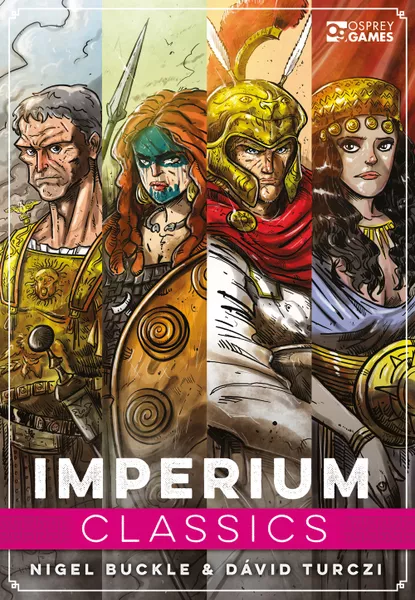
Welcome to this week’s review! This time I’m taking a look at a new favorite game to solo. So, without further ado, let’s jump into it.
Imperium
- Designers: Nigel Buckle, Dávid Turczi
- Publisher: Osprey Games
- Complexity: Medium-Heavy
- Time: 40-160 Minutes
- Players: 1-4
- Main Mechanisms: Deckbuilding
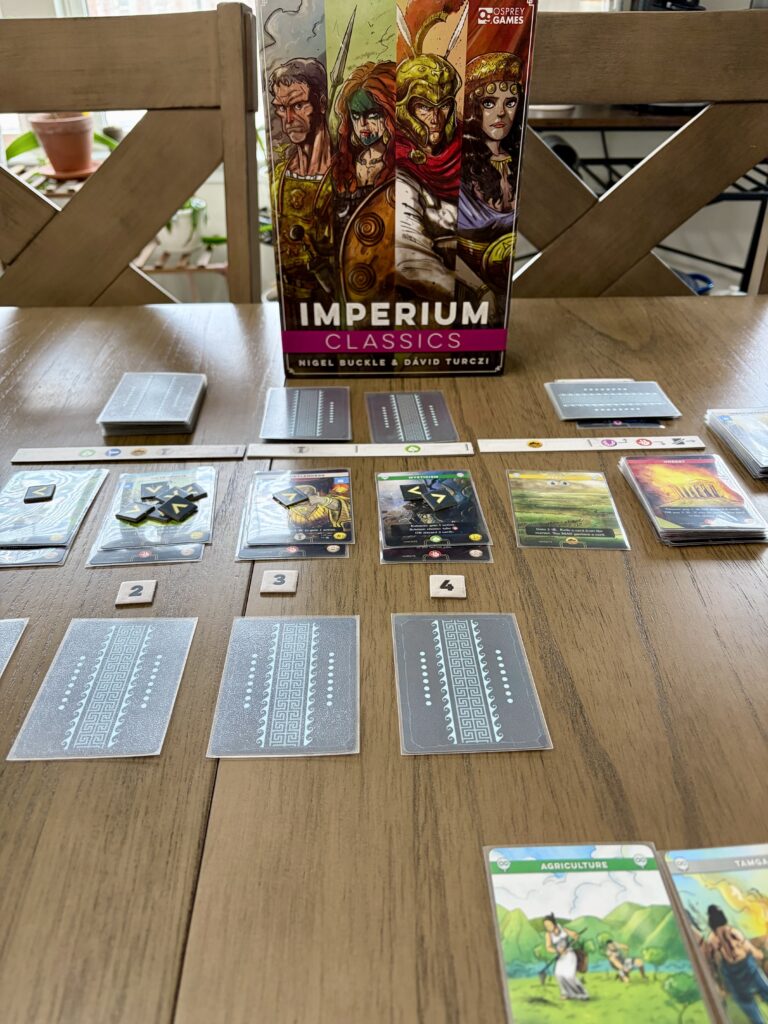
Imperium: Classics, Legends, and Horizons are civilization-themed deckbuilding games. In each game, players take on the role of a different civilization, each with their own deck of cards, and attempt to guide their civilization to glory. Each of the three games share the same core rules, while also providing a unique set of civilizations to play as and a different set of common cards that vary slightly between games. While I own both Classics and Legends, as of writing, I have only played using the Classics civilizations and common cards, so while I’ll mostly be referring to the Imperium system as a whole, I have yet to experience all of the content.
The key differentiator between the three games are the unique civilization decks. Both Classics and Legends each offer eight different civilizations to play as, who all feel highly unique and historically grounded. For example, playing as the Romans focuses on conquering a lot of region cards, whereas playing as the Greeks focuses on developing cities and technology. Each of the civilizations have both a starting deck, as well as additional cards that are gradually added to the player’s main deck. This mechanism is intended to simulate the Civilization’s gradual progression through history. There’s also a unique mechanism that once the Civilization develops enough cards from its deck, the Civilization transforms from a “Barbarian” tribe to a developed “Empire” which restricts which cards can be played, so some cards are more powerful early and vice versa.
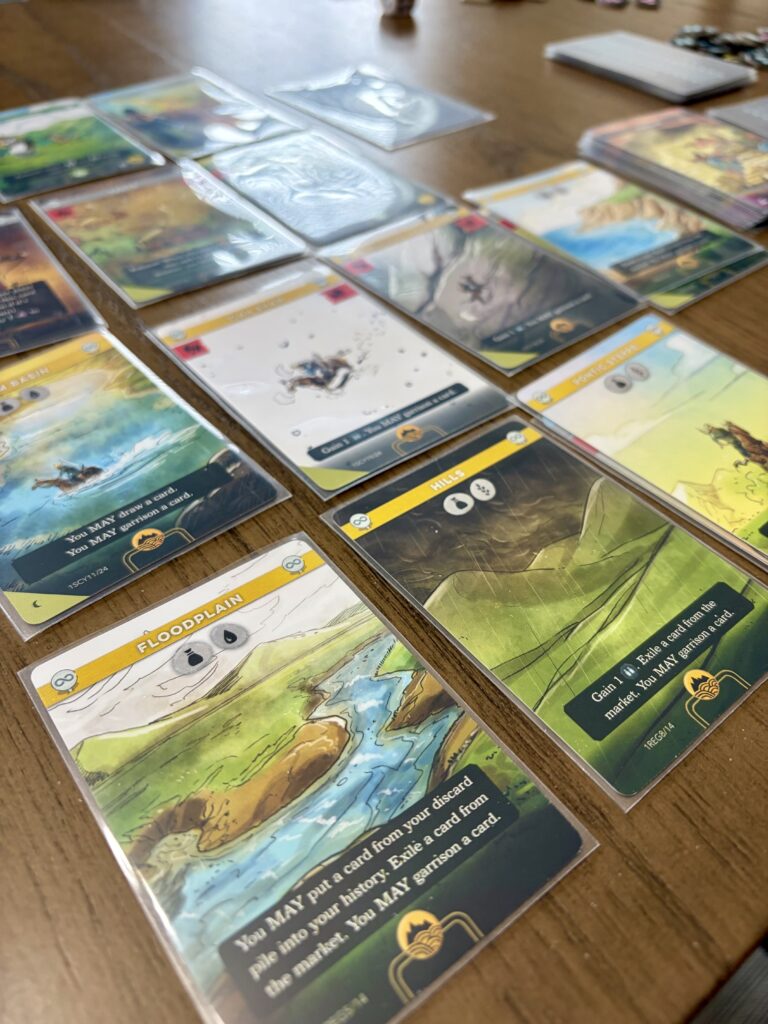
I personally really enjoy deckbuilding, and I’m happy to report that it is quite satisfying in Imperium. Often deckbuilding games struggle to find the right balance of allowing the player to expand their deck while still developing an efficient engine. For example, there are often limited ways to remove the weaker cards from your deck. Imperium strikes a nice balance in this regard by making it satisfying to add more cards to your deck, while at the same time offering multiple ways to cycle cards or remove them. The game also introduces some interesting decision making with timing when to send cards to the player’s history, which effectively removes them from the deck but they still score at the end of the game. In addition, players can also choose to garrison cards, which acts as a way to temporarily thin out the player’s deck.
I mentioned at the beginning that Imperium is quickly becoming one of my favorite games to play solo. While the game does support up to four players, I most likely will be playing the game predominantly solo. That’s partly because of the lack of player interaction (more on this in a bit), but also because the solo mode is particularly well designed. When playing the game solo, the player competes against an AI bot, who also receives its own civilization which comes with a civilization-specific reference card that dictates which actions the bot will take depending on which cards they reveal on their turn. This makes it so that the bot feels like a human opponent since the bot is always playing into its civilization’s strengths, and each game still provides a unique experience since there are plenty of different civilization combinations to try.
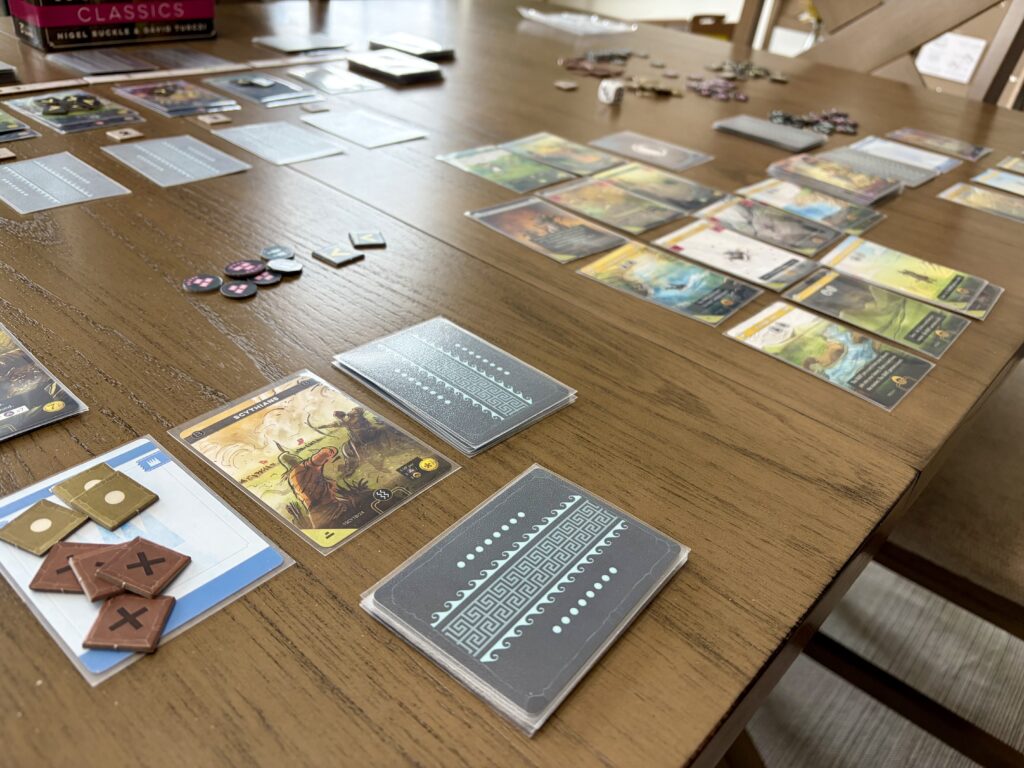
Overall, I found trying out each of the different civilizations highly addicting. Over time, I found myself picking up some of the nuances of each civilization’s deck, which adds a nice learning experience for the players who like to try to min/max a specific civilization. To further add to the amount of variety, each civilization has two different powers, and you only play with one of them each game, which leads to multiple viable strategies for each civilization from game to game.
Moving on to some slight negatives. First off, the component quality is not the best. While the artwork from “The Mico” on the cards is generally quite nice, the resources are fairly basic cardboard tokens with some rudimentary icons. In addition, I found it a bit tricky to differentiate the different resource values for the one, five, and ten tokens. The card stock is also not the thickest and since you’ll likely be doing a lot of shuffling during the game, I would likely recommend sleeving them.
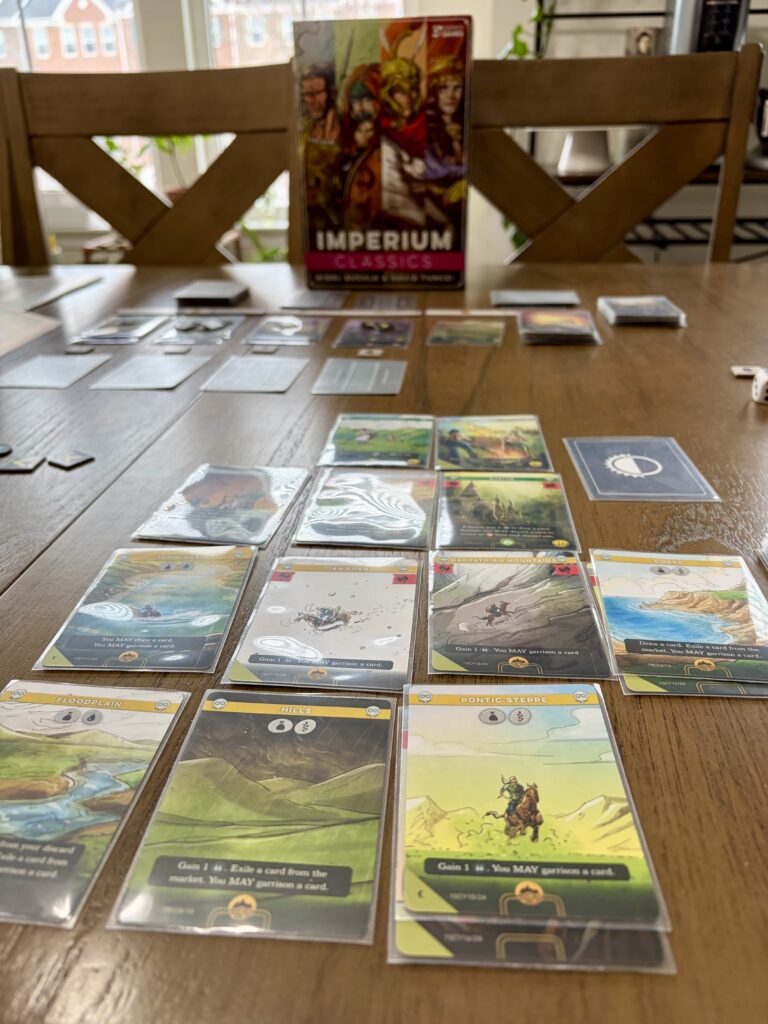
The game is also quite complex for a deckbuilding game, as players will need to learn a plethora of icons and keywords. The rulebook in Classics and Legends also makes the game particularly challenging to learn initially. Frustratedly, some of the civilization-specific rules are scattered throughout the rulebook, and the bot tables are in the rulebook instead of on their own printed cards. Horizons fixed this issue, but it would have been nice to see those included from the start. I personally downloaded the updated rulebook from Horizons, which made the game easier to grasp, but I still needed a few games under my belt before the rules fully started to click.
I already mentioned that I’ll mostly play the game solo, which is for a few reasons. First off, the game is challenging to teach to new players, as there are a lot of keywords and icons to learn. Secondly, there are not that many opportunities to direct interact with other players. Players are largely focused on their own deck, and outside of a shared market row of cards, there are not that many interactive elements. In addition, there is some “negative” player interaction, such as stealing resources, which is easier to stomach when playing against a bot compared to another human player. Thirdly, the bot does such an excellent job of simulating a human player that you’re able to get a very similar experience playing the game solo as compared to with other human players. Finally, the game has a tendency to run long, even as a solo game, and I suspect that playing this game with more than two players would be a bit of a slog to get through.
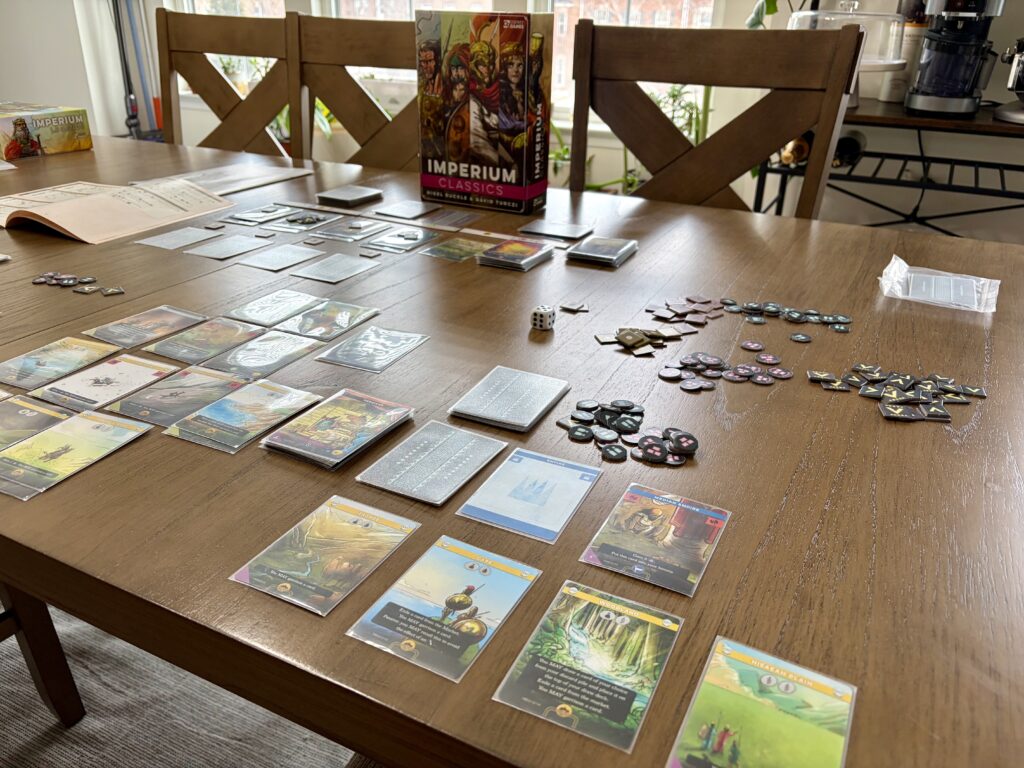
Overall, I have really enjoyed the Imperium system, and I’m eager to dive into more of the different civilizations. I haven’t played Star Trek: Captain’s Chair, which utilizes a similar system as the Imperium games, but I know almost nothing about Star Trek, so I imagine the theme would be lost on me. However, even with just the Classics, Legends, and Horizons, there is more than enough content here to keep me excited to come back to it for quite some time.
With that, I’ll wrap up this week’s review! If you’ve played any of the Imperium games, I’d love to hear your thoughts on the system, and what are your favorite civilizations to play as? Also, if you’ve played Star Trek: Captain’s Chair, I’d love to hear your thoughts on that game and how it compares to Imperium. I’d love to hear your thoughts on any of the games I’ve mentioned or future content suggestions in the comments below. Happy gaming!
If you liked this post and want to be notified when new content is released, then follow me on Instagram @themeepledigest.