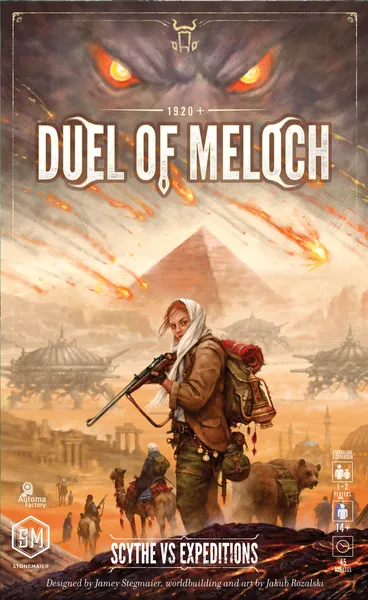
Welcome to this week’s review! This week I’m taking a look at a new two-player game that combines two existing games from the same designer and publisher. So, without further ado, let’s jump into it.
Disclosure: A review copy of this game was provided to The Meeple Digest in exchange for an honest, unbiased review. This review is not intended to be an endorsement.
Duel of Meloch
- Designer: Jamey Stegmaier
- Publisher: Stonemaier Games
- Complexity: Medium
- Time: 45 Minutes
- Players: 1-2
- Main Mechanisms: Action Selection
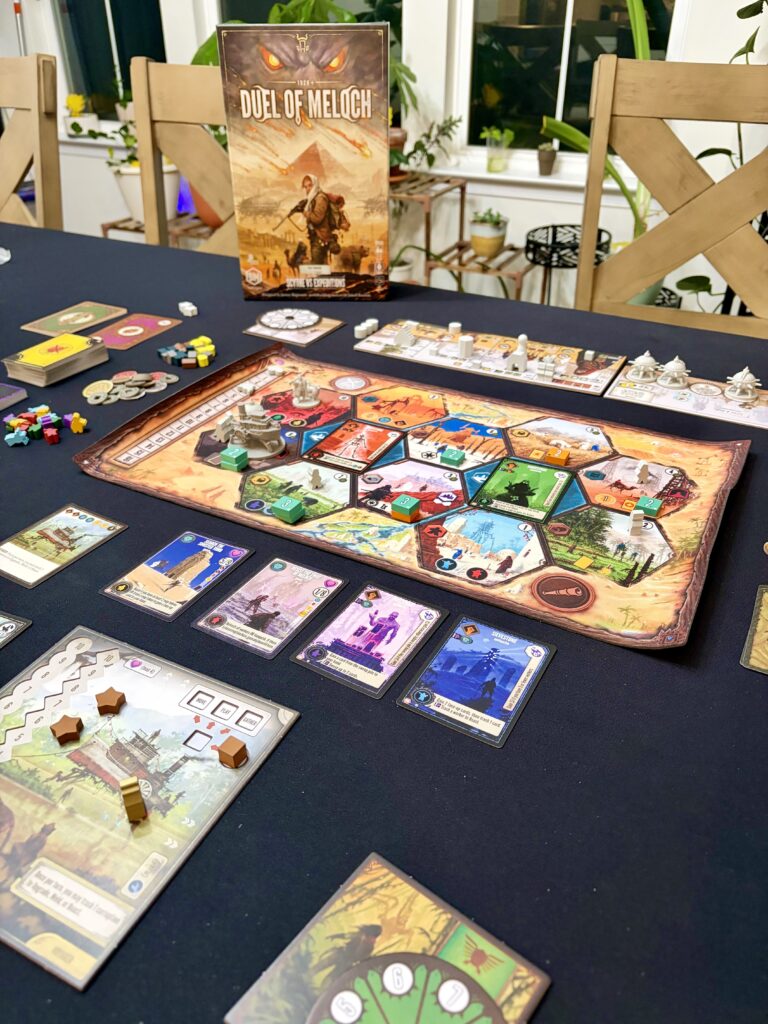
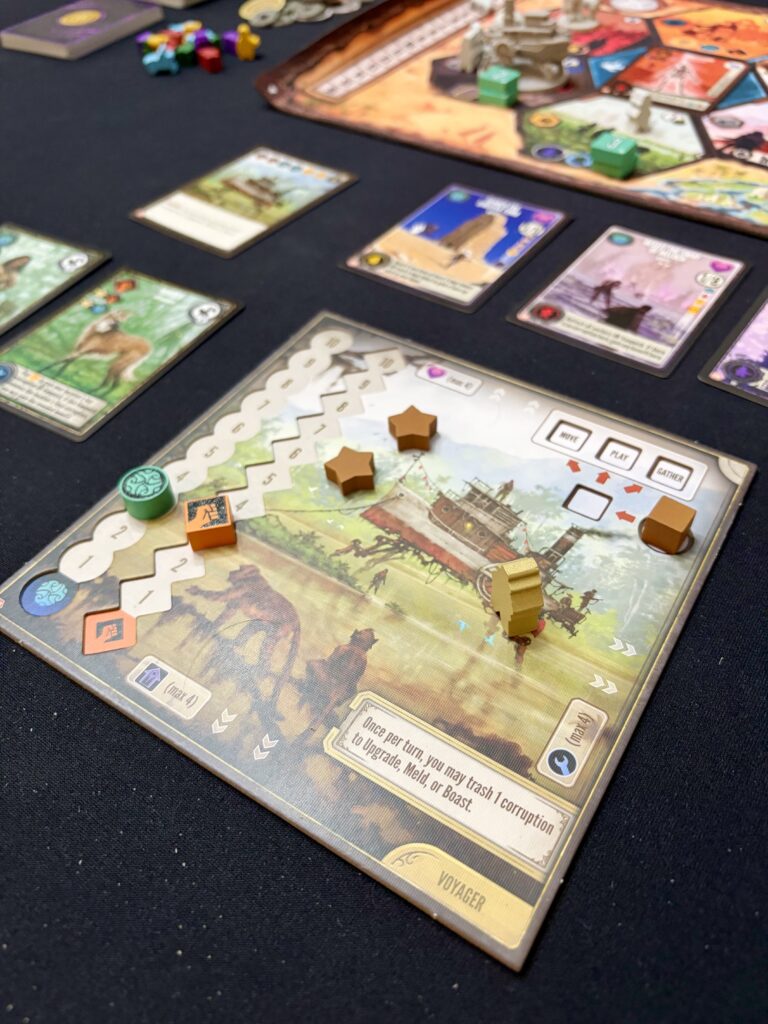
Duel of Meloch is a two-player game that combines both Scythe and Expeditions. In Duel of Meloch, one player controls a Scythe faction, while the other player controls an Expedition mech, character, and companion, with each using rules and components from their respective games. The goal of the game is to be the first player to claim four stars on the Triumph track.
First off, the game itself is quite a unique concept. While two-player, duel games are nothing new, I can’t recall another game that effectively merges two existing and separate games into something both new and similar at the same time. I’ll touch more on the pros and cons of this approach, but I have to applaud the ingenuity of the design.
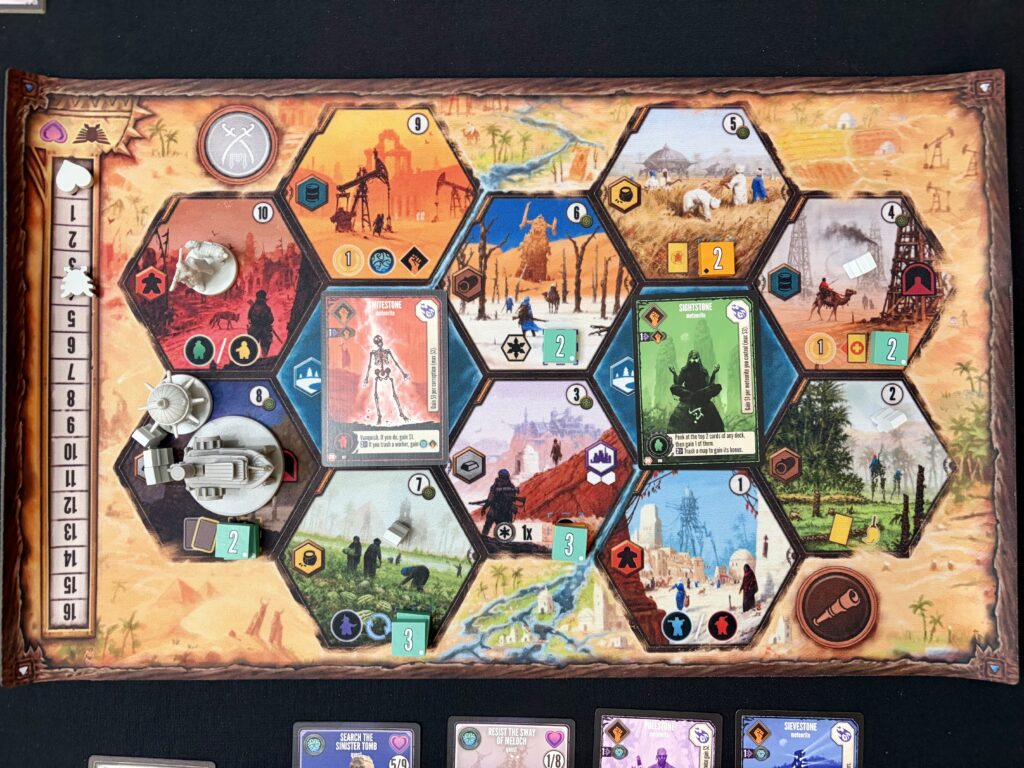
While the game comes with one new Scythe faction and a new Expedition mech, character, and companion, players can also use any existing Scythe and Expeditions content within Duel of Meloch. The game can also be played as a two-player only version of Scythe vs. Scythe, or Expeditions vs. Expeditions. I typically don’t play base Scythe with only two players, as the large map is ideally suited for more players, but I’d be open to a two-player game of Scythe using the smaller map from Duel of Meloch. In addition, Duel of Meloch acts as an expansion to both Scythe and Expeditions, as players are freely able to use Duel of Meloch components to expand either game.
Arguably my favorite new mechanism that Duel of Meloch introduces are multi-use combat cards. I’ve mentioned countless times that I’m generally a big fan of multi-use cards in game, and now in addition to playing combat cards during combat, combat cards can also be discarded to provide an immediate benefit. This provides an incentive to continue gaining combat cards, even when you already have high strength cards. Each combat card also has an effect when played during combat. For example, one combat card lets you play an additional combat card when revealed during combat, while another provides more strength for each combat card used during combat. Having both the discard benefit, as well as the new played effects, gives more depth to the combat cards, and I am tempted to always use these combat cards for all games of Scythe moving forward.
Another interesting mechanism in Duel of Meloch is the shared Triumph track. For each space along the Triumph track, there are different requirements for both the Scythe and Expeditions player. Some of them are fairly similar, for example having 13 power as the Scythe player versus having 10 power as the Expeditions player. However, some are completely different, like needing three buildings as the Scythe player or having seven corruption tokens as the Expeditions player. In addition, once one player has claimed a star, that space is no longer available for the other player. This makes it so that players will need to monitor what the other player is doing, so that they can race to claim stars before the other player.
Speaking of the Triumph track, whenever a player claims a star, the opposing player draws and plays a Meloch card. When you play a Meloch card, you cover up one half of the most recently played Meloch card. Then, whoever played the Meloch card gets each benefit on the cards facing themselves. These cards act as a “catch-up” mechanism and provide another layer of decision-making.
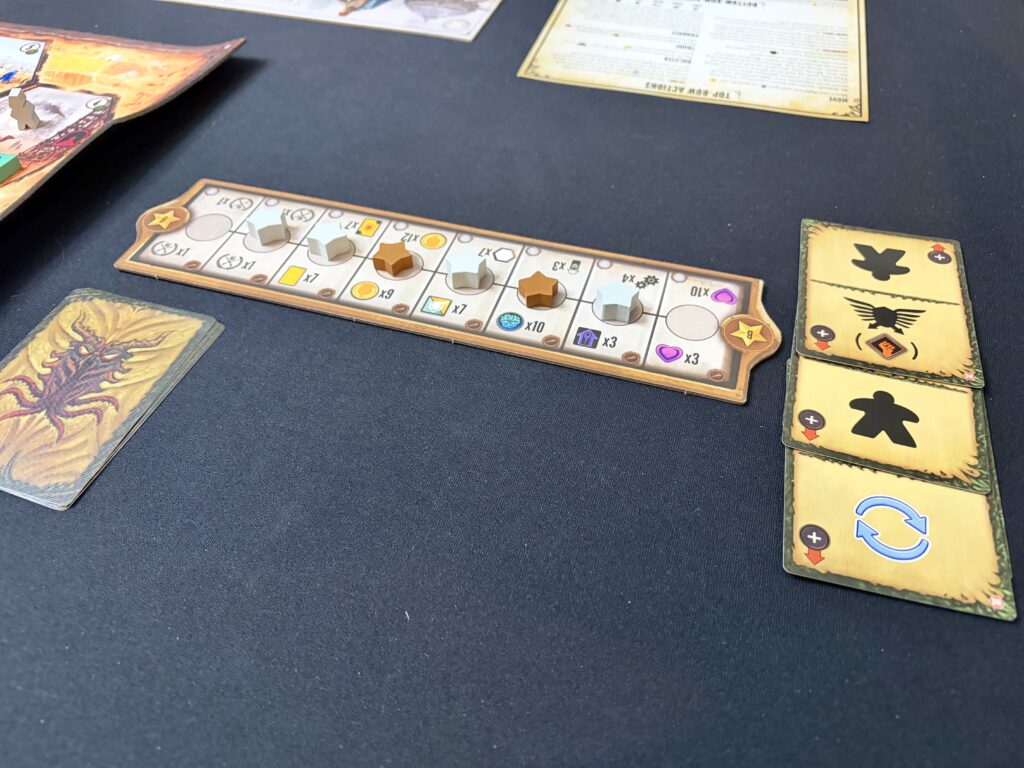
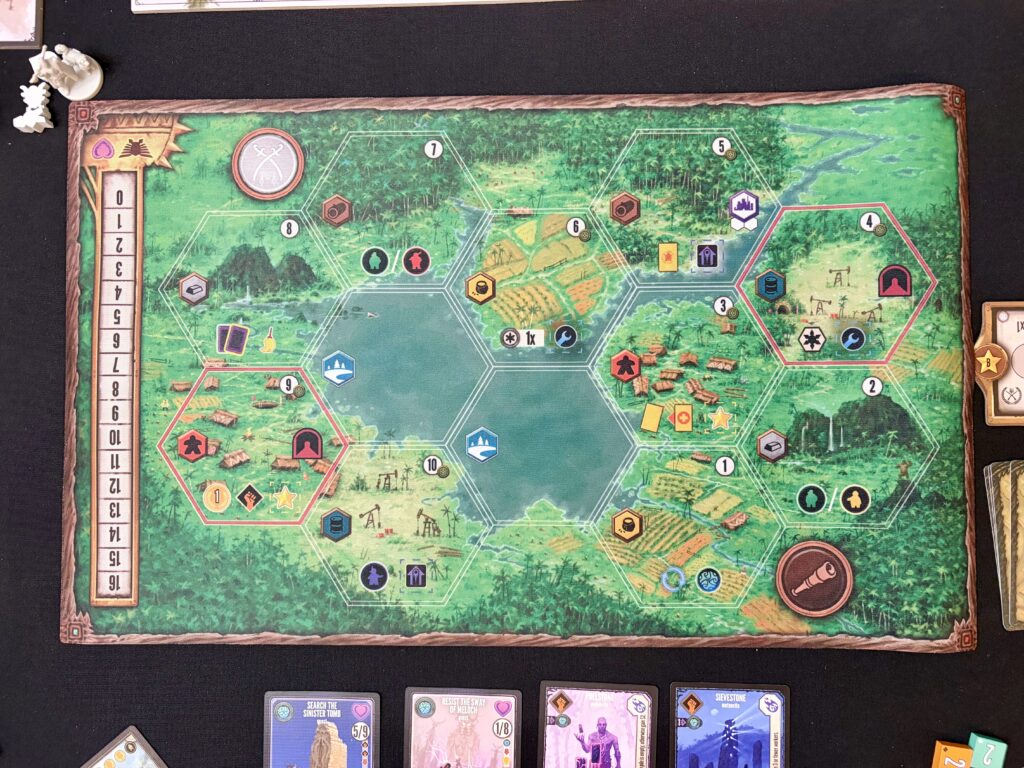
I already mentioned that if you already own Scythe or Expeditions, you can use any of those factions when playing Duel of Meloch. In addition, both the Triumph track and map are two-sided, which provide a fair amount of replayability. The game also comes with a Tournament of Meloch sheet if you want to play a tournament comprising of existing Scythe and/or Expeditions factions.
Moving onto a few caveats about the game. First off, since both players are playing by their respective game’s rules, this has the feeling of players playing two separate games from one another. Each territory on the map has a resource for the Scythe player and benefits for the Expeditions player, but outside of combat cards and racing to claim stars and encounter tokens, there’s very little that is shared across both players. It might be that both my wife and I are fairly conflict adverse, but we rarely got into combat outside of when the game forces you in order to claim stars. Most of the games involved both of us staring at our own individual components, and I felt like there was less interaction in Duel of Meloch compared to other duel games. I suspect that with more plays, players could find more opportunities to disrupt the other player, but as is, Duel of Meloch feels like playing two very distinct games rather than something shared.
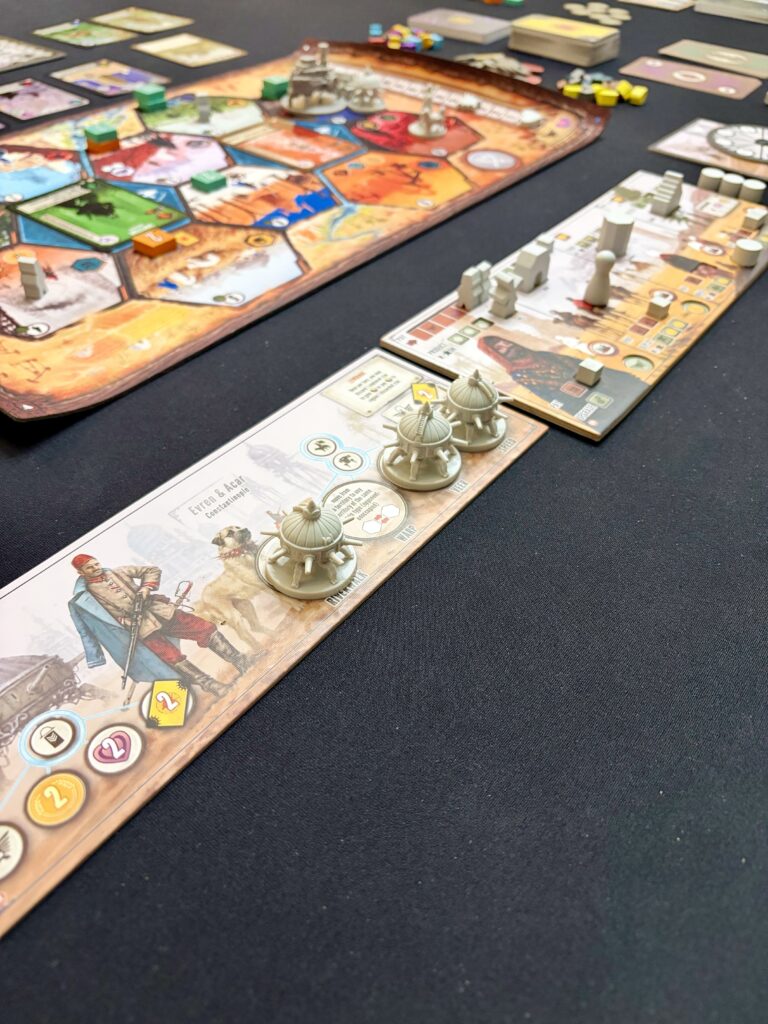
Expanding on the above, the Scythe and Expeditions players feel like they experience different game arcs. With Scythe, typically the early part of the game is slow until the player has expanded their number of workers and upgraded different parts of their player mat. As with playing base Scythe, typically it’s a lot slower to claim your first star or two compared to your last ones, and there’s definitely quite a steep ramp up as the game progresses. Whereas for the Expeditions player, it’s much more gradual of a burn. This could be due to not having as much experience with Expeditions compared to Scythe, but playing as the Expeditions player I found that I was usually quicker to claim my first star or two, whereas it was easier for the Scythe player to snowball at the end. Since combat works similar to in Scythe, the Scythe player has a sizable advantage in combat the longer the game lasts, as long as they keep their mechs closely bunched together.
Moving onto the big elephant in the room, in my opinion the biggest barrier to entry to this game is needing to understand the rules to both Scythe and Expeditions. There are fairly good player aid summaries that do a nice job of highlighting the key rules, but they act more as memory joggers than as a substitute for knowing the rules to Scythe and Expeditions. In that sense, if you’re planning to play Duel of Meloch as a Scythe vs. Expeditions experience, this game is ideally suited for those already familiar with both games.
Overall, Duel of Meloch is a very neat concept about combining two existing and separate games into a two-player experience. It’s also nice that this game acts as an expansion to both games, and existing Scythe and Expeditions content can also be used within Duel of Meloch. In trying to cater to all audiences, I’m not sure that this game succeeds in all areas, and it’s difficult to recommend to those who are not already familiar with at least one of Scythe or Expeditions. I’m curious to try Duel of Meloch as a Scythe vs. Scythe experience, but as is, I’m not sure I would I would pull this off the shelf over the games this game is based on.
With that, I’ll wrap up this week’s review! If you’ve played Duel of Meloch, feel free to share your thoughts on the game in the comments below, as well as your thoughts on Scythe and Expeditions. Happy gaming!
If you liked this post and want to be notified when new content is released, then follow me on Instagram @themeepledigest.
Leave a Reply