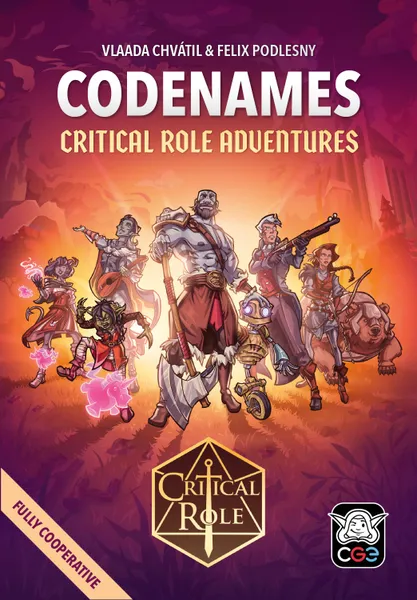
Welcome to this week’s review! This week I’m taking a look at a Dungeons & Dragons (D&D)-inspired version of a popular party game. So, without further ado, let’s jump into it.
Disclosure: A review copy of this game was provided to The Meeple Digest in exchange for an honest, unbiased review. This review is not intended to be an endorsement.
Codenames: Critical Role Adventures
- Designers: Vlaada Chvátil, Felix Podlesny
- Publisher: Czech Games Edition (CGE)
- Complexity: Light – Medium
- Time: 25 Minutes
- Players: 2-4
- Main Mechanisms: Cooperative, Limited Communication
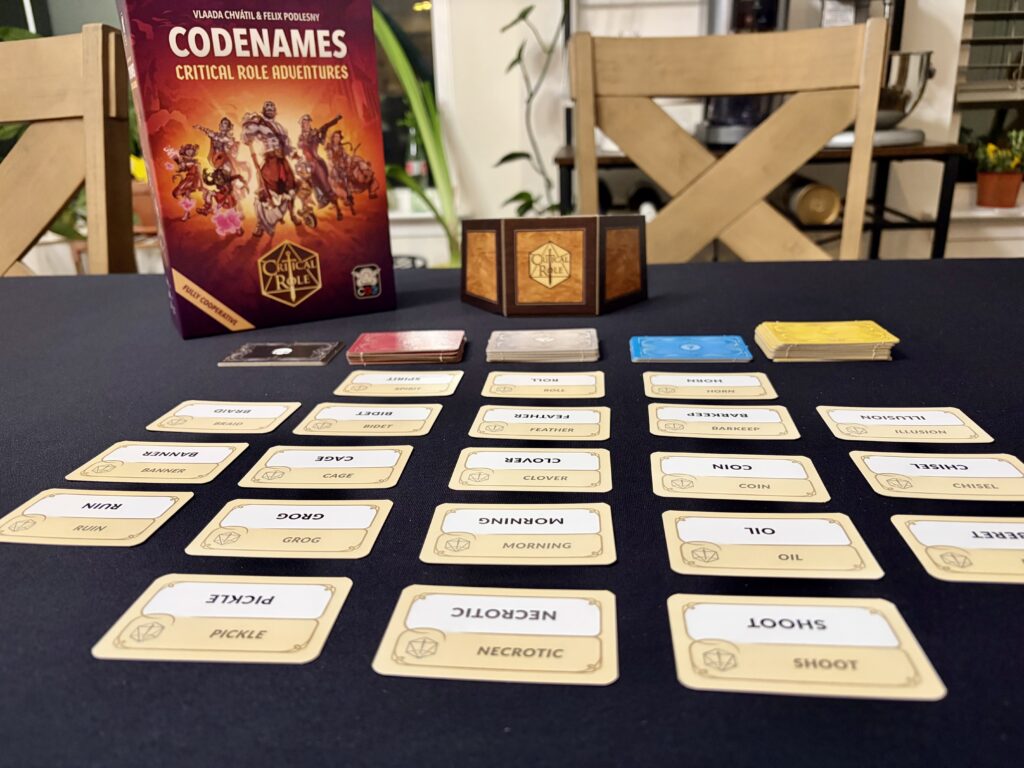
Codenames: Critical Role Adventures is the latest version of the popular party game Codenames. Critical Role Adventures is inspired by the Critical Role universe, which is a web series where a group of professional voice actors play Dungeons & Dragons. The game contains three cooperative campaigns, where players take control of three characters that level up as players progress through one of the game’s three campaigns.
If you’ve never played Codenames, the core gameplay involves one player acting as the “clue giver”, while the rest of the group has to correctly guess words from among cards displayed on the table. The “clue giver”, in Critical Role Adventures referred to as the Game Master (GM), secretly has a unique solution card, which shows which cards are successes or failures, and in order to win a scenario, the group has to guess a certain number of successes within a certain number of rounds, while avoiding the incorrect cards. Each round, the GM says one word that serves as the clue, followed by a number that serves as how many words apply to that clue, and that clue is supposed to help the rest of the group correctly identify the correct words on the table. As the game’s rules point out, the clue is “always a stretch”.
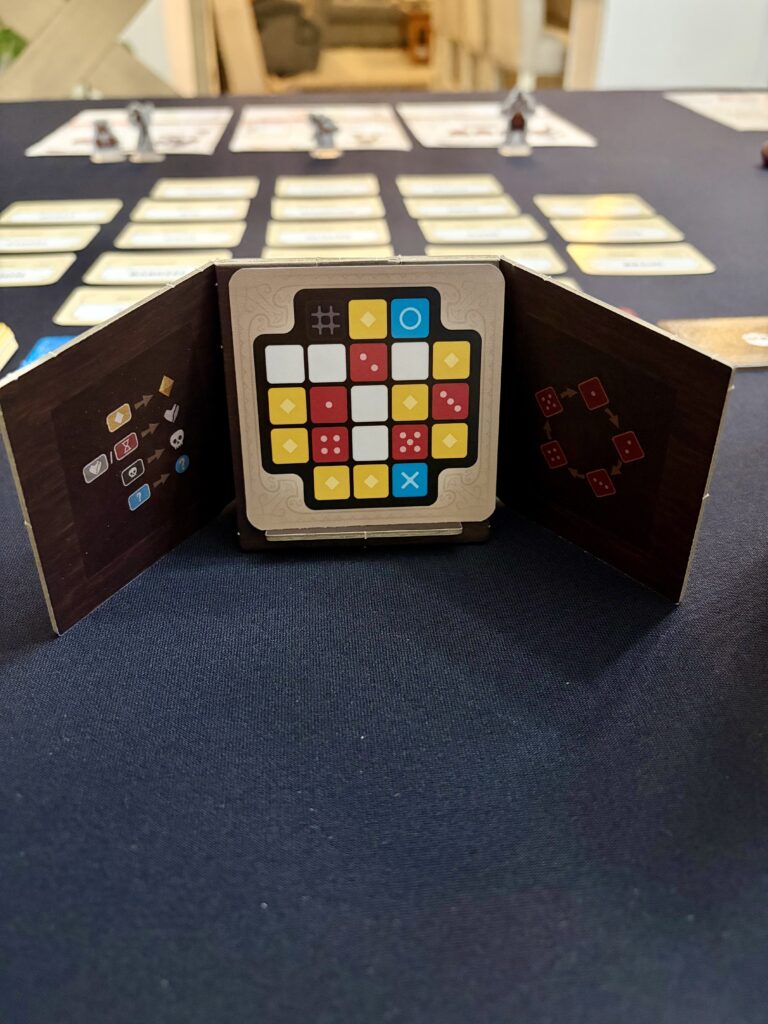
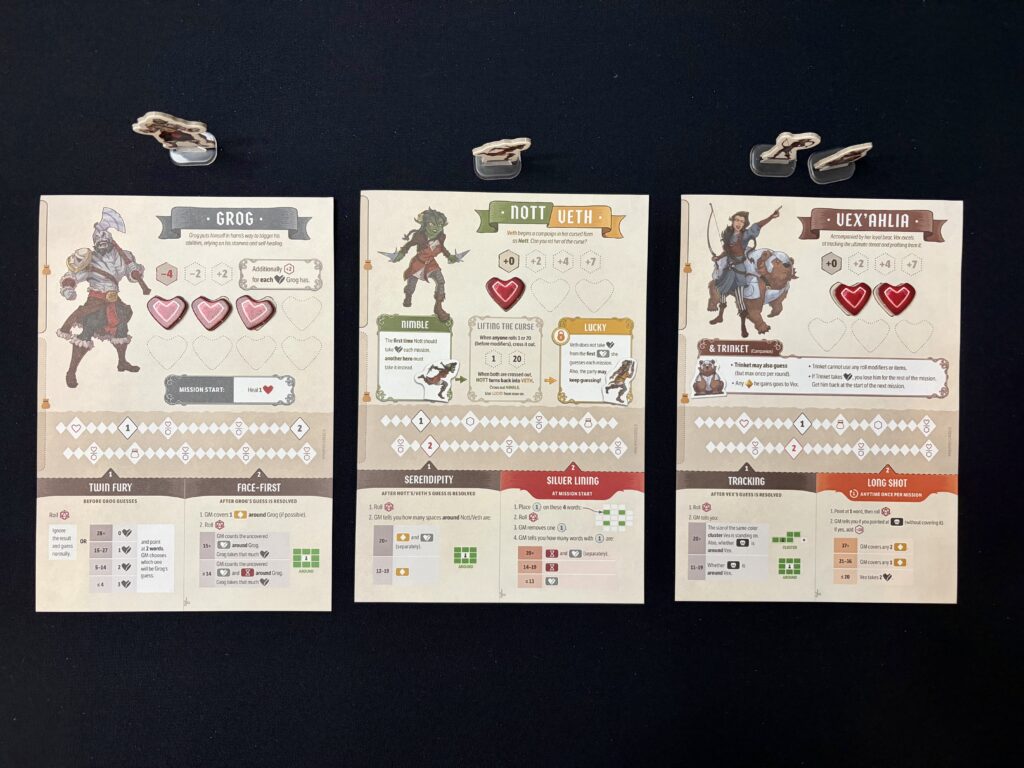
Critical Role Adventures retains much of the Codenames formula, while adding new mechanics designed for the more strategic gamers. Along with being fully cooperative, arguably the biggest addition in this version are the characters that players act as during a campaign. Regardless of the number of players, the group selects three characters from a set of seven when starting a campaign, and those characters remain throughout the course of the five to six scenarios in each campaign. Whenever the group makes a guess, they must place one of their characters on that word card. Each character has a certain amount of health, which is lost from incorrect guesses, and if a character loses all of their health, the group fails the scenario. Each character also has a unique trait and two or three skills that are unlocked once the character gains enough experience points, which are gained from making correct guesses.
The characters are not as complex as controlling a D&D character, but provide a similar feeling. I particularly enjoy finding ways to utilize each of the character’s unique skills. For example, one character’s skill allows the GM to identify how many correct words are around that character after making a guess. Most skills also require a “skill check”, which involves rolling the twenty-sided die, and the result dictates how that skill resolves. Characters can also gain modifiers to increase the result of a die roll as they gain more experience. In addition, during a round, each character has to make a guess before characters can be used again, which leads to some interesting strategy on which characters you use for each guess.
Another nice addition is through a type of “fail-forward” mechanism. As you progress through a campaign, the scenarios gradually get more difficult, which typically requires more correct guesses in a shorter amount of time. If the group fails a scenario, the party still gets to keep all of their earned experience and coins, and the characters also regain some of their health. This allows the group to continue progressing their characters, even during a loss. If the party fails too many times, the group technically losses the campaign, but there’s nothing stopping the group from continuing on.
Moving onto a few caveats – while the campaigns are relatively short, I think this game is best when played with the same group. It is possible to finish a campaign in a single sitting, but I preferred to play a few scenarios each night rather than try to complete all of them in a single night. In addition, while I typically reserve Codenames for larger groups, Codenames: Critical Role Adventures is best suited for smaller groups, ideally between two and four players. I had a great time playing the game with my wife, and I think this game is great for couples or families.
Next, while the campaigns do follow a story and have a couple branching paths, I found the writing to just be okay. I’m not sure what I was expecting from a Codenames campaign, but it mostly just serves as window dressing to vary up the scenarios. While I haven’t played through all three campaigns yet, some missions have special rules, but for the most part they just act to create some variety with the core formula remaining the same throughout. In addition, while there are a couple of branching opportunities, the campaigns do remain fairly linear, and I didn’t come across a situation where a decision had much impact on the rest of the campaign. If CGE does release more campaigns in the future, I wouldn’t mind seeing them push a little more outside the box.
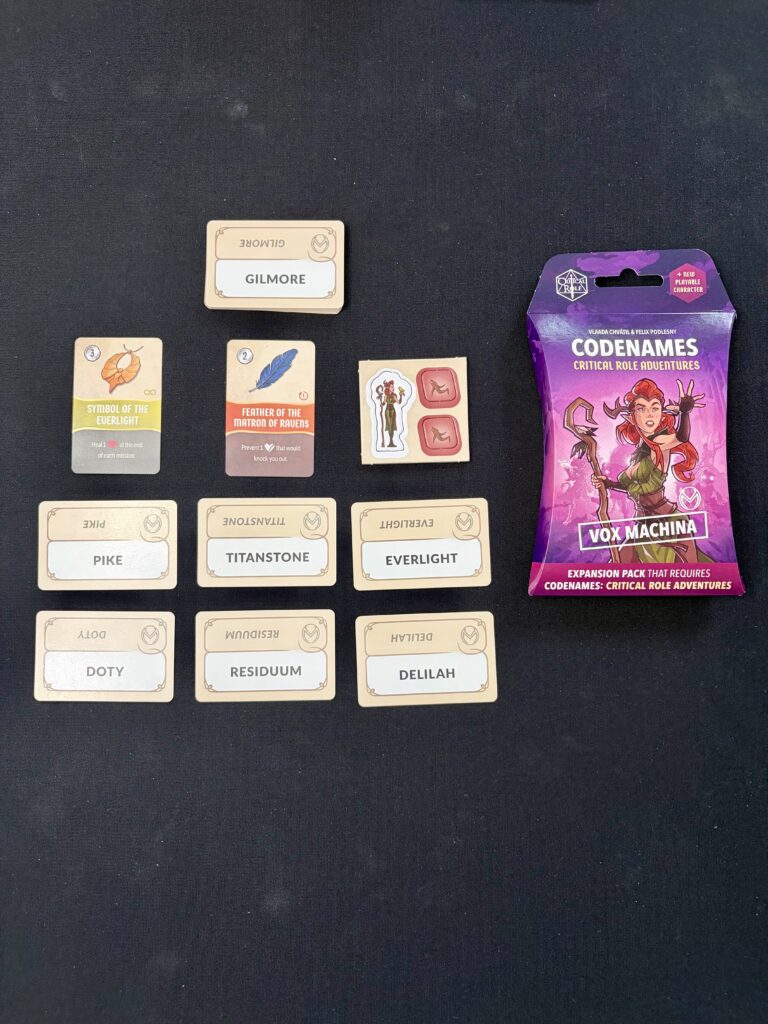
There is also a Vox Machina expansion pack, which adds another character, along with more word cards from Critical Role’s first campaign. One small complaint with the expansion is that you have to print out your own character sheets. While I appreciate the additional character, as someone who isn’t the most familiar with Critical Role, the expansion is fairly niche and aimed at players who are familiar with Critical Role’s content as we did have to look up quite a few of the words.
Overall, Codenames: Critical Role Adventures feels like more of a “gamers” version of Codenames. This version of Codenames isn’t intended to be a replacement of regular Codenames, but rather another addition for those looking for a light campaign style game. If anything, this version of Codenames is closer to a replacement for the two-player Codenames: Duet, rather than the original party-game version. Minor complaints with the campaigns aside, Critical Role Adventure is an excellent implementation of the Codenames formula.
With that, I’ll wrap up this week’s review! If you’ve played Codenames: Critical Role Adventures, I’d love to hear your thoughts on the game, and what is your favorite version of Codenames? Happy gaming!
If you liked this post and want to be notified when new content is released, then follow me on Instagram @themeepledigest.
Leave a Reply