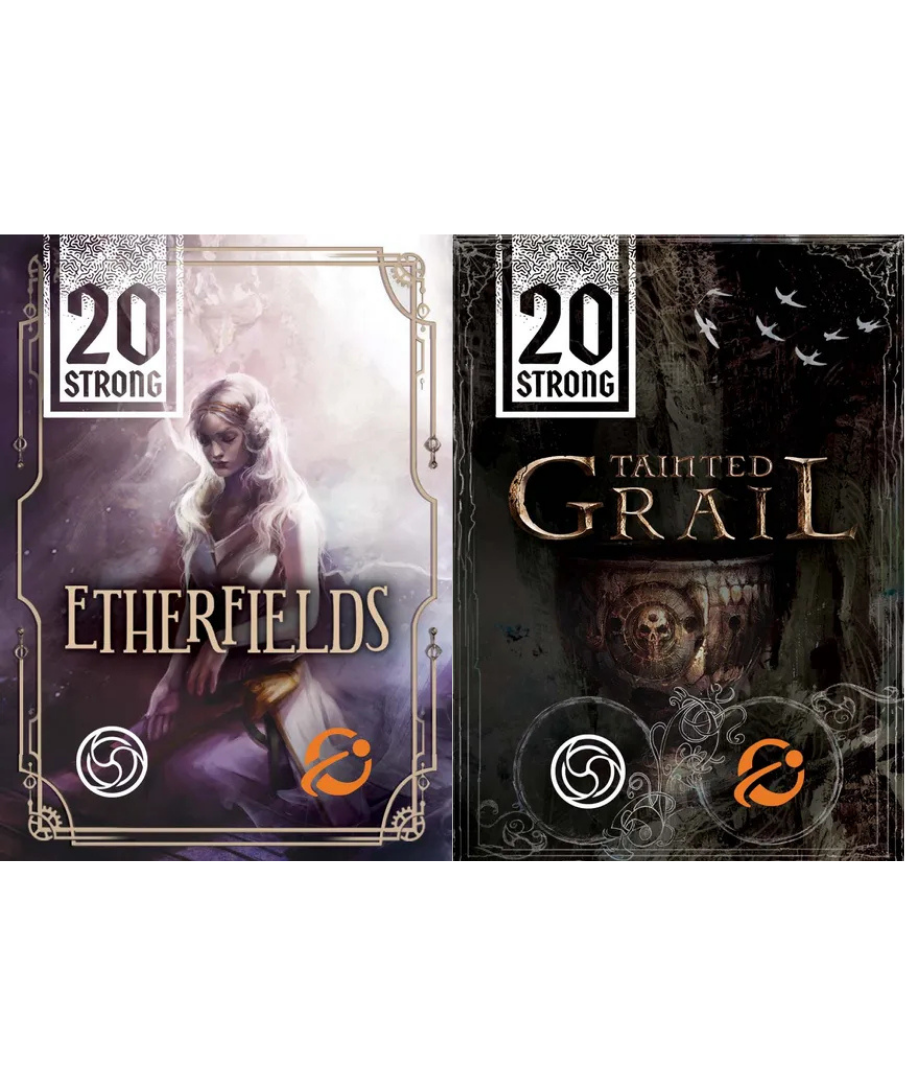
Welcome to this week’s review! This week I’m taking a look at two more new 20 Strong decks. So, without further ado, let’s jump into it.
Disclosure: A review copy of this game was provided to The Meeple Digest in exchange for an honest, unbiased review. This review is not intended to be an endorsement.
20 Strong: Tainted Grail
- Designers: Josh Carlson, Ryan Howard
- Publisher: Chip Theory Games
- Complexity: Medium
- Time: 40-60 Minutes
- Players: 1
- Main Mechanisms: Dice Rolling
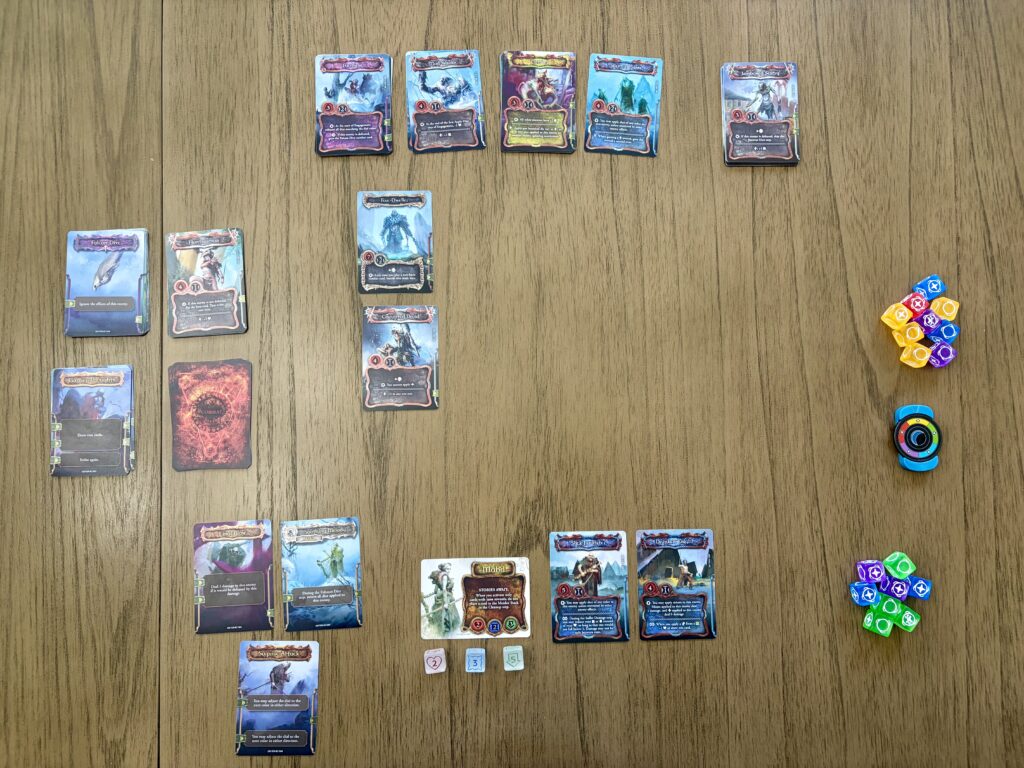
First up is 20 Strong: Tainted Grail. This game is themed around the Tainted Grail board games from publisher Awaken Realms. In 20 Strong: Tainted Grail, your goal is to survive until you fight and defeat the final boss.
The game typically lasts eight rounds before you reach the final boss, and in each round, you must activate one enemy from one of the four face-up enemy decks. Each enemy has certain effects, as well as health and damage they deal. Each deck of enemy cards provides different types of rewards when they are defeated. Purple enemies provide upgraded combat cards (more on that later), gray enemies allow you to upgrade your hero’s stats, green enemies give instant rewards, and blue enemies offer items that provide either one-time or ongoing effects.
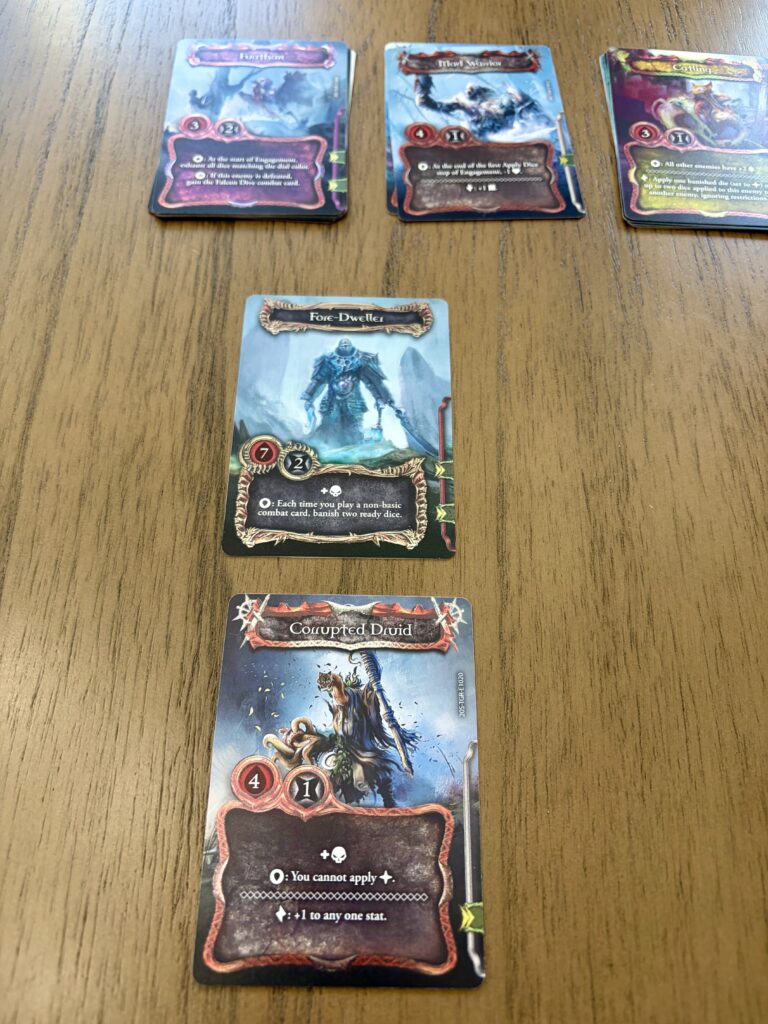
I love how the game provides a plethora of interesting choices. Having the enemy decks faceup is a very interesting design twist. Choosing which enemies you want to face each round depends not only on how strong they are, but also the rewards they provide. In addition, all enemies, regardless of whether they have been defeated or not, are discarded at the end of the round, so you only have one opportunity to gain each enemy’s reward.
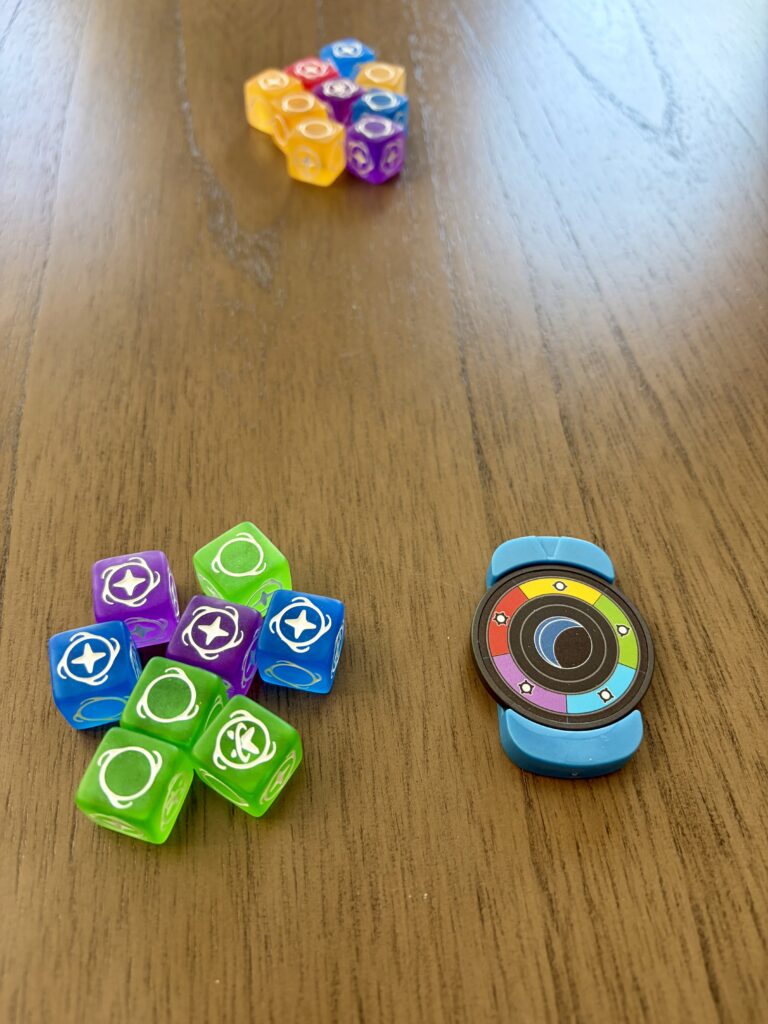
This also leads into another exciting mechanism in the game. The dial, which corresponds to one of each of the different die colors, rotates once each round. And in each round, you’re only able to apply dice matching the dial’s current color. Therefore, it may be advantageous to target weaker enemies while the dial is yellow or green, which correspond to dice with the lowest probability of rolling a hit, and aim to tackle the stronger enemies when the dial is blue or purple.
Arguably my favorite element in the game takes place at the end of each round. After performing cleanup, you have to place the top enemy from one of the different decks into the Menhir Stack. This is one way to get rid of strong enemies; however, there’s a catch. When the boss is activated, they get to activate one or more additional enemies from the Menhir Stack. This creates some really fun decision-making, as well as a bit of push-your-luck. Do I throw all of the stronger enemies into the Menhir Stack, making it more likely that I’ll survive and reach the boss or do I seed the Menhir Stack with a mix, potentially making the final fight a bit easier? Your decision is also driven by the number of enemies the boss will activate. For the boss that activates three additional enemies, you might want to play the Menhir Stack safe, whereas for the boss that only activates a single enemy, you can take more of a risk.
Another neat addition to the game is the combat cards. During a round, you get to apply combat cards to enemies, which might provide additional damage or allow you to apply dice of different colors, thereby allowing you to circumvent the restriction of the dial’s current color. Each combat card has different nodes, which need to be matched up with either the enemy’s node or the previous combat card played against that enemy in order to be played. In addition, the purple enemies grant upgraded combat cards, and the game offers some fun strategies around focusing heavily on the combat cards. While the combat cards may seem like a small addition, they add another interesting layer of strategy and decision making.
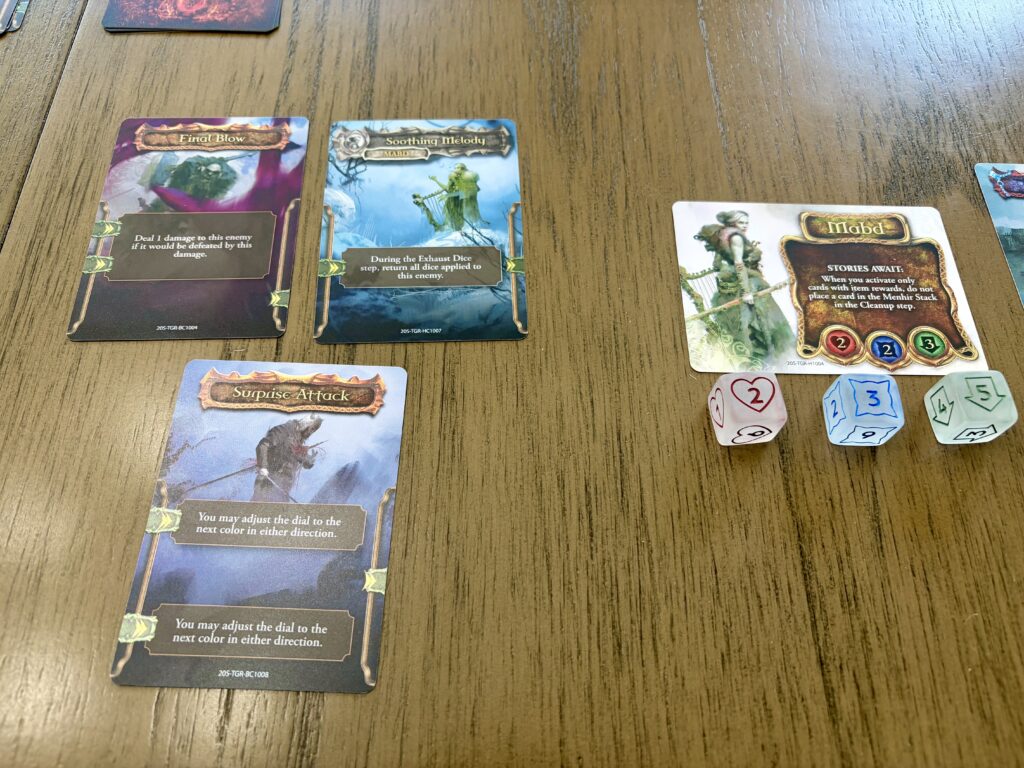
Games of 20 Strong: Tainted Grail are also surprisingly quick. With more plays, I suspect I could get the playtime to under 30 minutes making this an easy candidate to pull off the shelf when I’m looking to play a board game but don’t want to go to the trouble of setting something larger up. Of the three new Awaken Realms themed decks, this one was the quickest and easiest to get into.
The only slight complaint I have with the game is that I wish there was a few more enemies and bosses to enhance the replayability, but as a whole, I’ve thoroughly been enjoying this deck quite a bit.
20 Strong: Etherfields
- Designers: Josh Carlson, Salem Scott
- Publisher: Chip Theory Games
- Complexity: Medium
- Time: 40-60 Minutes
- Players: 1
- Main Mechanisms: Dice Rolling
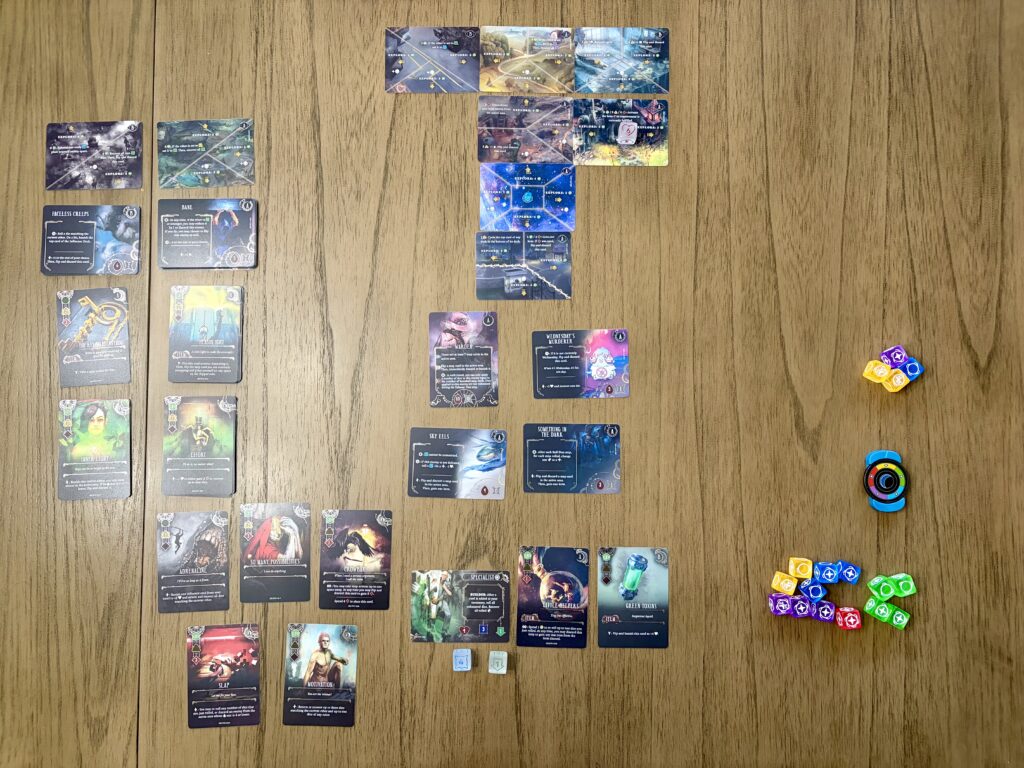
Finally, the last new Awaken Realms themed deck, 20 Strong: Etherfields, is themed around the Etherfields board game. In this game, the goal is to explore and traverse a map of dreamscape cards until you meet the boss’ activation requirements and find the map card that lets you activate the boss.
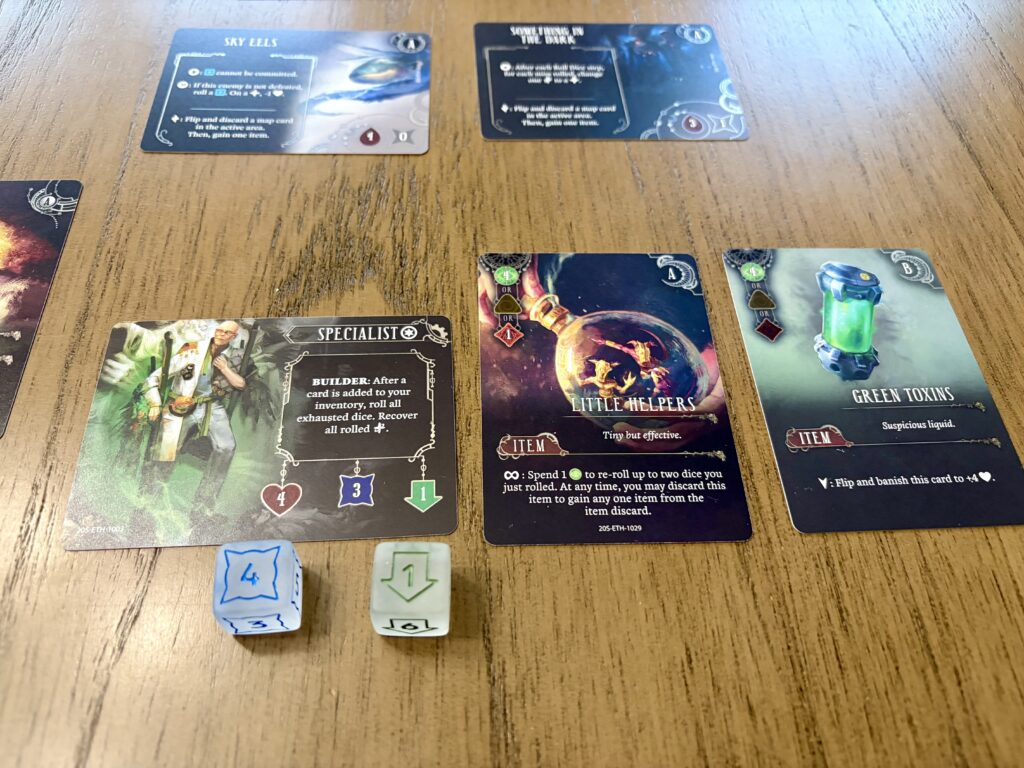
The unique element with the game is that the decks are ever-changing from game to game. Each card in the game is double-sided, and cards often have effects that cause them to flip to the other side. Cards can also change types as well. For example, if you defeat an enemy, it might become an item. And on the flip side, if you fail to defeat an enemy, it might turn into a stronger version of that enemy that can show up in future games. This means that over the course of multiple playthroughs, your version of the deck is likely to be unique.
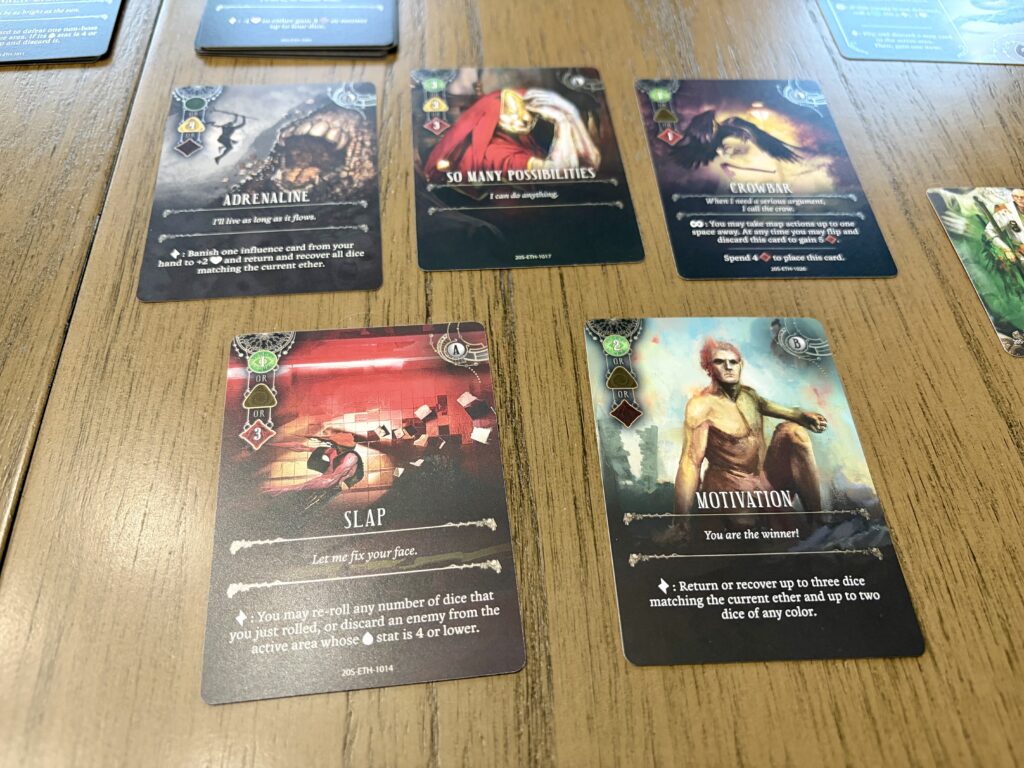
Another interesting mechanism in the game are the influence cards. At the beginning of each round, you’ll draw back up five cards, and these can be played throughout the round. Each influence card has a unique effect, as well as up to three different resources that can be spent to take other actions. You can play the card for its effect or spend it for its resource value. I love multi-use cards in games, and I like how the influence cards provide interesting choices on how to leverage them for your goals.
In order to reach the endgame and defeat the boss, each boss has a unique activation requirement in order to trigger the endgame. For example, a boss might require the dial to be a certain color, which can typically only be adjusted through actions on map cards. Other bosses might require you to have explored a certain number of map cards or have a certain number of items in your inventory. In addition to the ever-changing decks, the bosses provide some nice replayability and can change how you decide to approach each playthrough.
Moving on to some slight negatives, I wish there was a bit more control over the different decks. For example, sometimes you reach a point in a playthrough where you’re searching for a specific map card but it happens to be at the bottom of the deck. This can make the game drag on and feel a bit tedious at times. Another example is the enemy deck. Each round you have to activate one enemy and sometimes you can end up situations where enemies chain activations and you end up with a bunch of enemies to deal with. This can also lead to some playthroughs feeling quite easy whereas others can be more challenging just based on the order the cards come out. There are a few cards that provide ways to cycle cards from the top of the decks, but I wish there were a few more opportunities to do so.
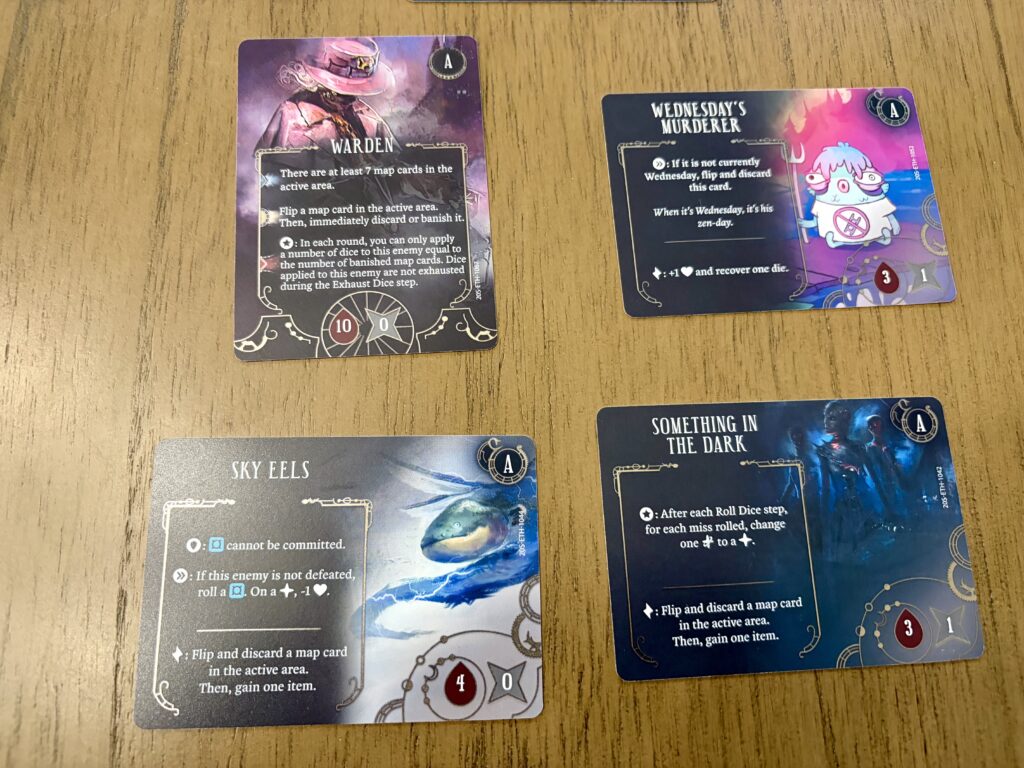
Next, compared to the lightning quick games of the 20 Strong: Tainted Grail, I found that games of Etherfields typically lasted much closer to around an hour and can sometimes stretch beyond that in cases like I just mentioned. The influence deck does act as a bit of a timer since whenever you have to reshuffle that deck you must either banish two cards from the deck or lose health. However, I never got to a point in a game where I was too worried about the deck running out. This means that you can usually take the game at your own pace, and since undefeated enemies are not discarded at the end of each round, there were some rounds where I would pause exploration in order to just deal with enemies. If you’re not managing to cull the number of activated enemies, they can easily spiral and will likely be the reason that you’ll lose. I like how Tainted Grail has a fixed timer, and I almost wish there was something in Etherfields to continually push you towards the objective, as I had the occasional playthrough that overstayed its welcome. The endgame can also feel a bit anticlimactic when compared to the endgame in Tainted Grail, as the hardest part of the game is getting to the endgame rather than facing the boss.
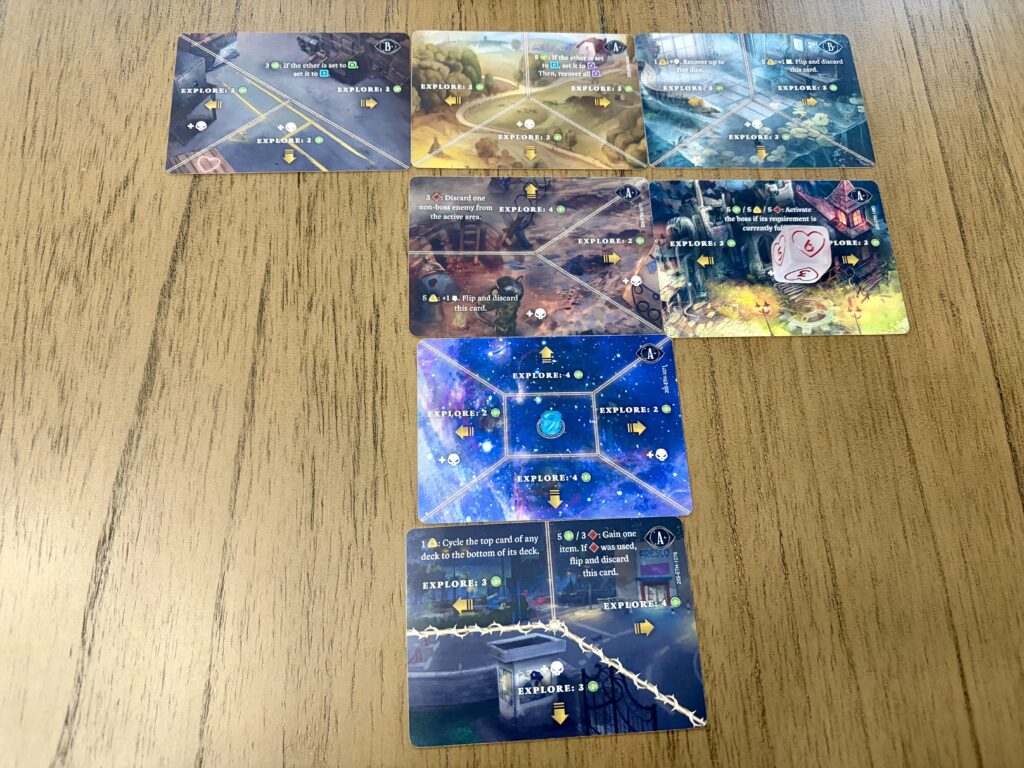
Finally, while I didn’t find the game too difficult to grasp, especially having played the other two 20 Strong decks prior, the gameplay didn’t feel quite as smooth when compared to Tainted Grail. I think this is due to the multi-use influence cards because while I enjoyed the added decision space, I found that it also led to some confusion around timing certain effects.
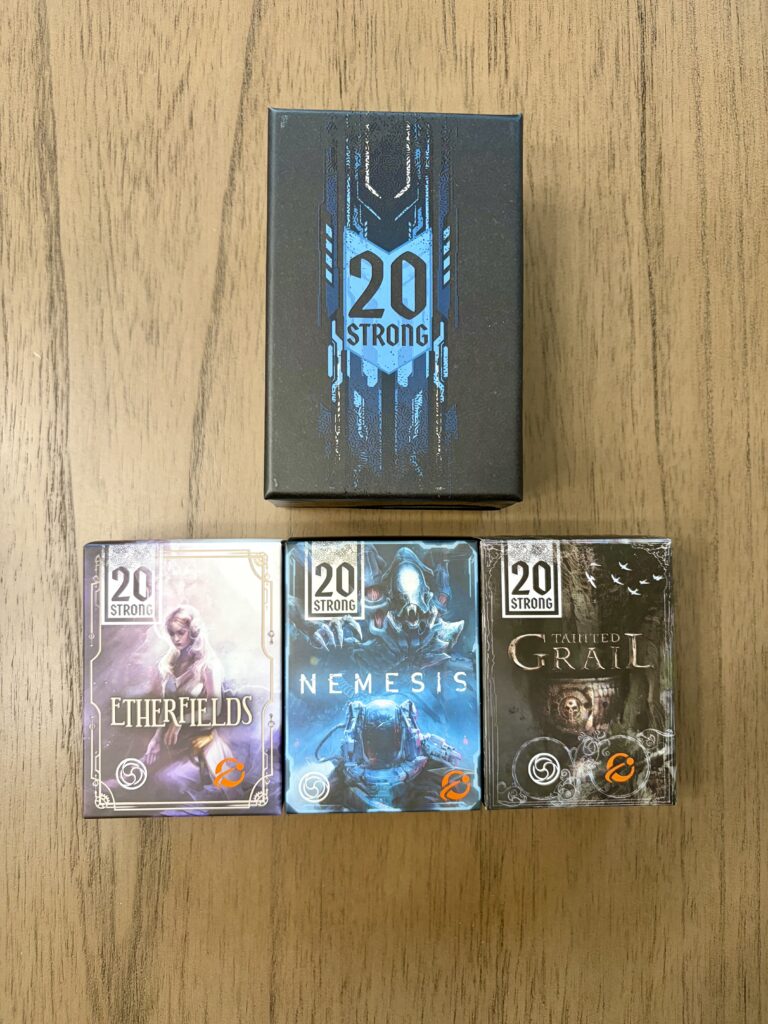
Overall, between the Nemesis, Tainted Grail, and Etherfields decks, my favorite is Tainted Grail, followed by Etherfields and then Nemesis. I can definitely foresee myself bringing out either Tainted Grail or Etherfields when I’m looking for a fairly quick solo game with minimal setup, and each game feels different enough to warrant keeping both, even if I expect to get Tainted Grail out more often. I mentioned in last week’s review of the Nemesis deck that I’d be open to trying that game multiplayer, but I don’t anticipate returning to it solo and it was by far my least favorite of the three. Where Nemesis is a bit harder to recommend, Tainted Grail and Etherfields are big hits for me and are an easy recommendation to solo gamers or existing fans of 20 Strong.
With that, I’ll wrap up this week’s review! If you’ve played any of the new 20 Strong decks, I’d love to know your thoughts on them and what your favorite 20 Strong decks are. Also what are your favorite solo games? Happy gaming!
If you liked this post and want to be notified when new content is released, then follow me on Instagram @themeepledigest.
Leave a Reply