Welcome to this week’s review! This week I’m taking the look at the sequel to one of my favorite games from last year. So, without further ado, let’s jump into it.
Disclosure: A review copy of this game was provided to The Meeple Digest in exchange for an honest, unbiased review. This review is not intended to be an endorsement.
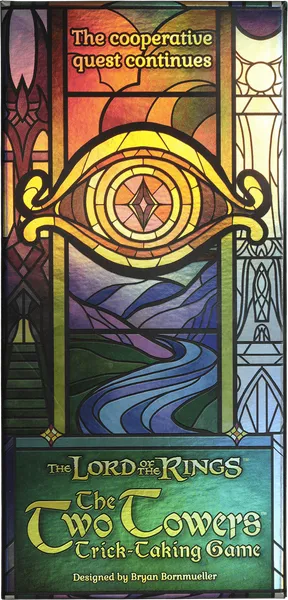
The Two Towers: Trick Taking Game
- Designer: Bryan Bornmueller
- Publisher: Office Dog
- Complexity: Light
- Time: 20 Minutes
- Players: 1-4
- Main Mechanisms: Cooperative, Trick-Taking
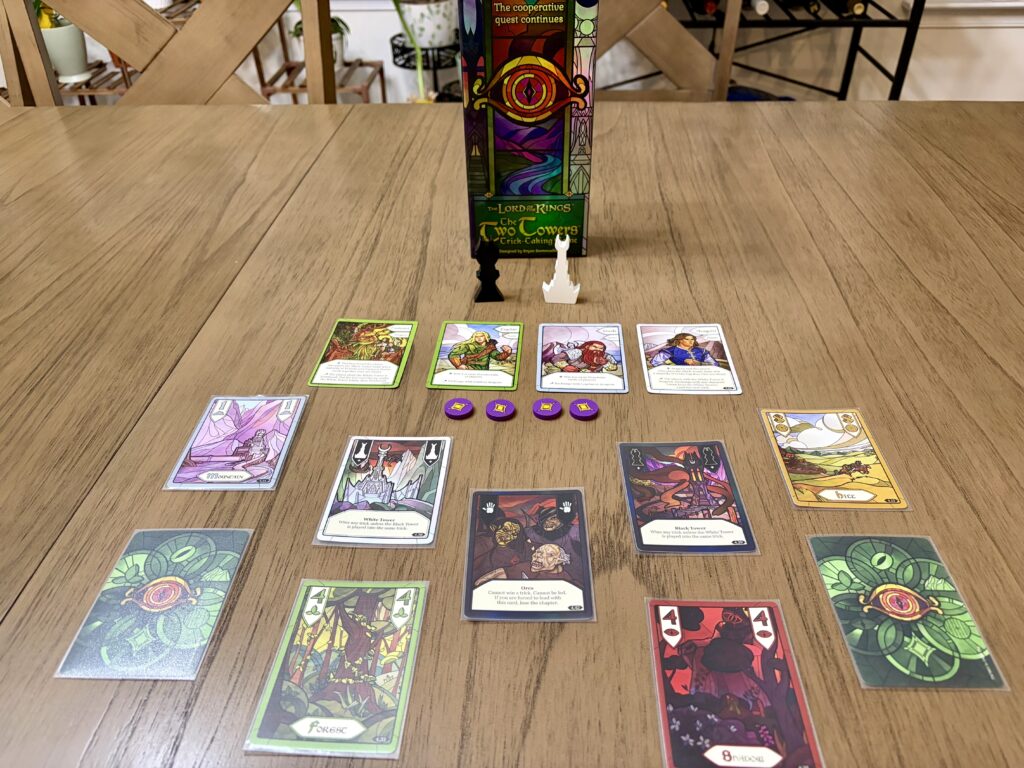
Let’s get the obvious out of the way – if you liked The Fellowship of the Ring: Trick-Taking Game, you’re probably going to like the follow-up: The Two Towers: Trick-Taking Game. Other than a few minor changes to the main deck, the biggest difference in the second game is the introduction of new characters and objectives that take players through the events of the second book in The Lord of the Rings series.
If you haven’t played The Fellowship of the Ring: Trick-Taking Game, it’s a cooperative trick-taking game that is heavily inspired by The Crew. In each chapter, players select one of the available characters, who each has an objective that needs to be completed, and if all players succeed, then the group successfully completes the chapter.
The Two Towers makes a couple of slight changes to the main deck. First, the five ring cards are gone, and in their place are two tower cards symbolizing the white and black tower, as well as three orc cards. The two tower cards are each trump cards, so they automatically win the trick, unless both towers are played into the same trick. The orc cards are not part of a suit and cannot win tricks. In addition, if a player is forced to lead a trick with an orc card, then the group automatically loses the chapter. While these changes are minor, I appreciate the extra trump card, and the objectives often utilize both the tower cards and orc cards that shake things up.
Speaking of the objectives, many will feel similar to the ones from the first game. For example, win a certain number of cards of a specific suit or win a certain number of tricks. However, as a whole, there appears to be a bit more creativity in the objectives. For example, the player(s) with the white and black towers have to win the majority of tricks, or two characters have to win the same number of tricks. There’s also a character that always plays one trick later than the other characters. While I haven’t completed all chapters, overall, there appears to be more variety in the types of objectives compared to the first game.
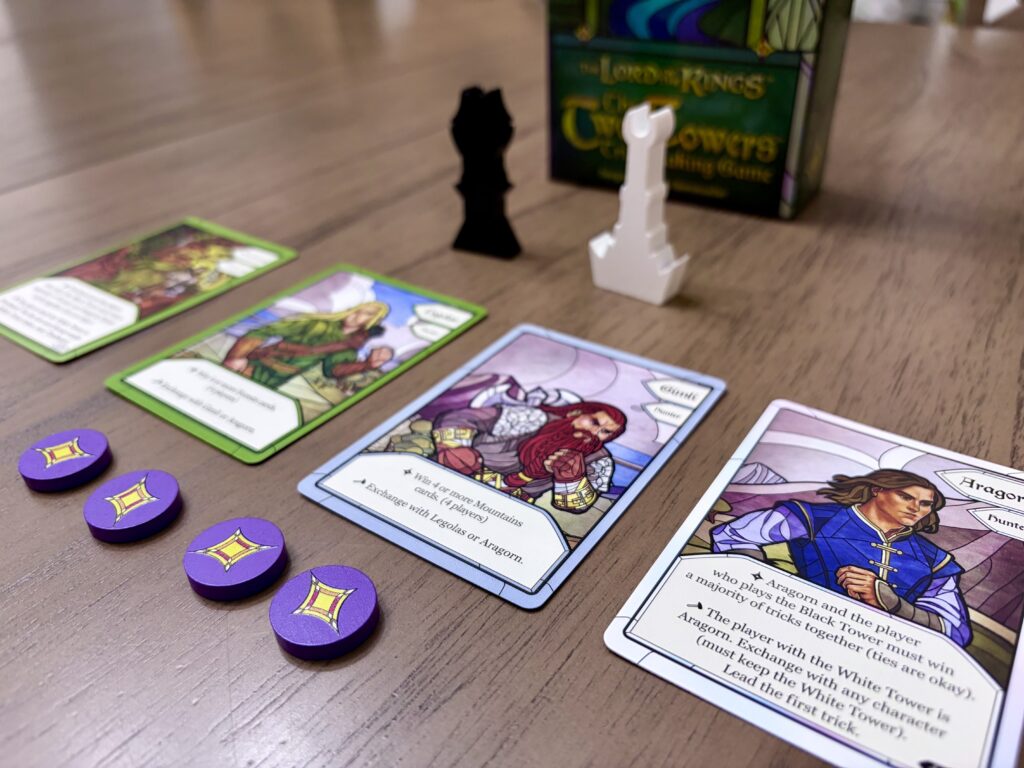
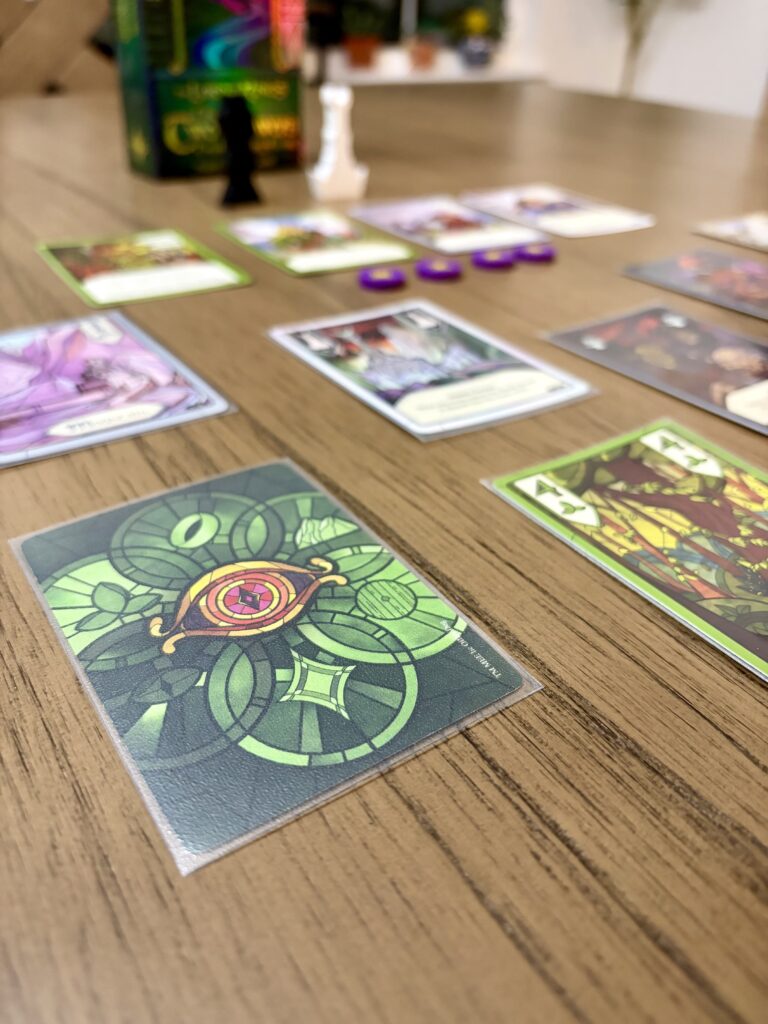
Like The Fellowship of the Ring, The Two Towers leverages a similar stained glass art style. While it may not appeal to all gamers, I personally found the production in the first game outstanding, and that is carried forward into the sequel. While there are only a few pieces, the tokens for the two towers (to identify which player(s) have each tower) is a nice touch.
Back too are the long chapters, in which all characters in that chapter have to be completed over multiple rounds. While this introduces some variability and strategy to determine which characters mesh well with one another, I personally found those chapters to be the most tedious to complete. In addition, while similar, the chapters in The Two Towers feel slightly more difficult than in The Fellowship of the Ring. Being very familiar with trick-taking, I personally liked the added challenge, but I understand everyone’s mileage here can vary.
Comparing these games to The Crew, I still prefer The Crew. Whereas The Crew has regularly been in my top 15 games of all time, The Fellowship of the Ring: Trick-Taking Game was just outside my top 40. One key reason that I rank The Crew so highly is the almost-infinite variety from the mission cards in Mission Deep Sea. In addition, unlike The Lord of The Rings games, the mission cards also allow me to tailor the difficulty each session. If I want to be challenged, I throw more mission cards in, versus if I’m teaching the game to new players, I use fewer. In The Lord of The Rings games, I either have to pick an easier chapter or pick characters to play with outside of the chapter rules.
This is likely one of my shortest reviews, but like I said at the start, if you enjoyed the first game, I suspect you will like this one as well. If you didn’t, then I doubt there are enough changes here to sway your opinion. If I were to only pick one, my preference would likely be The Two Towers, but then again, I enjoy the second film more than the first, so I might be a bit biased.
With that, I’ll wrap up this week’s review! If you’ve played The Lord of the Rings trick-taking games, I’d love to hear your thoughts on either game and if you all have any other favorite cooperative trick-taking games. I’d love to hear your thoughts on any of the games I’ve mentioned or future content suggestions in the comments below. Happy gaming!
If you liked this post and want to be notified when new content is released, then follow me on Instagram @themeepledigest.