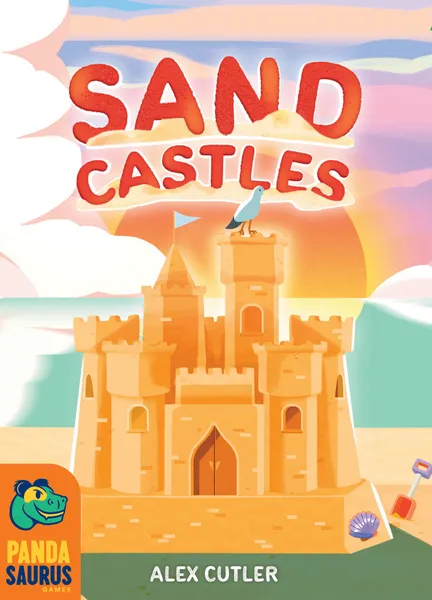
Welcome to this week’s review! This time I’m taking a look at a small, abstract, tile-laying game. So, without further ado, let’s jump into it.
Disclosure: A review copy of this game was provided to The Meeple Digest in exchange for an honest, unbiased review. This review is not intended to be an endorsement.
Sandcastles
- Designer: Alex Cutler
- Publisher: Pandasaurus Games
- Complexity: Light
- Time: 10-20 Minutes
- Players: 2-6
- Main Mechanisms: Tile Placement
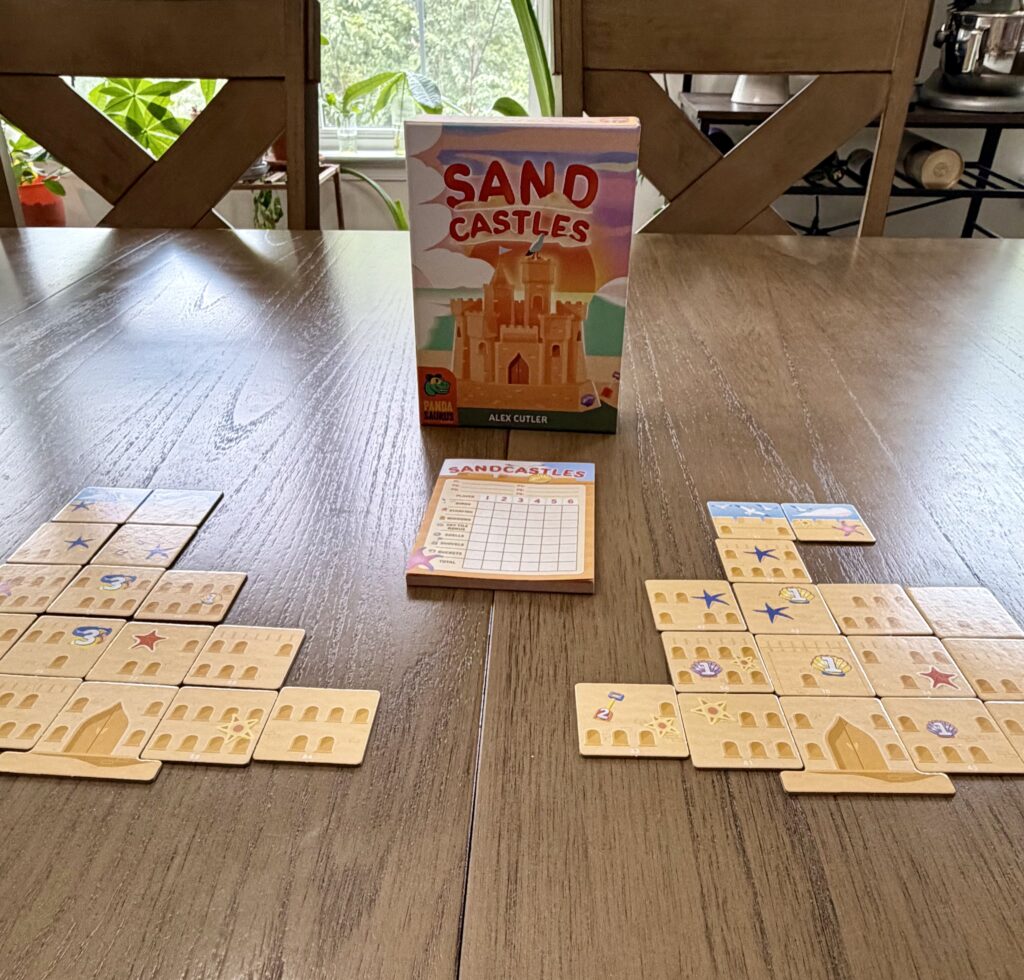
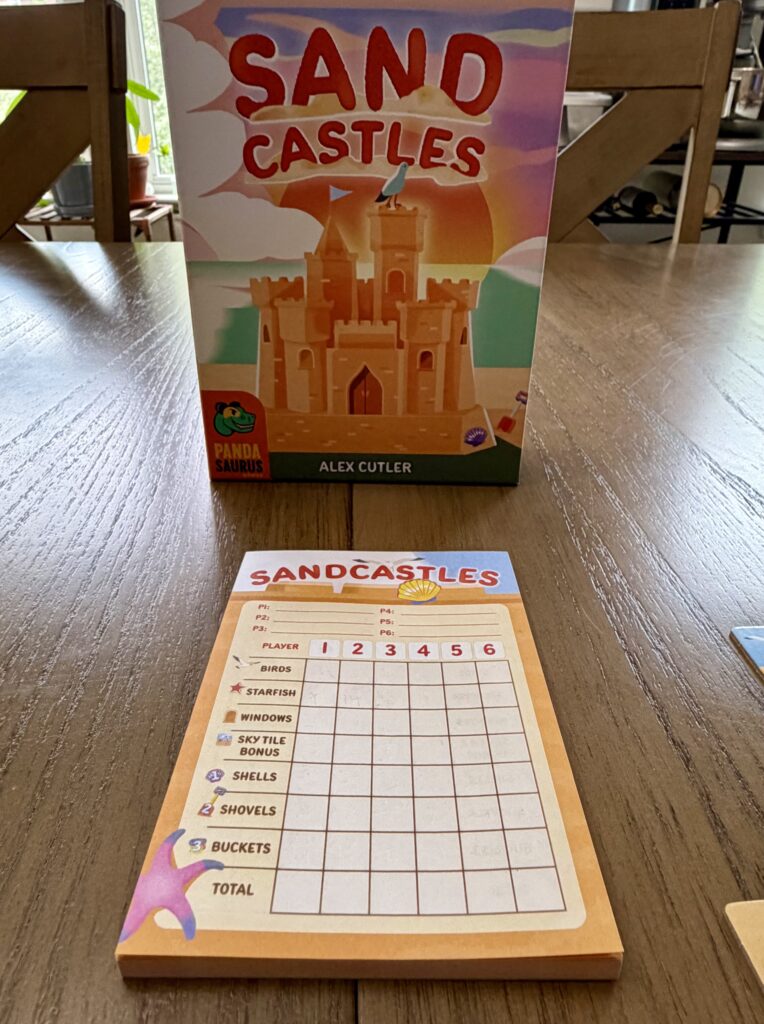
Sandcastles is the latest game from designer Alex Cutler, who was a co-designer on A Place for All My Books and Critter Kitchen. Sandcastles is a light, tile-drafting game where players compete to construct the most impressive beach castle. At the end of the game, players will score points from a variety of icons in their castle. There are a couple of restrictions on where players can place certain tiles, and some tiles can score more points based on their adjacency to other icons. Overall, the game is very light in complexity, easy to teach, and plays relatively quickly even at higher player counts since players only draft 15 tiles in the game.
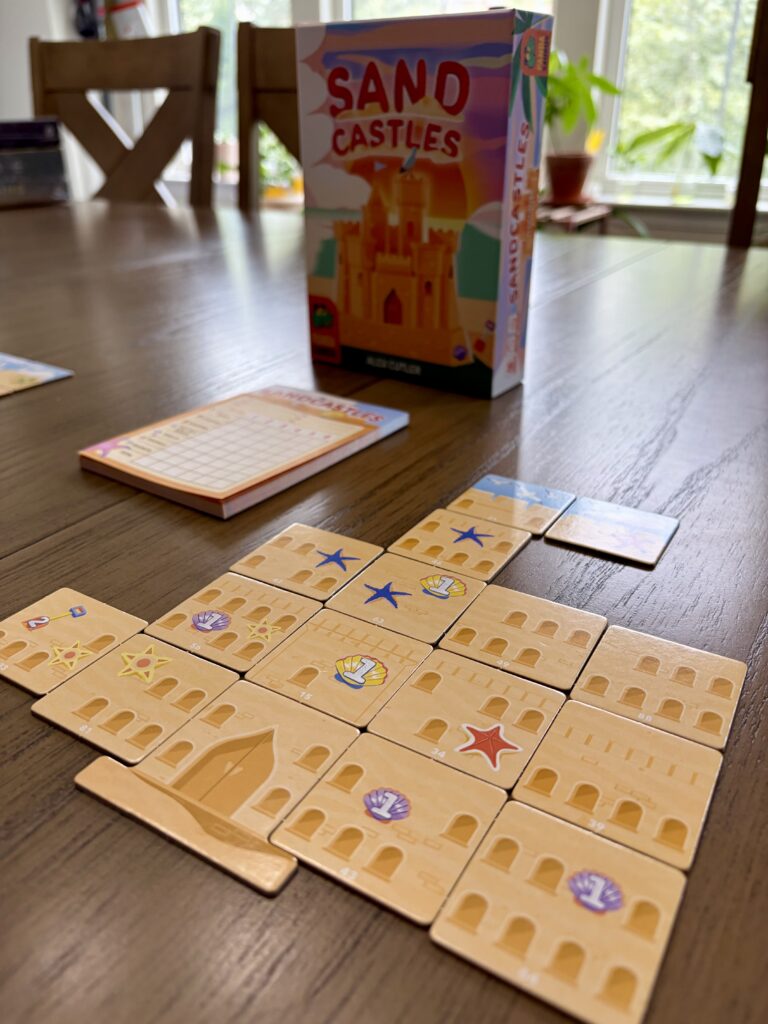
The game utilizes an open-drafting mechanism where players have the option to select a tile or push-their-luck and hope for a better tile later in the round. If all players choose to pass on a tile, then the last player in turn order gets stuck with it. I liked this small element of push-your-luck; however, while the game supports two to six players, I personally think the game is better suited with four or more players because of the tile drafting system. I tried the game at two players and the game fell flat since there wasn’t much decision space; you either choose to keep the tile or give it to your opponent. The other downside to this push-your-luck system is that it can be a bit frustrating if you’re last in turn order and get stuck with a tile that no one else wanted.
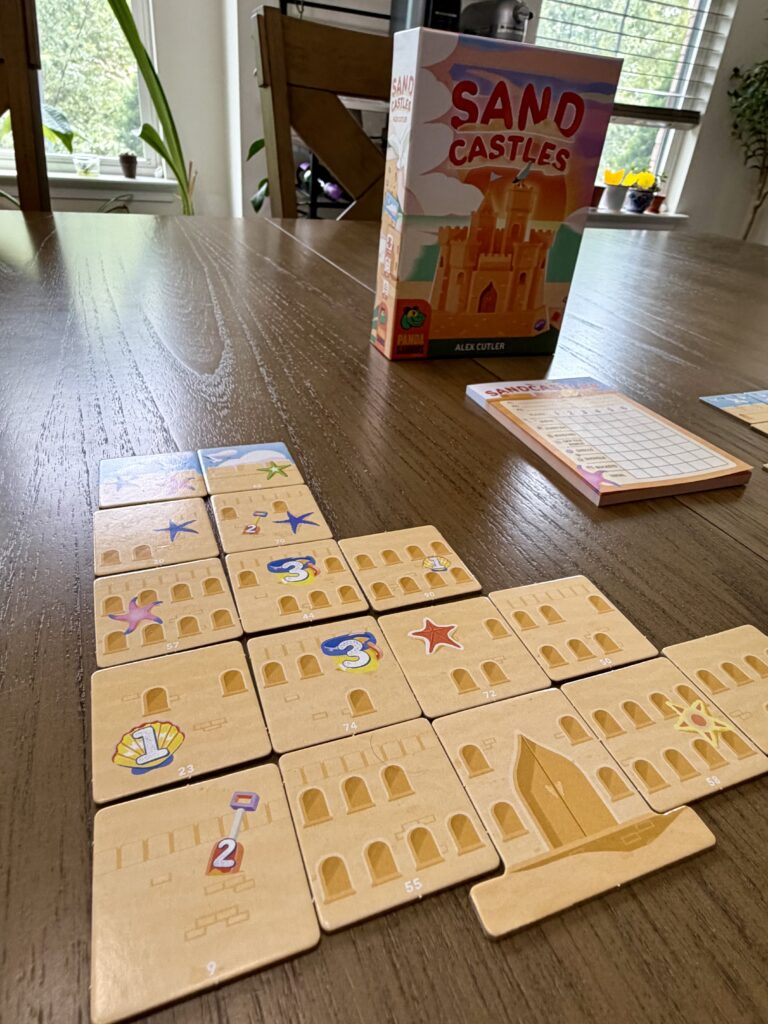
The theme of building a sandcastle is certainly abstracted, but I enjoy games that give a sense of accomplishment of building something that you can look back at the end of the game. Unfortunately, the tile artwork is a bit bland, which makes the finished product look a bit simple. One head-scratching decision is that players build a 5×5 grid of tiles, but there are only 15 rounds each game, which means that it’s impossible to complete your sandcastle. I understand this is meant to be a quick filler, but why not make it a 4×4 grid instead? Having an incomplete castle makes the ending a bit less satisfying.
My biggest gripe with the game is the tedious scoring. There are six different scoring icons that score in unique ways. Three of the icons just give a flat number of points, but the other three reward players for having more of them. For example, the more birds a player has, the more points each one will be worth. The most tedious scoring by far are the windows. Almost all tiles have between one and eight windows that are spread across two rows on each tile. At the end of the game, the more windows a player has in a given row, the more points that row will score. However, there are thresholds for the number of windows needed to reach the next point threshold. This alone is very tedious to count, but it’s compounded by the frustrating lack of scoring aids. The only one is on the back of the small rulebook, and since you frequently need to know the different point thresholds, you’ll end up needing to pass the small booklet around to the different players. It feels like an oversight that a scoring aid for each player was not included. Overall, for such a short game, I ended up spending more time than I would have liked tallying up the scores.
Overall, Sandcastles is fine enough as a simple tile-laying game, and I think the game is best suited to families and younger audiences. However, the components and art don’t stand out, and the tedious scoring is compounded by the lack of individual scoring aids. In a crowded genre of tile-laying games, there are many others I would gravitate to over this one. For example, I recently reviewed Harmonies, which is prettier, works better at lower player counts, and has more decision space. There’s also family-weight reimplementations of other popular games like Cascadia Junior or the upcoming Azul Kids for younger audiences. Unfortunately, Sandcastles won’t be remaining in the collection.
With that, I’ll wrap up this week’s review! If you’ve played Sandcastles, what are your opinions on the game? And what are your favorite tile-laying games? Happy gaming!
If you liked this post and want to be notified when new content is released, then follow me on Instagram @themeepledigest.