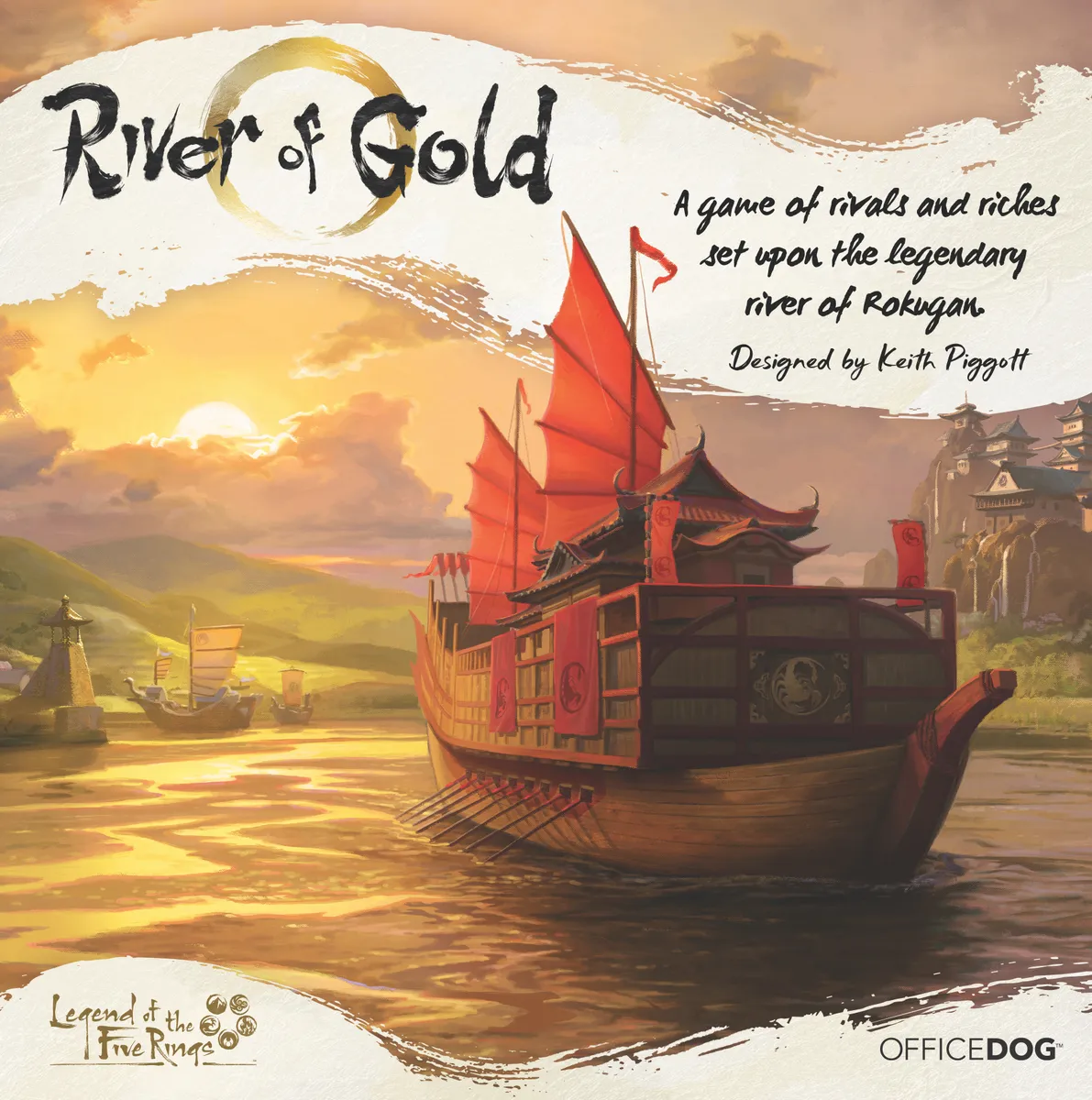
Welcome to this week’s review! This week I’m taking a look at one of my favorite “new to me” games from last year. So, without further ado, let’s jump into it.
Disclosure: A review copy of this game was provided to The Meeple Digest in exchange for an honest, unbiased review. This review is not intended to be an endorsement.
River of Gold
- Designer: Keith Piggott
- Publisher: Office Dog
- Complexity: Medium
- Time: 60-90 Minutes
- Players: 2-4
- Main Mechanisms: Dice Rolling, Action Selection
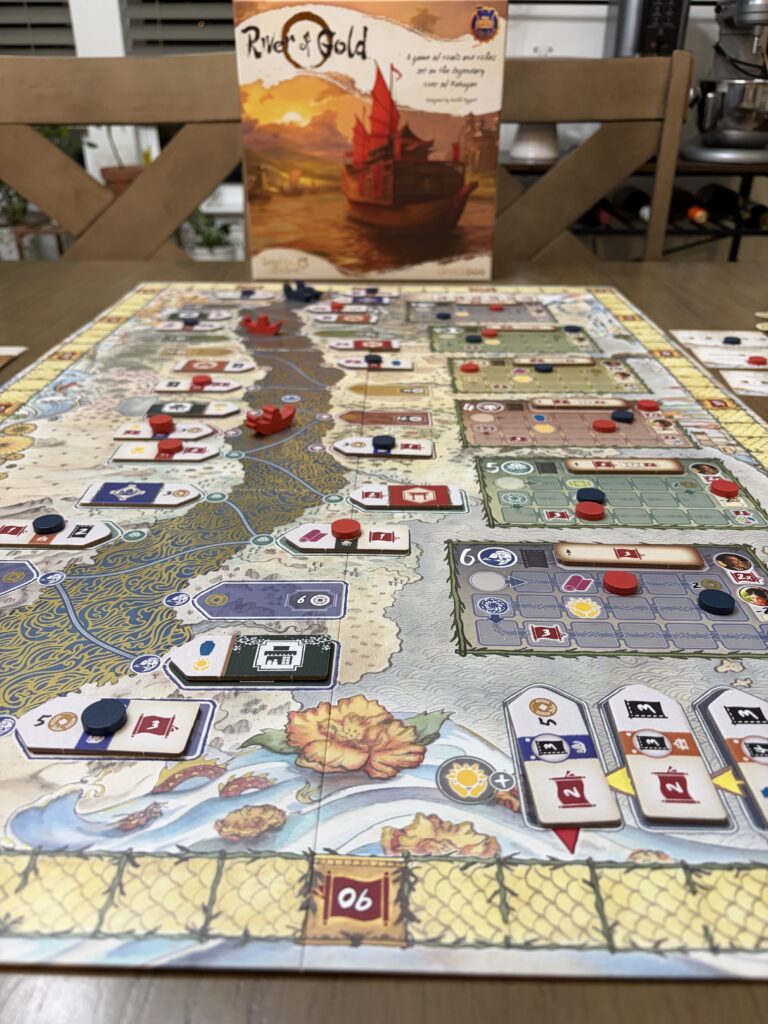
River of Gold is loosely themed around the Legend of the Five Rings, a fictional world inspired by feudal Japan where different clans clash for power. Each turn, players perform one of three different actions: build a building, sail a ship, or deliver to a customer. Each player has one die that they roll each turn, which dictates which region they can build in, how many spaces they can move a ship along the river, or which customers they can deliver to. There is a bit more to the game than what I’ve described above, but the core of the game is incredibly streamlined, which makes it a breeze to teach to new players.
I particularly enjoy the interaction with the river. Placing a building grants the player influence in the corresponding region, and each region can provide one-time resources, as well as victory points at the end of the game for the players who have the most influence in that region. In addition, each river space is connected to four different building slots. When stopping along the river, the player receives all resources and benefits from all four connected buildings. In addition, the owner of each building receives a separate benefit. Overall, this creates a nice level of positive interaction.
The game is somewhat of a point-salad, in that players can receive victory points in a number of different ways. While it can be challenging to focus entirely around one specific element, there are still multiple paths to victory. For example, in one game I constructed fewer buildings, and instead focused on completing more trips along the river because of additional bonuses from completed customers, as well as bonuses when visiting other players’ buildings. For such a streamlined game, I was pleasantly surprised by the amount of depth. And while the game felt similar after repeated plays, each game requires a lot of tactical decision-making to keep things feeling fresh since players are forced to adapt to their die, as well as which buildings come out.
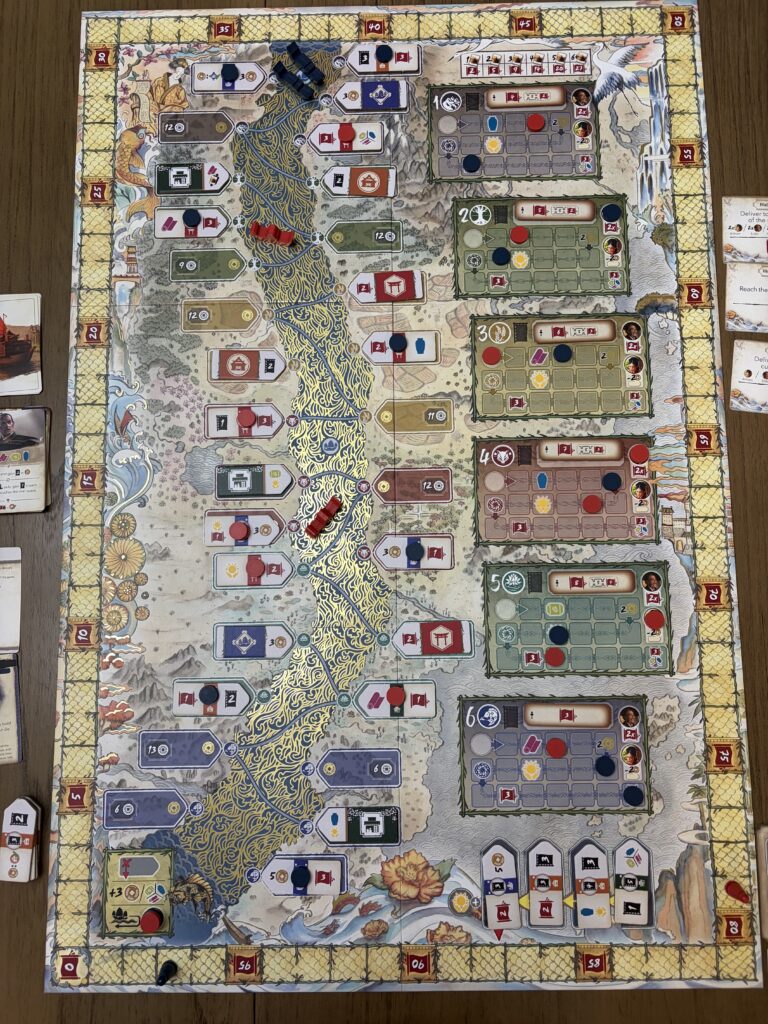
Moving on to arguably the most captivating aspect of the game: the production. I’m someone who very much prefers substance over style, but even I have to admit that the fantastic artwork is certainly a selling point. The game board is perhaps the most striking I have ever seen, with heaps of gold embellishments throughout. The artist, Francesca Baerald, certainly didn’t hold back on the amount of gold. The rest of the production is no slouch either as the cardboard buildings and tokens are quite thick, and even the dice are quite prominent. The rulebook is also excellently structured, which makes learning the game from the rulebook super easy (and the included player aids for each player act as a quick memory jogger).
I imagine the most controversial element of the game are the dice, since it largely constrains which actions the player can perform. There is a resource called divine favor that allows players to modify the number on their die, but there can be times during the game where the number on your die just doesn’t align with your plans. This element didn’t bother me too much, as the die prevents a lot of analysis paralysis. There are still plenty of options, it just takes less time to evaluate them because players are somewhat constrained. And since the game is somewhat of a point-salad, even if you don’t perform the action you had originally planned, the game is still rewarding you each turn.
The game also comes with a mini-expansion called Clan Patrons which introduces asymmetric player powers. During setup, players will select a patron, which provide benefits throughout the game. For example, one patron allows the player to ignore the die value when constructing a building, while another grants victory points when visiting another player’s building. The bonuses these patrons provide are quite powerful to the point that I would suggest they could be slightly unbalanced. They do add a nice layer of thematic tie-in to the Legend of the Five Rings for those familiar with the source material. While I appreciate the asymmetric patrons, they don’t feel mandatory to get the full experience, and I probably won’t always include them.
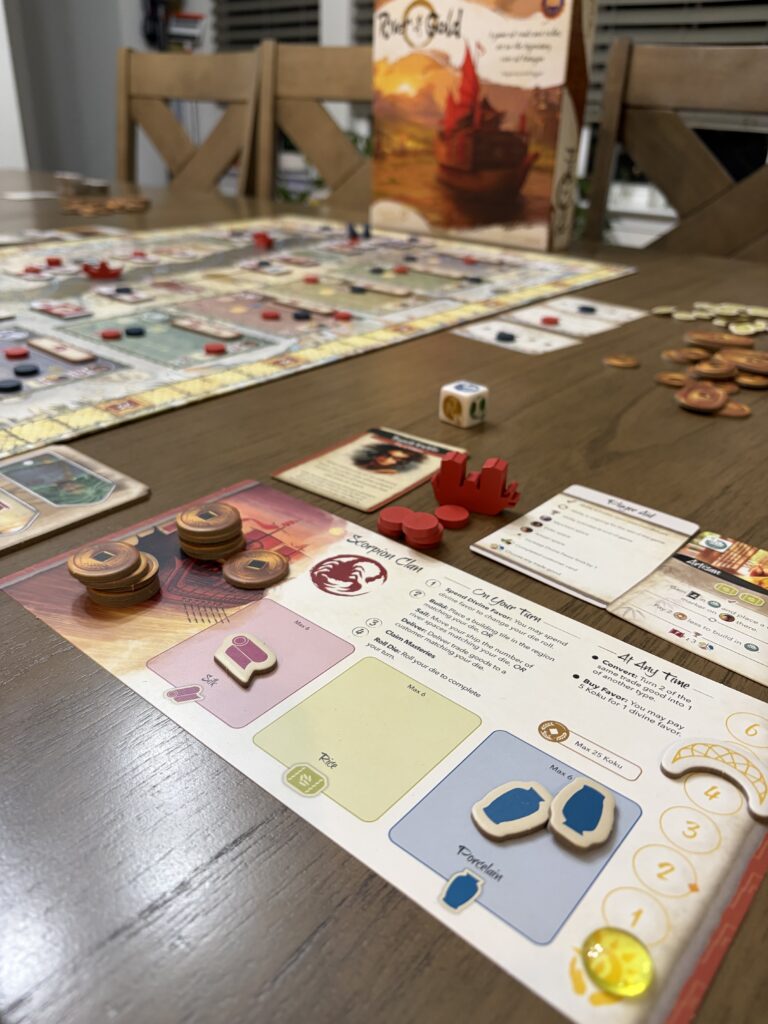
Overall, River of Gold is an excellent game that looks amazing on the table and has a fairly simple ruleset, while still offering a nice layer of tactical depth. This is an easy recommend for almost all types of gamers, and particularly for those looking for the next step up from gateway level games.
With that, I’ll wrap up this week’s review! If you’ve played River of Gold, I’d love to hear your thoughts on the game. And what are your favorite gateway+ games to recommend? I’d love to hear your thoughts on any of the games I’ve mentioned or future content suggestions in the comments below. Happy gaming!
If you liked this post and want to be notified when new content is released, then follow me on Instagram @themeepledigest.