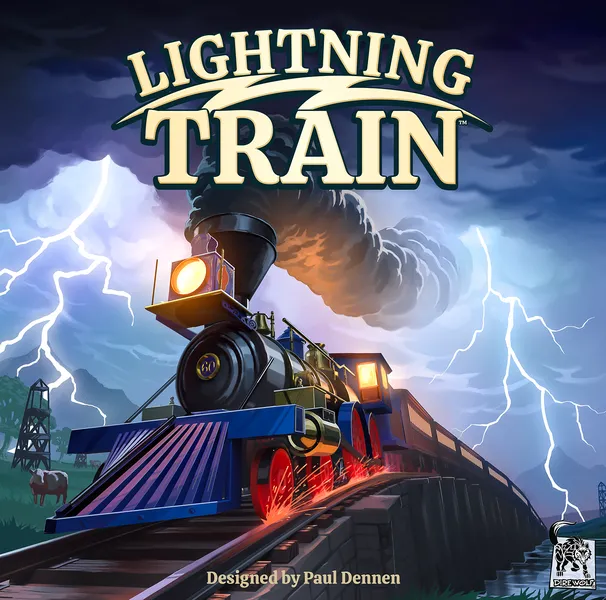
Welcome to this week’s review! This week I’m taking a look at a new game bag-building game. So without further ado, let’s jump into it.
Disclosure: A review copy of this game was provided to The Meeple Digest in exchange for an honest, unbiased review. This review is not intended to be an endorsement.
Lightning Train
- Designer: Paul Dennen
- Publisher: Dire Wolf
- Complexity: Medium
- Time: 60-120 Minutes
- Players: 1-4
- Main Mechanisms: Bag-Building, Route-Building
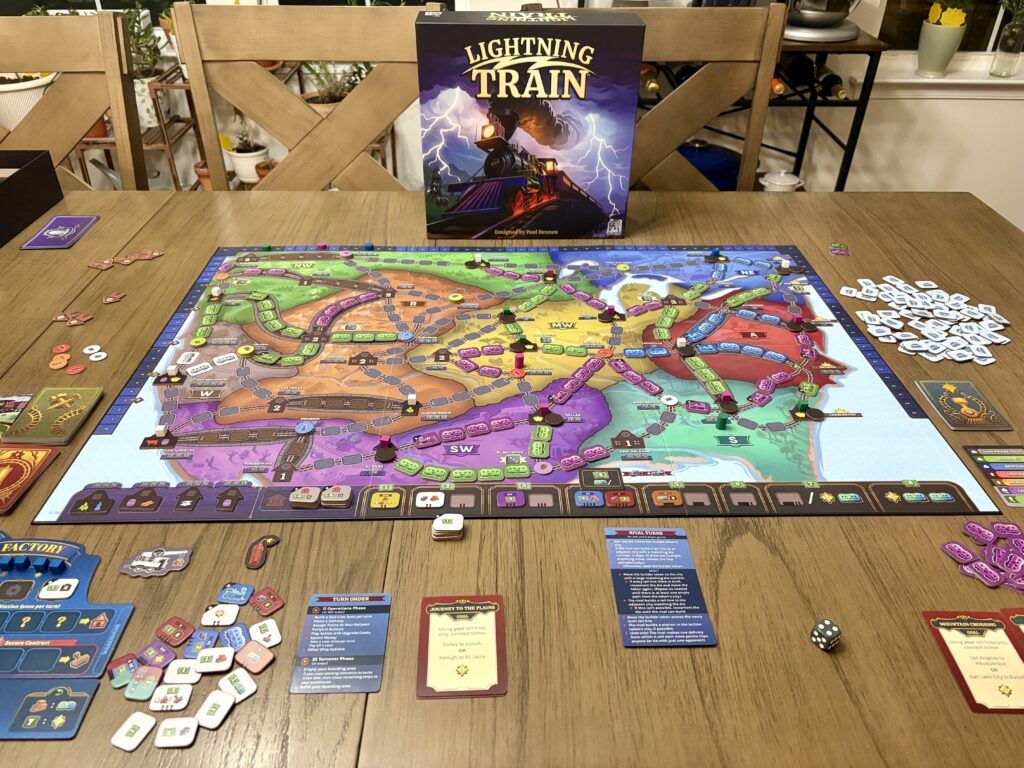
Lightning Train is the latest game from designer Paul Dennen, best known for designing games such as Dune: Imperium and Clank!. While there is no deck-building this time around, the game uses a bag-building system that is akin to deck-building. Bag-building is one of my favorite mechanisms that feels underutilized in the hobby, and both Orléans and Quacks have been regulars inside my Top 40 Games of All Time.
In Lightning Train, players are competing to build the most successful railway company by building rail lines and stations, while delivering goods across North America. Players have a bag of chips which they draw a “hand” from at the start of each round. These chips grant different effects, like money that can be used to purchase more chips, deliveries, and contracts to different regions which are necessary to build stations and rails.
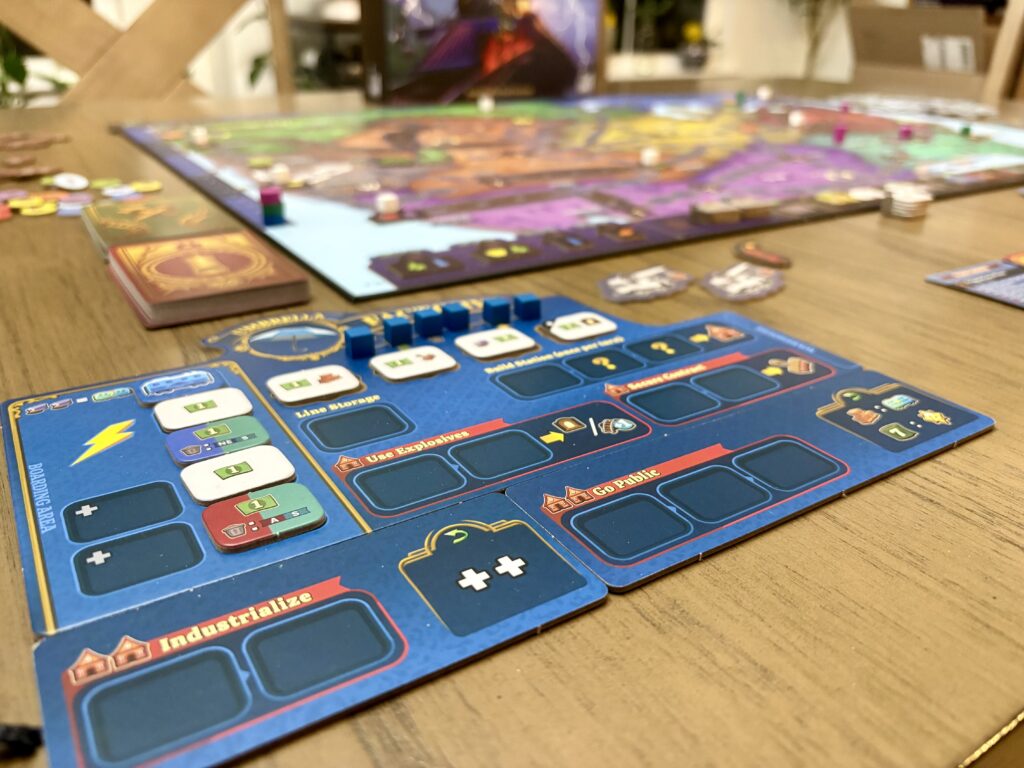
One of the more interesting mechanisms in the game is the use of the lightning train symbol. Train chips take up space in a player’s bag and are required to perform a number of actions in the game, most notably building rail lines and stations. When a player uses trains to build a line, those tokens are placed on the board and are effectively removed from the player’s “deck”. In order to gain more train chips, anytime a player draws a chip with a lightning train symbol, they immediately gain an additional train chip that can be used immediately or banked. Ultimately, this leads to some interesting decisions to make since you have to balance how often you are gaining and spending train chips.
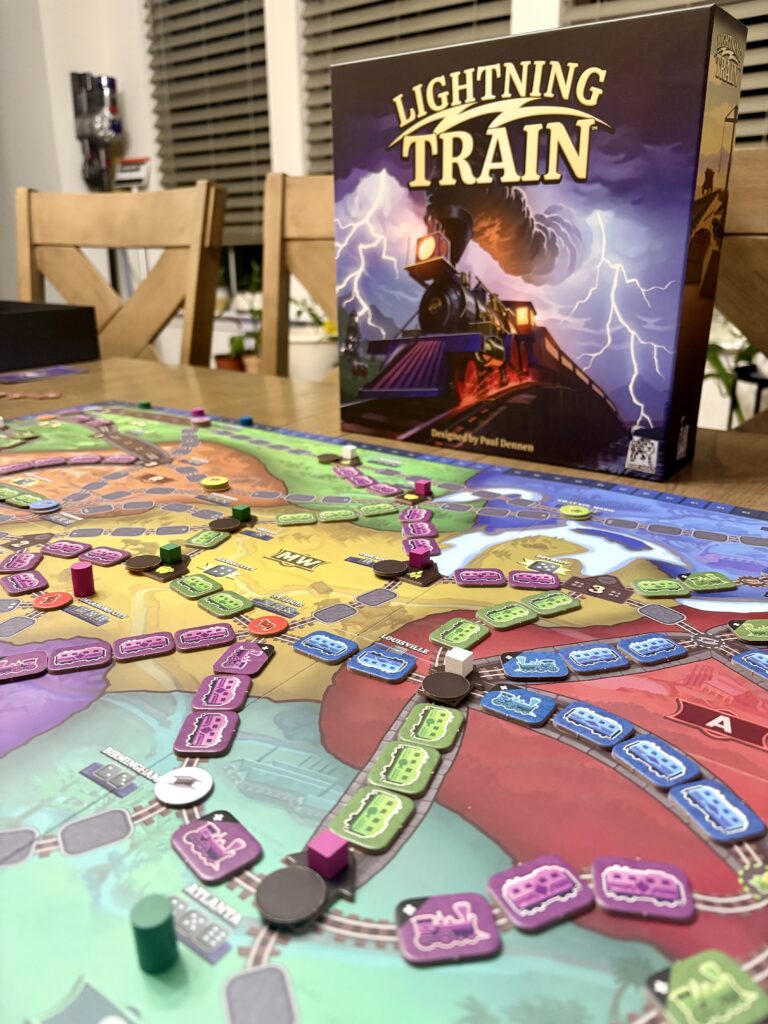
The key way players earn victory points is by delivering goods to stations. Stations come in two sizes, small and large, which specify either one or two goods respectively the station requests. There are a number of cities across the map that are designated as producer cities, with each city producing a specific type of good. At the beginning of each round, two goods are placed on cities on the board. To deliver a good to a station, there has to be a connecting route of rail lines (owned by any number of players), to a station requesting that good. Each rail line along that route scores that player one point, and the player who owns the station also receives a point. Once a good has been delivered to a station, it cannot be delivered to the station again.
Overall, I enjoyed building out a network of station and rails, and especially towards the end of the game, delivering across long rail lines felt quite satisfying. This also created a fair amount of player interaction, as players frequently jostled for routes, and other player’s stations and rail lines can be used for deliveries.
I mentioned that bag-building is one of my favorite aspects of the game, but it also led to a fair amount of frustration. One problem that many deck-building games face is providing enough ways for players to tailor their deck. Lightning Train suffers from a similar issue because ultimately there aren’t enough ways to trash chips from your deck. This leads to a deck that feels bloated and in turn some frustrating rounds.
Compared to Orléans where you’re rewarded when you trash chips, you have to decide how early in the game you want to do so. The earlier you trash chips, the leaner your bag becomes and the better rewards you get, but you are also giving up potential actions.
In Lightning Train, there were times where I drew a poor combination of chips, and there are not enough ways to mitigate this luck or adapt efficiently. This was compounded by the fact that each player has a maximum of 12 turns in a game and you are limited to building a single rain line and a single station each turn. If you happen to have a bad couple of turns early, this can have a dramatic impact on your ability to recover and perform well the rest of the game. As I became more familiar with the game, I found myself being more particular on the chips I chose to add to my bag, and like Dune: Imperium, sometimes ending up not finding any of the chips appealing. If you have a turn where you don’t draw any trains, and there are no appealing chips to buy, it can feel like a wasted turn. And when you only have a limited number of turns, it can feel quite frustrating.
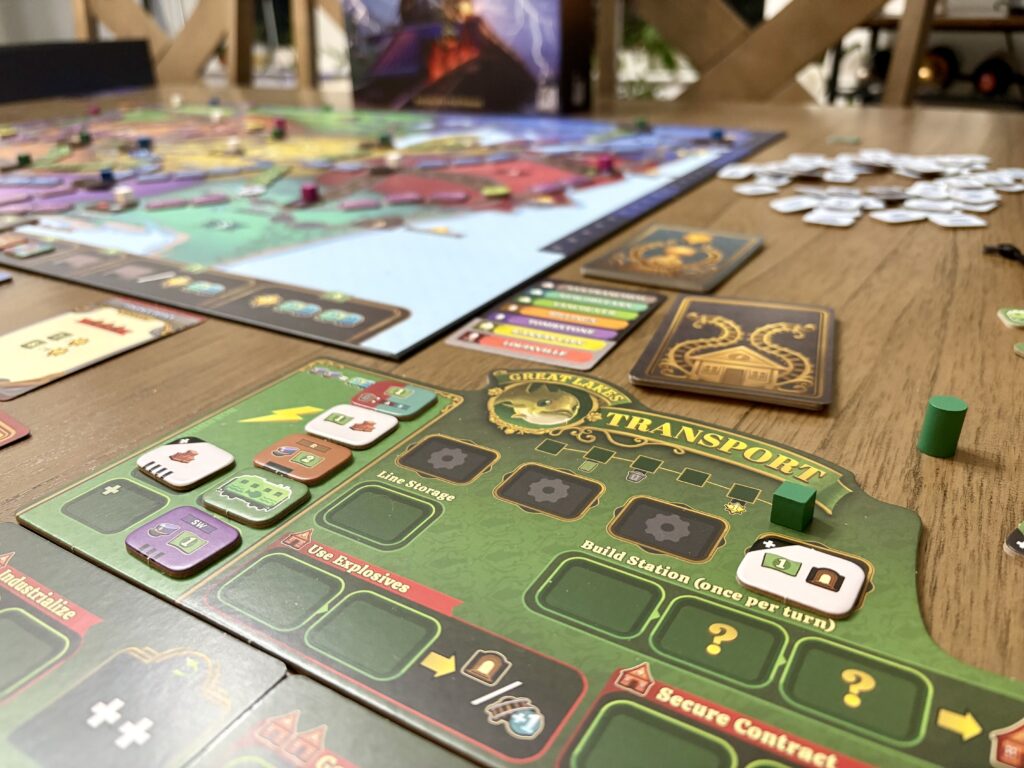
Another element of the game that I have mixed feelings on is the way that new goods are added to the map. At the beginning of each round, a card is drawn from a deck, which adds two goods to one or two cities on the board. Three production cards are removed during setup, so while the production cities and resources are fixed, there’s no guarantee that certain cities will have goods each game. I like how this forces players to adapt throughout the game, but it does cause a degree of randomness that isn’t always enjoyable. For example, two players could be building rail lines through different parts of the map, but out of pure luck, goods happen to spawn closer to one player over the other. I don’t enjoy games where I have to plan out my entire strategy at the beginning of the game, but I would have liked to see this mechanism refined so that it’s not so swingy.
There are two decks in the game – one is a deck of upgrade and end-game scoring cards, while the other is a deck of action cards that give immediate rewards. I personally found these decks to be a missed opportunity. Like trashing chips, there are very limited chances for players to draw cards throughout the game, and I frequently found myself only playing a maximum of one or two action cards each game. The end-game scoring cards give players some goals to target during the game, but the upgrade cards can be quite powerful if played early enough, and since they are dispersed in the same deck as the end-game cards, there’s no guarantee you’ll draw one. And if you happen to draw an upgrade card late in the game, it can be almost pointless. Overall, I wish the game provided more opportunities to draw cards, and maybe if the upgrade and end-game cards had been split into two different decks, it might have created a better balance.
The game’s artwork is functional but isn’t the most eye-catching on the table. More importantly, I did have issues with parts of the production. There was an instance with one of the cards where the icon didn’t match the text on the card. Additionally, while the concept of the game isn’t that difficult to wrap your head around, for some reason the rulebook didn’t quite click, and there are some important rules that I had difficulty in remembering. For example, it took a few games for me to realize that building a rail from one of your stations gives you a free train token from your supply. A frequently overlooked rules section or important rules being more easily identified in the rulebook would have helped. While there are individual player aids, I found they lacked a fair amount of important information. For example, I forgot to award subsidies a number of times since it’s not called out on the player aid. Taking all of these in conjunction, it took a few games before everything started to click. With more plays, I did find myself having more fun, but Lightning Train is a game that feels like players will need a few plays before coming to grasp with the game.
Finally, I will likely avoid playing this game solo in the future. While the AI opponents are easy to pilot, it didn’t do a great job of simulating a multiplayer game. For each AI opponent, you roll a dice, which will dictate where the opponent will build. The problem with this system is that the AI ends up building in a largely random nature. Additionally, in the solo game, each of your two opponents will attempt to deliver each turn; however, the game specifies that it’s not necessary to find the delivery that will score the most points for that opponent, only that it has to score more points than any other player. I understand that this was done in effort to speed up the game, since later in the game it can be a fair bit challenging to find deliveries, but this can lead to scenarios where there could be wild point swings. In a two player game, there is still an AI that will build rails and stations, but it won’t make any deliveries or score points, and I found this system worked fine.
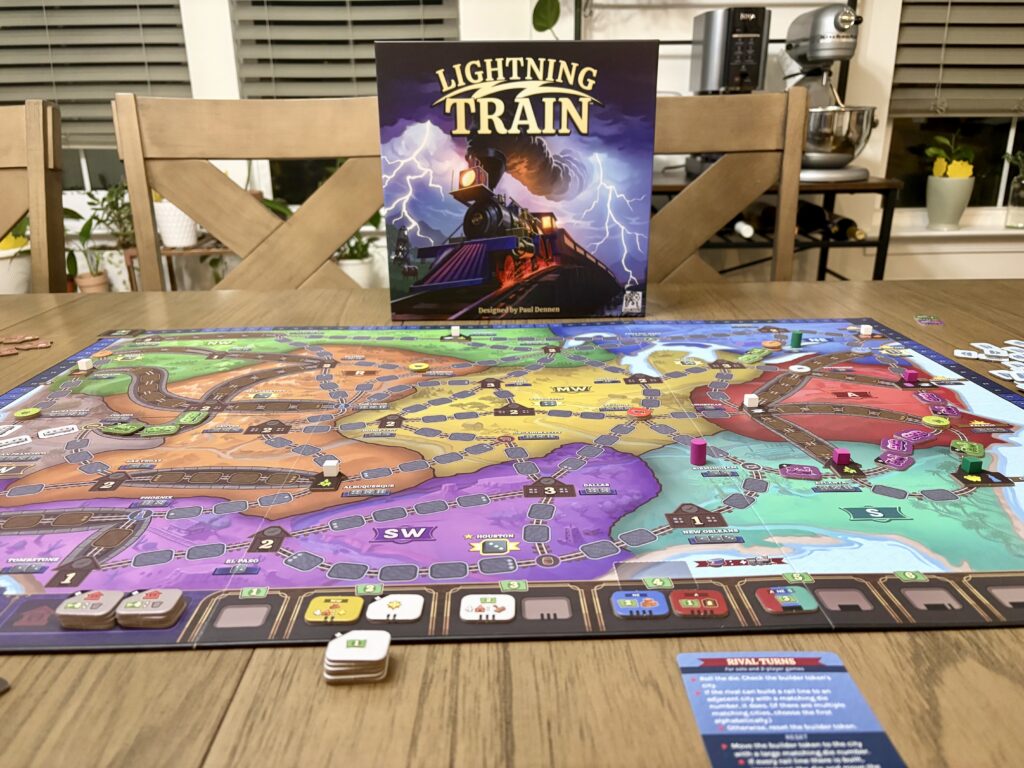
Ultimately, while I enjoy bag-building and route building, Lightning Train is a game that I think needed more time at the station. There are some interesting elements, but parts of the game (e.g., bag-building) could have used more refinement. As I became more familiar with the game, Lightning Train did grow on me, and I would recommend gamers who enjoy train games, bag-building, or games like Orléans to give this one a look. Personally, I’m still undecided on whether this will remain in the collection.
With that, I’ll wrap up this week’s review! If you’ve played Lightning Train, I’d love to hear your thoughts on the game, and what are some of your favorite bag-building games? I’d love to hear your thoughts on any of the games I’ve mentioned or future content suggestions in the comments below. Happy gaming!
If you liked this post and want to be notified when new content is released, then follow me on Instagram @themeepledigest.