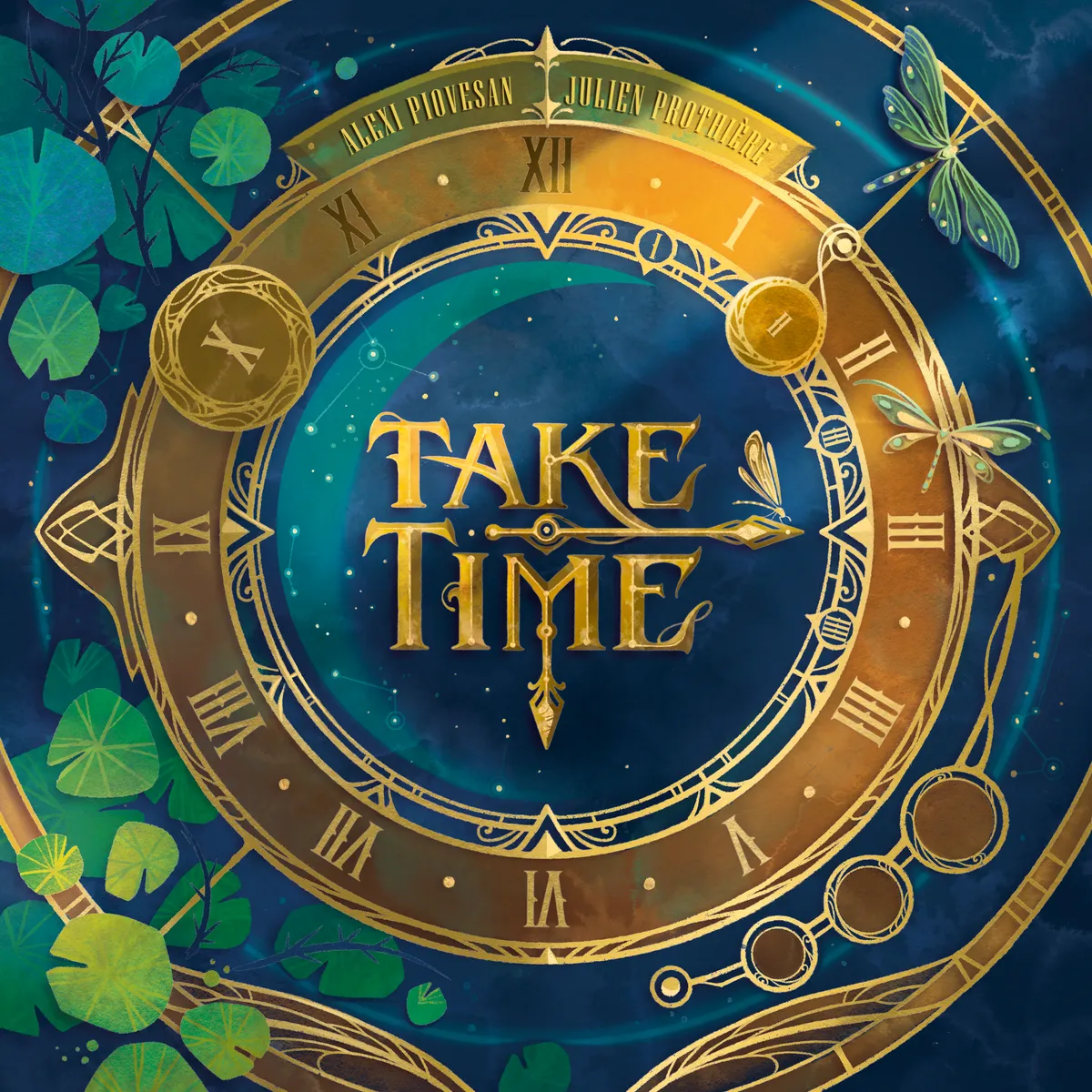
Welcome to this week’s review! This week I’m taking a look at a new cooperative card game with beautiful artwork. So without further ado, let’s jump into it.
Disclosure: A review copy of this game was provided to The Meeple Digest in exchange for an honest, unbiased review. This review is not intended to be an endorsement.
Take Time
- Designers: Alexi Piovesan, Julien Prothière
- Publisher: Libellud
- Complexity: Light
- Time: 30 Minutes
- Players: 2-4
- Main Mechanisms: Cooperative
Take Time is a cooperative card game for two to four players. The game shares similarities to The Mind, but in Take Time, players play numbered cards face down around six segments resembling a clock. Once all cards have been played, they’re revealed in hopes that the sum of the cards in each segment must be equal to or greater than the previous segment to succeed.
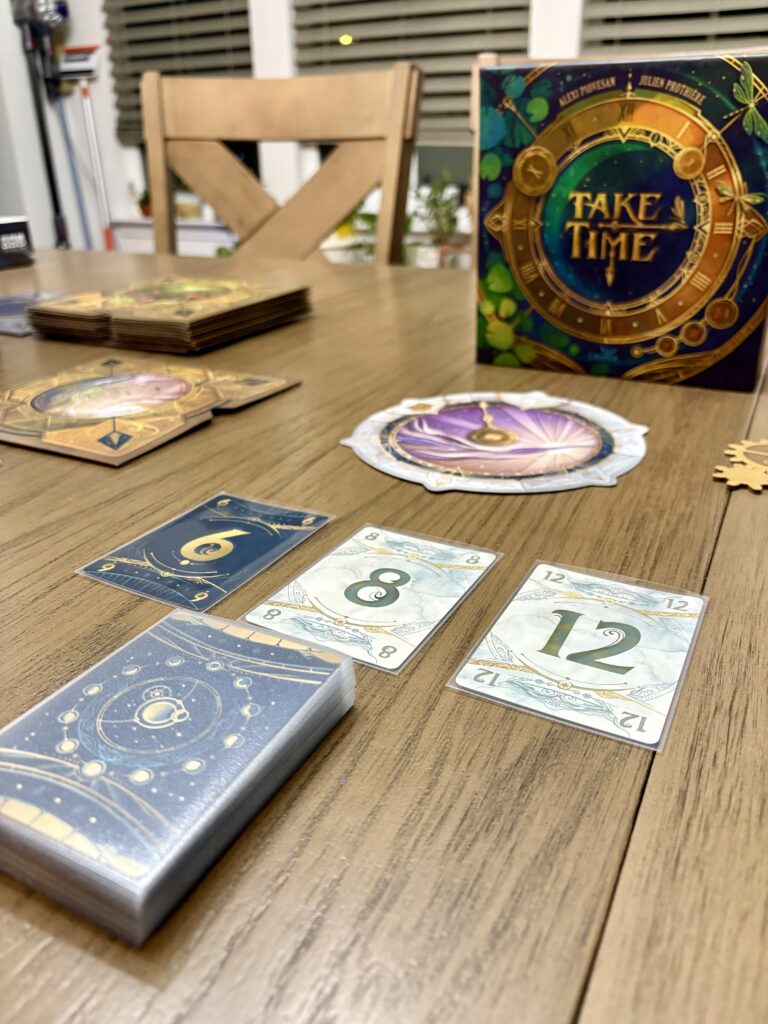
Initially, I was worried that the game would be too luck dependent, and the difference between winning and losing would come down to whether you happened to play your cards in the correct spots. However, I’ll happily admit that there is a fair amount of strategy and planning involved in deciding how to allocate the cards between segments. First off, while there is no communication allowed while cards are being played, the group is permitted to talk about their strategy before looking at their hand. For example, the group could decide that if a player has a high or low numbered card, they should lay the first card or target a specific number on a certain segment.
In addition, while the default is to play cards face down, the group is allowed to play a certain number of cards face up, often dictated by the number of players. Deciding when to play a card face up is often imperative, and in the groups I played with, we would often discuss strategies around when and where to play cards face up.
There are 24 cards in total, which are split between two decks with cards from one to twelve. Each deck has a different card back (light vs. dark), and while both decks are shuffled together before each scenario, you can deduce information by analyzing the backs of other players’ cards since only 12 cards will be dealt in each game.
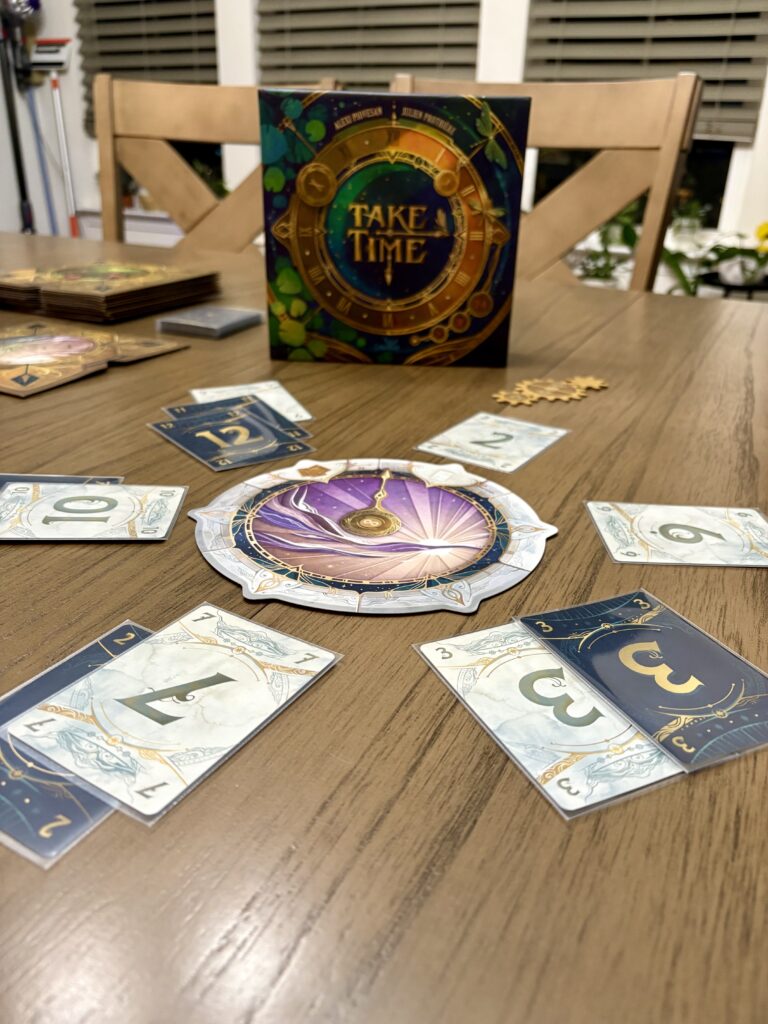
The game comes with 40 scenarios and while I haven’t played through all of them yet, each one introduces some new rules or constraints that mix things up. For example, only a certain number or type of card can be played in a specific segment or the first card has to be played in a specific segment.
In addition, the scenarios often build on each other, and they certainly become more challenging as you progress. If you’re able to play with the same group, I expect playing through all 40 to be quite the achievement, and I imagine you’ll manage to develop quite a few strategies along the way.
The game also allows you to tailor the difficulty level by allowing the group to play more cards face up, and if a scenario becomes too challenging, you can always skip it and come back to it later. Once you’ve managed to pass all 40 challenges, you can replay any of them, and the game also comes with additional options for further replayability once you’ve finished all 40 scenarios.
The rules themselves are relatively straightforward and easy to teach, and I was able to quickly teach new players. Additionally, scenarios are fairly short, lasting only a handful of minutes depending on the group and challenge, which makes it a fun, shorter game option.
I mentioned the beautiful artwork in the intro, and I would be remiss if I didn’t touch on the overall production value. Each scenario is gorgeously illustrated and the scenarios are in groups of four, with each one having a specific artwork theme. Even the gold-highlighted cards are striking. I would definitely recommend sleeving the cards to protect them since they’ll be shuffled often. While the production quality is quite solid, if I had to nitpick, the scenario cards are a bit thin, and I worry about bending them when taking them in and out of their sleeves.
The game can be played with anywhere between two and four players with the only difference being the number of cards in each player’s hand. There are always twelve cards that are dealt in each game, which are evenly distributed between the number of players. In a two-player game, there’s a slight rule change where each player is dealt a hand of four cards and a hand of two cards. The players are not allowed to look at or play any of the cards in the hand of two until they have played all of the cards in the hand of four.
Even with this slight rule tweak, I found the game played well across player counts. Personally, I enjoyed the game at both two and three players because I found that it provided a nice balance of strategy and planning, along with some unpredictability that comes with more players.
While you’re likely to need a fair amount of strategy to be able to succeed, there is an element of luck involved. It’s impossible to plan for all the different scenarios of cards you could be dealt, and you’ll have to adapt to the hand. This comes with some degree of luck when you’re torn between placing a card between two segments that will decide whether the group succeeds or fails that challenge. Sometimes, you’ll happen to make the wrong choice, and I imagine some types of gamers might be put off by this. Personally, I found the game to toe the line quite well in this department, but I haven’t completed the game to definitively say one way or the other.
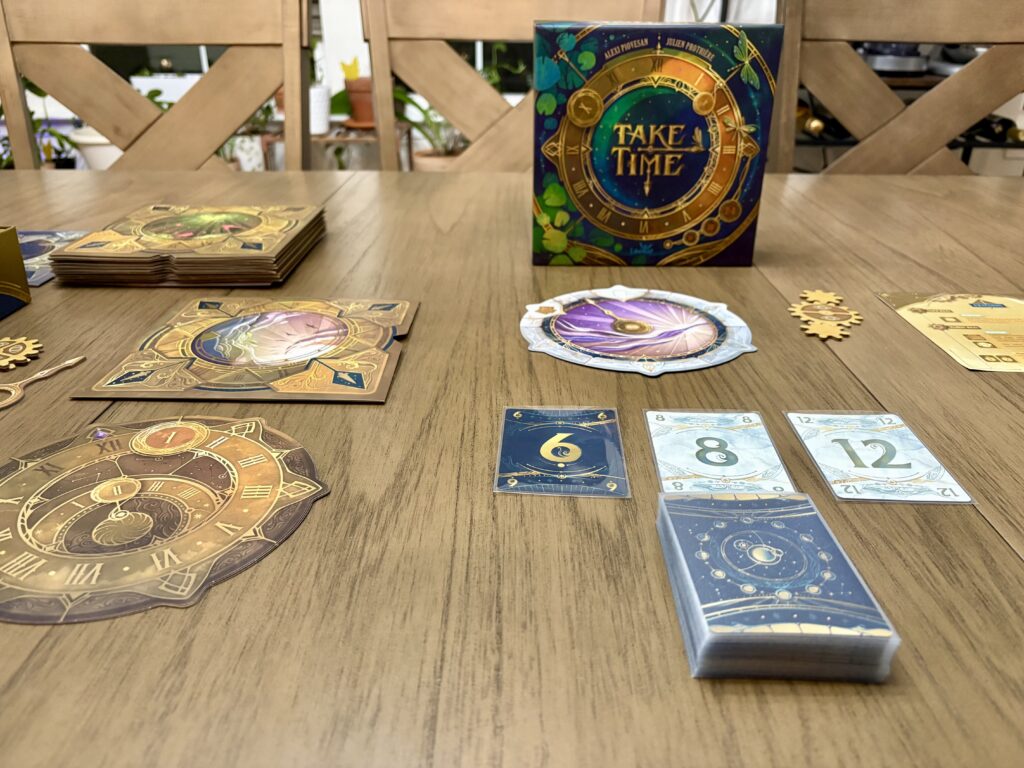
Overall, I have really enjoyed my time with Take Time so far. The game reminds me of some of my favorite parts of cooperative games like The Crew or The Lord of the Rings – Trick-Taking Games. I find trick-taking games to be best at four players, so Take Time offers an excellent alternative when I find myself with a group of two or three. Take Time is an easy addition to the collection, and I would happily recommend it to anyone that enjoys these type of light, cooperative card games.
With that, I’ll wrap up this week’s review! If you’ve played Take Time, I’d love to hear your thoughts on the game, and what are some of your favorite cooperative card games? I’d love to hear your thoughts on any of the games I’ve mentioned or future content suggestions in the comments below. Happy gaming!
If you liked this post and want to be notified when new content is released, then follow me on Instagram @themeepledigest.