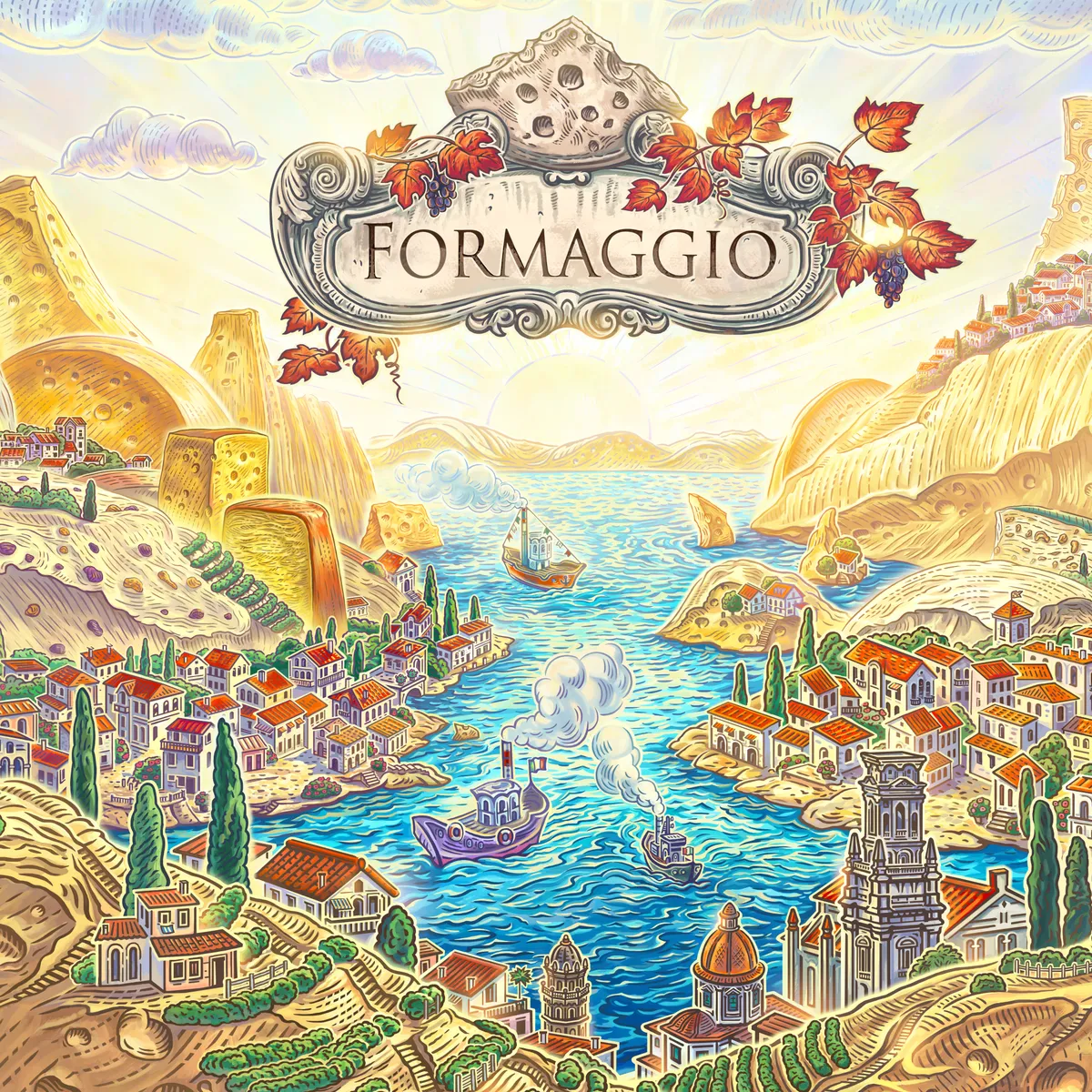
Welcome to this week’s review! This week I’m taking a look at a sequel/standalone expansion for a popular 2024 game. So, without further ado, let’s jump into it.
Disclosure: A review copy of this game was provided to The Meeple Digest in exchange for an honest, unbiased review. This review is not intended to be an endorsement.
Formaggio
- Designer: Ben Rosset
- Publisher: Road To Infamy Games (R2i Games)
- Complexity: Medium
- Time: 30-45 Minutes
- Players: 1-4
- Main Mechanisms: Simultaneous Turns, Worker Placement
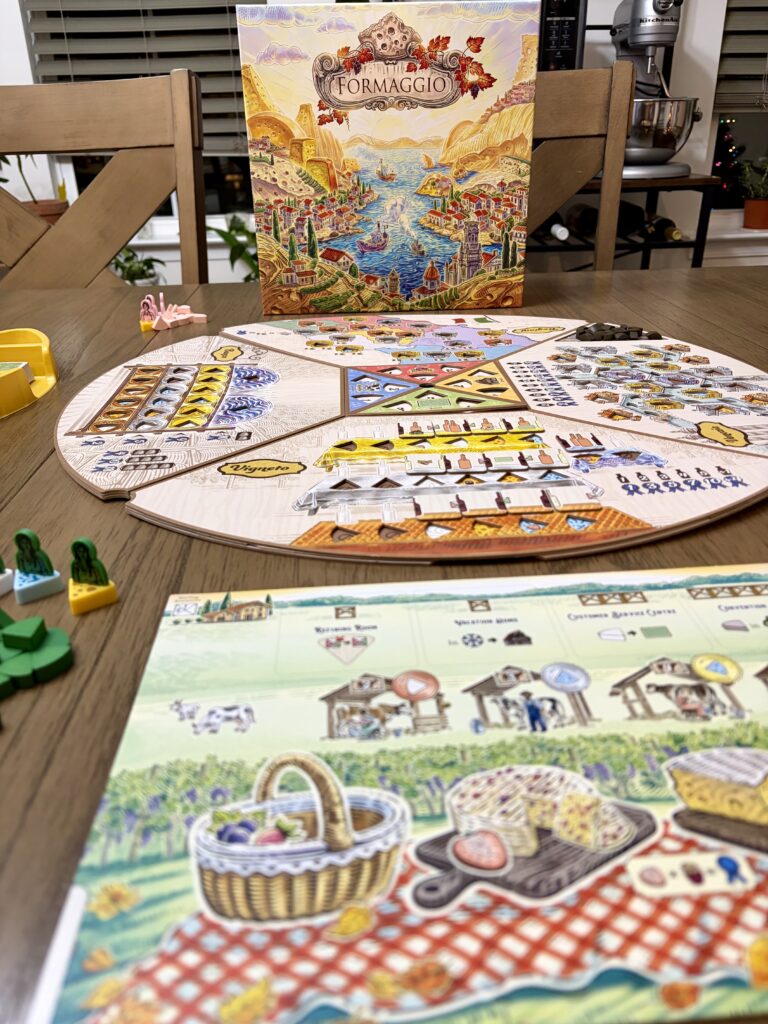
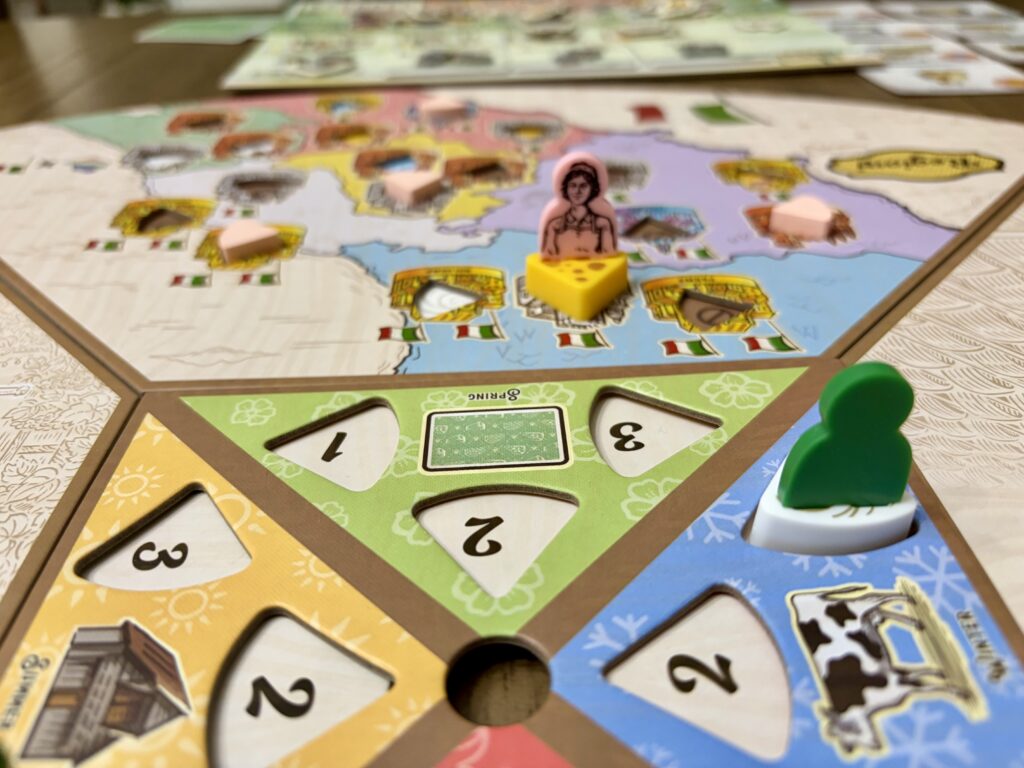
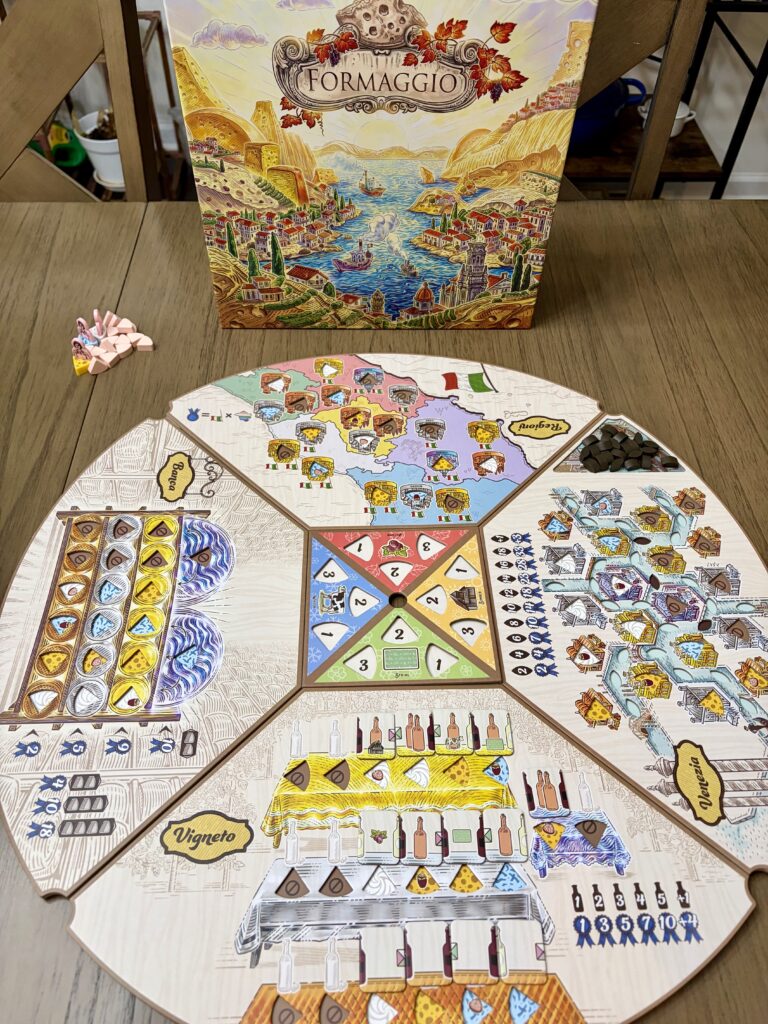
Formaggio is the sequel/standalone expansion for 2024’s Fromage. This time, instead of making French cheese, the game is set in Italy. The game is a simultaneous worker-placement game, where players place their workers each round to collect resources and produce cheese. The board is made up of four segments/venues, which rotates each round, and during the round, players can only place workers in the segment directly in front of them.
Each segment acts as mini-game, which has a different set of scoring rules at the end of each round. For example, one segment pushes players to make rows and columns of cheese, while another has players collecting and matching wine bottles to score points. My personal favorite is Venezia, which has players placing Gondola tokens each time they make cheese, and at the end of the game, players score points based on how many Gondolas are adjacent to each one of their cheeses. In addition, the game rewards players who focus on maximizing a few segments, rather than trying to diversify across all venues. Compared to the venues in Fromage, I personally found the ones in Formaggio to be a bit more interesting, albeit still standard euro game affair.
If you haven’t played Fromage, the key element in the game is the simultaneous turns, combined with the timing of placing and retrieving workers. In Formaggio, there are three different types of cheeses (soft, hard, and blu), which each correspond to one of the player’s three workers. Each type of cheese also comes in one of four different ages, and the age of the cheese corresponds to when the player can retrieve that worker. For example, a bronze-aged cheese only has to be aged one round, which means that the player will retrieve the worker at the beginning of next round (when the board rotates). In contrast, a platinum-aged cheese takes four rounds to age; platinum cheeses are new to Formaggio. Typically, the longer the cheese has to age, the better the venue space will be, which translates to more points at the end of the game.
Much of the strategy in the game comes down to timing when you plan to place and retrieve your three workers. Whereas games like Tzolk’in requires a lot of forward planning, I found it much more manageable in Formaggio, likely because there are only three workers and four segments and typically you’re only forced to plan up to four turns in advance. That said, there were still many times where I ended up in a position where I had the wrong type of worker available or I had screwed up my timing of worker placement/retrieval.
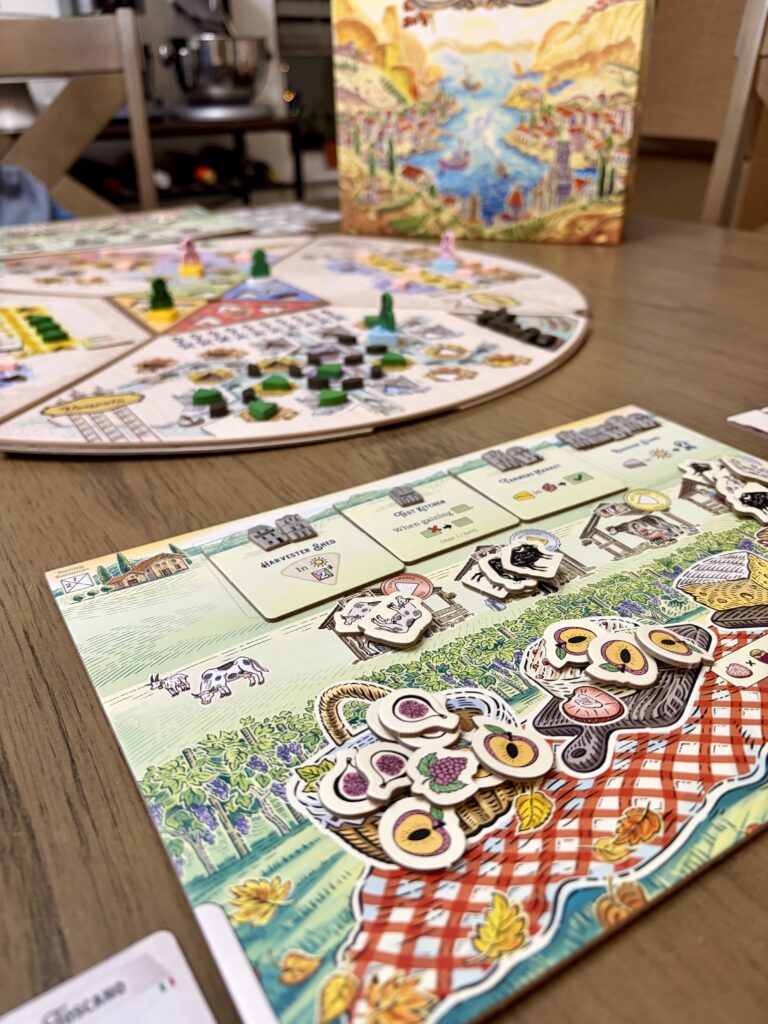
In each round, players take simultaneous turns, which means the game scales nicely across different player counts. Each venue has two different layouts, which correspond to the specific player count. For example, in a two-player game, there will be fewer available spaces in each venue. The game is a bit more interesting, albeit at the expense of more competition, at the full four player count, but I still enjoyed the game at only two players.
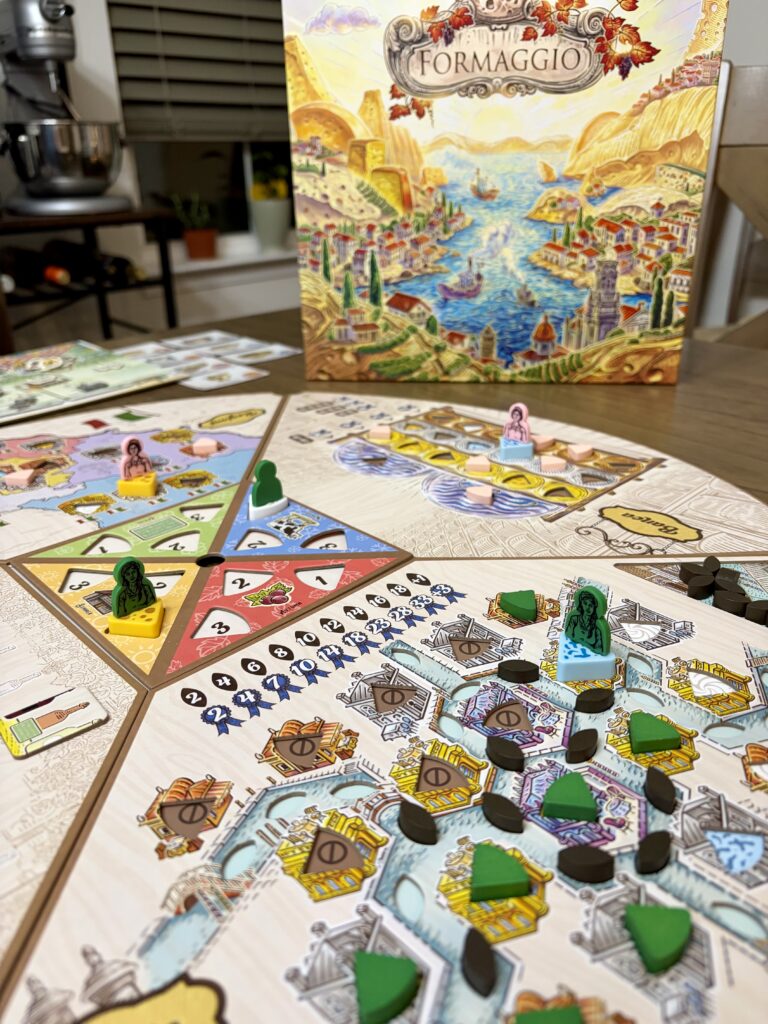
The game is themed around making Italian cheeses, and while the theme isn’t entirely pasted on, the game leans more mechanical rather than thematic. In terms of overall production value, the dual layer venue boards are nice, and the stands for each player’s workers are quite cute. My biggest issue with the production is that I wish the lazy Susan from the Limited Edition had been included in the base version of the game. I don’t need anything fancy, but a proper spinning mechanism would have been nice. As is, I did have instances where the four boards would come slightly ajar when trying to spin them, and they can be a bit fiddly at times.
In terms of balancing, I’m not sure all the venues are entirely created equal. For example, it feels easier to maximize the Gondola board, whereas matching the wine bottles is tricker. In addition, players can score a ton of points from the Regioni venue if there is less competition in that region. Speaking of balancing, some of the structure tiles feel blatantly better than others. Using the “advanced mode”, each player is dealt a hand of four random structure tiles that players draft, and once built, provide either endgame points or ongoing abilities or effects. For example, one structure tile allows the player to double the points from another one of their structures. So, combining that structure with the default structure that scores points for each cheese in a certain region is incredibly powerful. Compare that structure with one that allows the player to earn a resource when one of the four regions is facing that player, and I would much prefer the other one. There is also a structure that when built allows the player to randomly draw two new structures and automatically complete it, but who knows if either of the of those random structures will be beneficial. I’m not claiming the entire game feels unbalanced, but there appears to be stronger strategies than others.
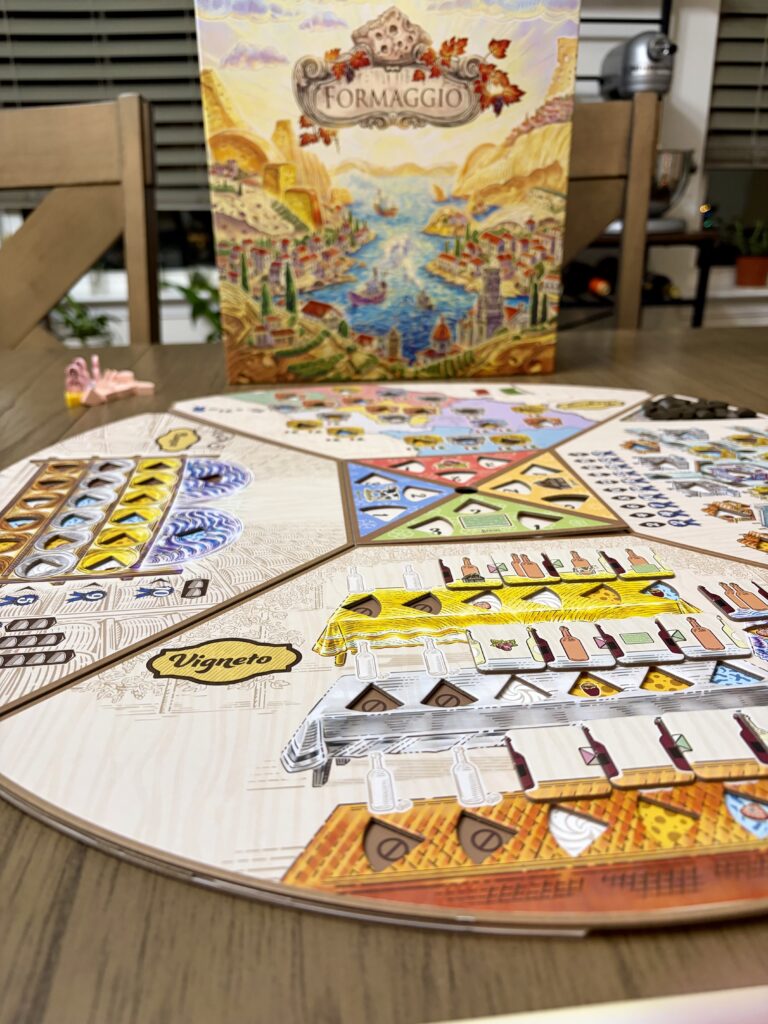
Comparing Formaggio to Fromage, the main difference between the two games are the venues. Formaggio is described as a standalone expansion, so if you own both games, you can mix and match the venues from both games. I do have some concerns about the overall replayability of the game, but having to buy and own a separate game just so that you can create more variety feels a bit much. Given the dual-layer boards, I understand it’s probably not the cheapest to give more options, but I would be happy with an expansion that just adds more venues.
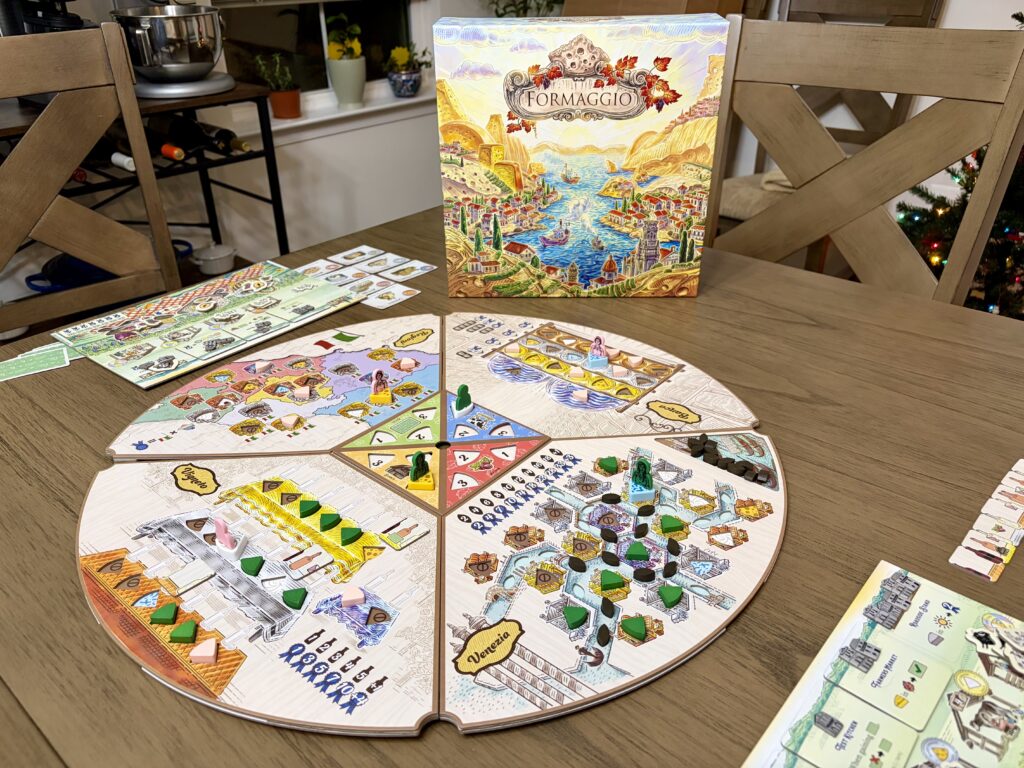
Overall, unless you already love Fromage, it’s difficult for me to recommend owning both games unless the publisher finds a way to sell the venues separately. Personally, I think I prefer Formaggio to Fromage because the new venues feel a bit more interesting, and Formaggio would be the game I would recommend buying first. If you already own Fromage, it’s a bit more challenging to recommend because the two games feel so similar. In general, if you’re looking for a simultaneous worker-placement game that isn’t too complex and has a relatively short runtime, then I would recommend giving Formaggio a look.
With that, I’ll wrap up this week’s review! If you’ve played either Fromage or Formaggio, I’d love to hear your thoughts on either game. And if you own Fromage, do you plan to pick up Formaggio? I’d love to hear your thoughts on any of the games I’ve mentioned or future content suggestions in the comments below. Happy gaming!
If you liked this post and want to be notified when new content is released, then follow me on Instagram @themeepledigest.