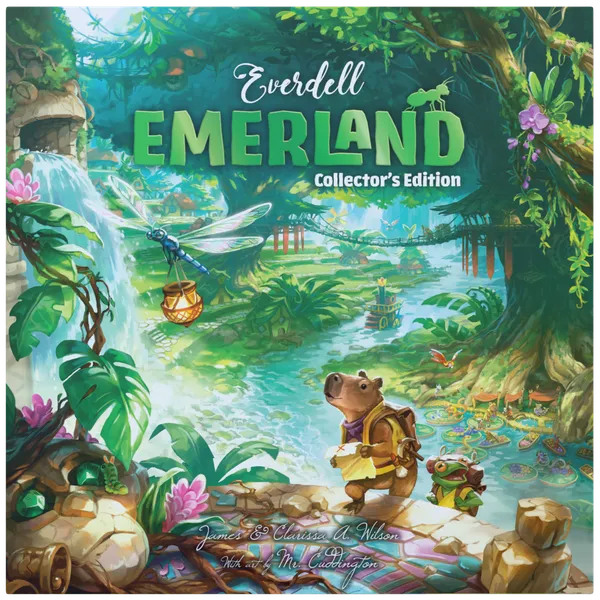
Welcome to this week’s review! This week I’m taking a look at the newest entry in a very popular critter-themed game. So, without further ado, let’s jump into it.
Disclosure: A review copy of this game was provided to The Meeple Digest in exchange for an honest, unbiased review. This review is not intended to be an endorsement.
Everdell Emerland
- Designers: James Wilson, Clarissa Wilson
- Publisher: Tycoon Games
- Complexity: Medium
- Time: 30-120 Minutes
- Players: 1-4
- Main Mechanisms: Worker Placement, Tableau Building
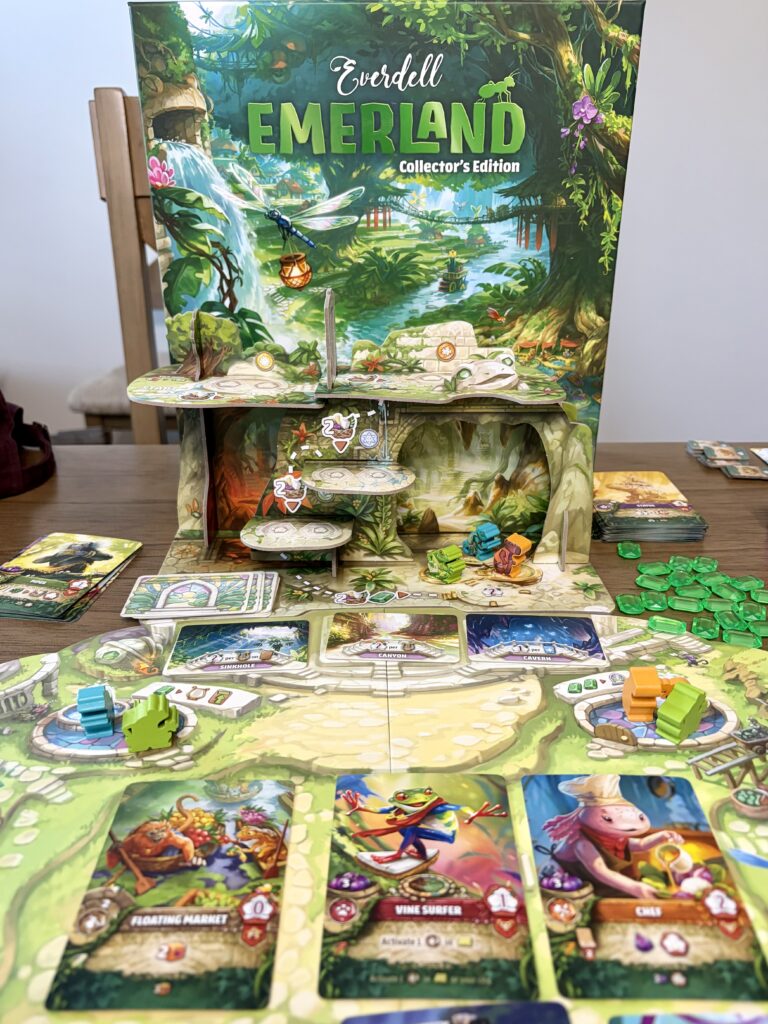
Everdell Emerland is the latest standalone game in the Everdell line. As a bit of background, I enjoy Everdell, and it’s consistently ranked within my Top 40 games of all-time. However, I wouldn’t consider myself a die-hard fan of the game, and I’m perfectly content to play just base Everdell.
Emerland is technically the fourth, standalone reimplementation of Everdell after Farshore and Silverfrost, released in 2023 and 2025 respectively (I’m also excluding the spinoff two player version Duo and the Welcome to Everdell kids version). I’m sure there are plenty of debates over which version of Everdell is the best, but for the purposes of this review, I’ll largely be making comparisons to the original Everdell.
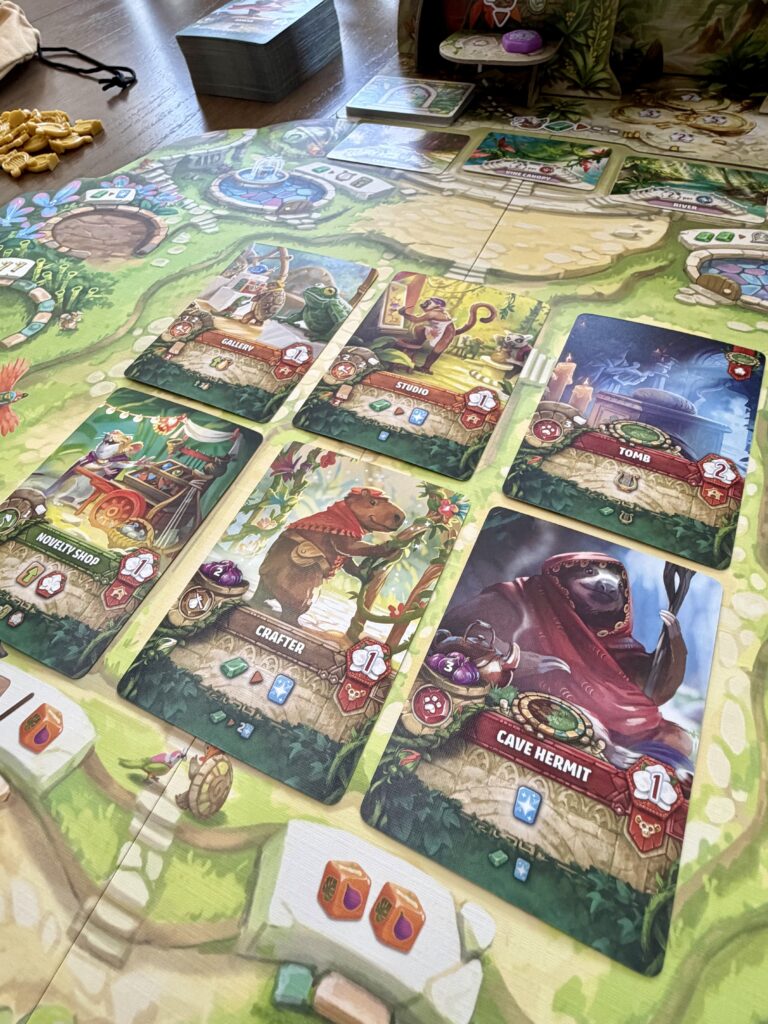
In terms of setting, Emerland trades the forests of the original Everdell with a tropical jungle setting. While the artists are different from the original Everdell, the artwork on the cards is still gorgeous, and the game is still striking on the table.
In terms of mechanics, the game maintains the same worker-placement round structure, where players place workers, play cards into their tableau, and progress through the four seasons at different speeds. One of the biggest changes in this new version is the introduction of another worker type called helpers. These are mini-workers that can be played alongside players’ normal workers to allow them to double the effect of a worker placement location and/or allow players to visit already occupied locations. There are also a few locations that can only be visited by helpers. Overall, I really enjoy the inclusion of this new worker type, as it adds a new layer of decision-making in terms of how to best optimize their placement.
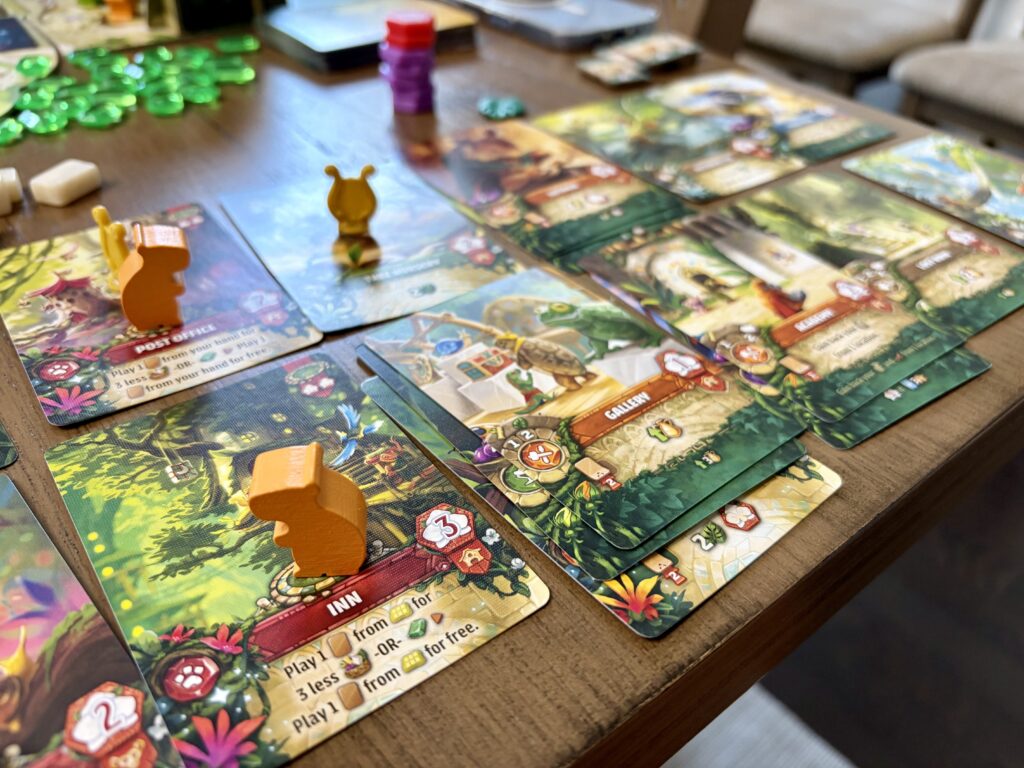
Another large change is that all critter and construction cards are double-sided. When cards are played into a player’s tableau, they start in their nonupgraded side, but can be upgraded throughout the game. Typically, the upgraded side will be an improved version of the original card, and an upgraded card provides an additional victory point at the end of the game. A neat touch is that the artwork on the upgraded side of the card is from a zoomed-out perspective to show more of the scene. Certain card types also trigger their effects again when upgraded, which adds another layer of strategy in terms of deciding whether to prioritize adding new cards to your tableau or upgrading your existing ones.
In the original Everdell, critters were linked to construction, and players could play certain critters for free if they had already built the associated construction, similar in a way to 7 Wonders. However, the criticism was that often players were at mercy to luck of the draw, and sometimes you might never see the matching critter or construction card. Farshore updated the mechanism to allow for more freedom to play critter cards, and Emerland follows with a similar system. In Emerland, players can place a harp token on an upgraded construction to play any critter for free; however, players are restricted to placing only one harp on each color construction. While I was never too bothered by the paired system in the original Everdell, the refined mechanism in Emerland certainly feels more balanced. The one caveat is that since not all critters cost the same number of resources, players are free to claim the more expensive critters through less expensive constructions.
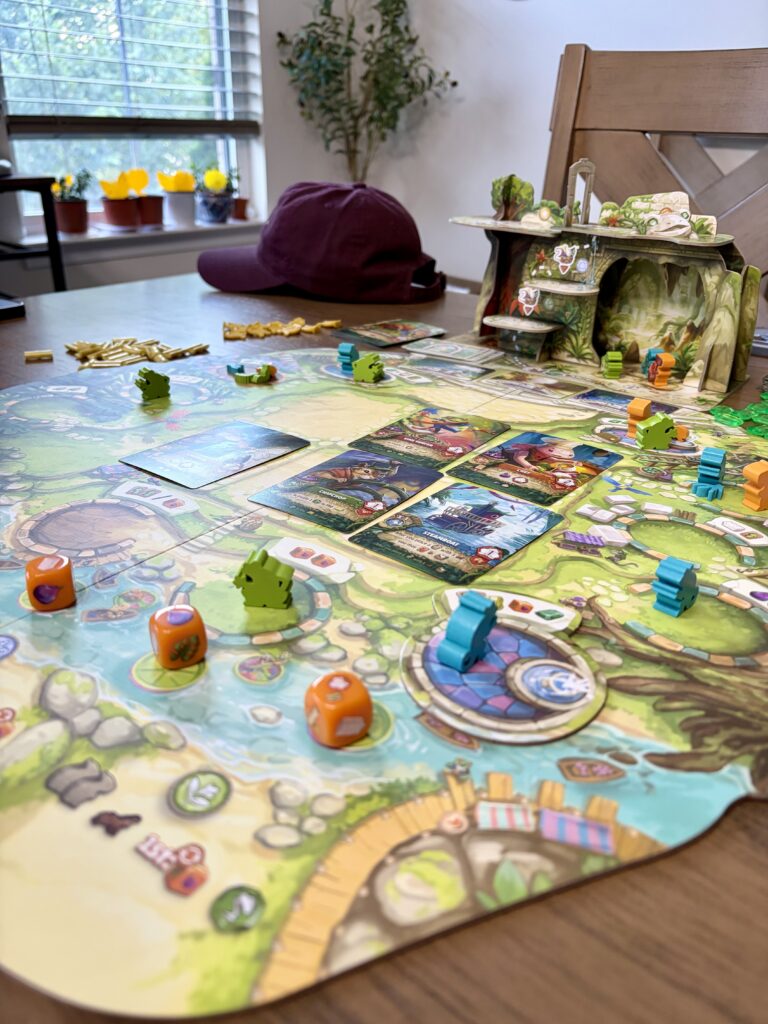
Since critters and constructions are no longer directly linked, it allows the freedom for more unique cards in the deck. In Emerland, the majority of the cards are unique, and while there are some similarities in abilities to the original Everdell, I enjoyed exploring the new effects and finding new combos. In addition, gone too are the terms “unique” versus “common” cards, and while uncommon due to more unique cards, there is no restriction on playing duplicate cards into your tableau.
Another new addition is the introduction of a new card type – Artisans. As an action, players can tuck a card from their hand underneath an Artisan card in their tableau in order to trigger the card’s effect. Each Artisan card also has a restriction on the number of cards that can be tucked. As an added wrinkle, while upgraded Artisan cards provide better effects, the number of tucked cards doesn’t reset after the card is upgraded, so players have to consider whether they want to wait to tuck cards until after the Artisan card has been upgraded. I could envision some fun strategies built around drawing and tucking cards.
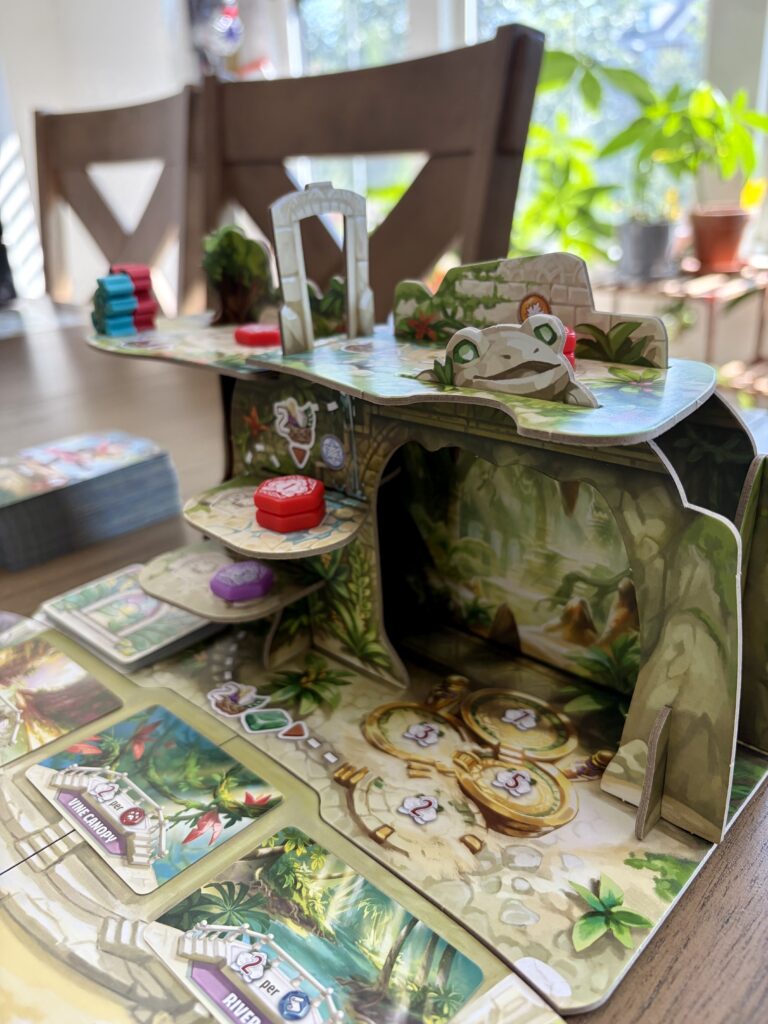
The last major new addition is an archeologist track, where players can advance along the track by paying resources, and the first players to reach spaces along the track receive victory points. In addition, whenever a player advances along the track, they have to discard at least one card from their hand. For every card discarded, that player gets to draw the same number of artifact tokens from a bag. However, regardless of the number of artifacts drawn, players can only keep one. Some artifacts provide immediate rewards, such as a resource, and the artifacts range in terms of the number of victory points they provide at the end of the game.
I’m personally a bit on the fence with this new addition. On one hand, there are some cards that allow you to draw artifacts outside of the archeologist track, as well as cards that increase the number of artifacts you get to draw each time. And building a strategy around these types of cards can feel quite fun. However, the artifact tiles vary widely in how many victory points each one is worth. Some tiles are only worth one point, whereas others are worth as many as seven points. As I mentioned above, while there is some luck mitigation, I’ve had times where I’ve only drawn one artifact and ended up with more points than when I had many more artifacts to choose from. These tiles can create some wild swings, and the introduction of such a heavy luck mechanism fell at odds with how luck was removed from having critters and constructions directly linked.
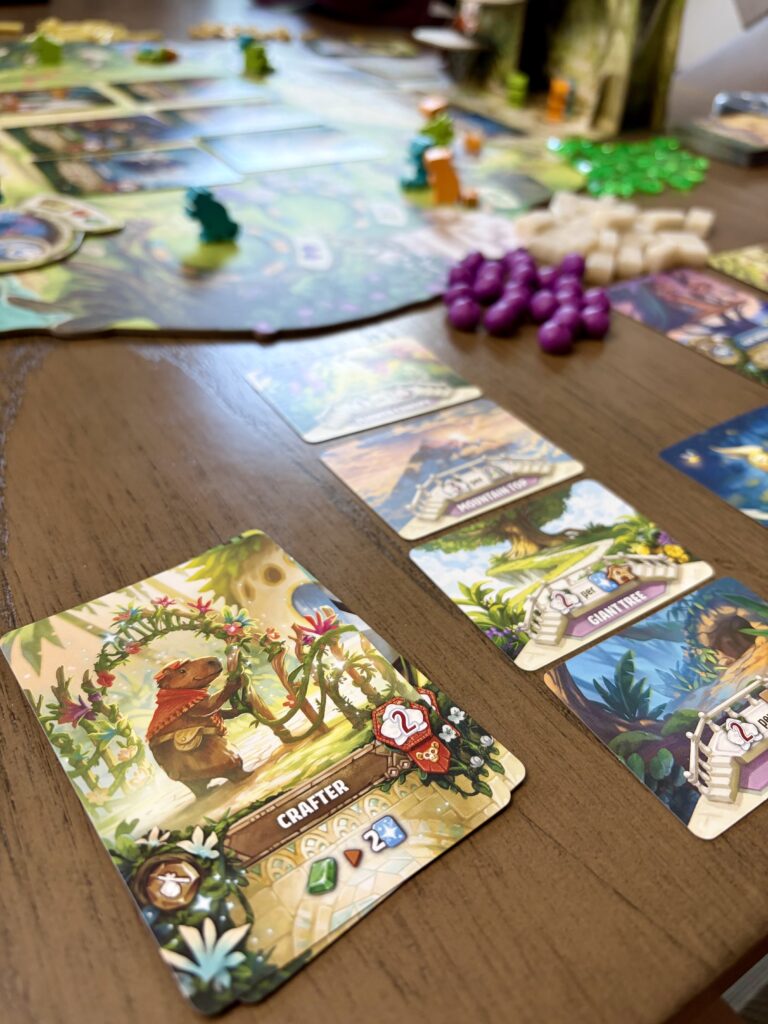
There is still a limit to the number of cards each player can have in their tableau; however, the limit can be increased by claiming realm cards. These offer end game scoring opportunities, such as providing victory points for each card of a certain type in a player’s tableau. In a way, these cards also replace the public objectives from the original Everdell, which also had its fair share of luck dependency, and overall, I think I enjoy the realm card system more. I still partly wish that there was no limit on the number of cards you could play into your city because in a recent game, I felt stuck in the last season because while I had the means to play more cards, I had no way of gaining more realm cards to increase my city limit. I understand that this mechanism is meant to deter players from spamming a bunch of low victory point cards, but the city limit can still feel quite restrictive.
For the purposes of this review, I was given a copy of the collector’s edition, which comes with upgraded components. Like with the tree in Everdell, I still think the standing structure is entirely unnecessary, but I do appreciate that there is a separate board that you can use instead that I’ll likely always opt for. That said, the component quality and upgraded resource tokens are quite nice. The one caveat I have with the collector’s edition is that the insert is designed with the deluxe resource vessels in mind, which is a separate add-on. Without the resource holders, the insert leaves a bit to desired. Overall, the production quality is quite nice, but even without factoring in the deluxe resource vessels, the MSRP does feel a bit steep.
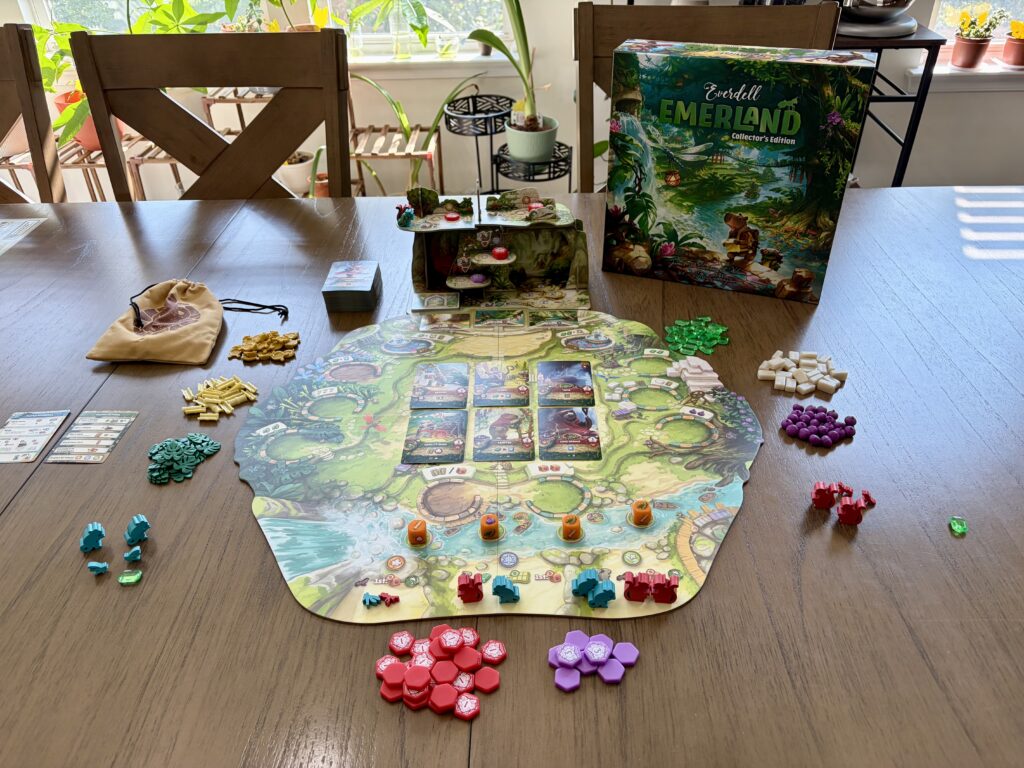
Overall, I have really enjoyed Everdell Emerland. The game retains much of what I enjoy about Everdell, while tweaking a few mechanisms to give it more depth. There will still be a place for Everdell in my collection, but I suspect that I’ll be reaching for Emerland more often given that there is much more for me to still discover about the game. I’m on the fence on how to feel about the artifact tokens, but the rest of the game feels like a more “gamers” version of Everdell. If you’re new to Everdell, I’d likely still recommend starting with the original, but if you’re someone that enjoys crunchier euro games, I might be tempted to recommend Emerland to you first. And if you’re someone that already enjoys Everdell, Emerland is an easy recommendation.
With that, I’ll wrap up this week’s review! If you’ve played Emerland already, I’d love to hear your thoughts about the game and what your favorite Everdell game or combination of expansions to play are. Happy gaming!
If you liked this post and want to be notified when new content is released, then follow me on Instagram @themeepledigest.