Welcome to this week’s review! This time I’m taking a look at Devir Games’ latest heavy euro game. So, without further ado, let’s jump into it.
Disclosure: A review copy of this game was provided to The Meeple Digest in exchange for an honest, unbiased review. This review is not intended to be an endorsement.
Covenant
- Designer: Germán P. Millán
- Publisher: Devir
- Complexity: Medium-Heavy
- Time: 100 Minutes
- Players: 1-4
- Main Mechanisms: Worker Placement
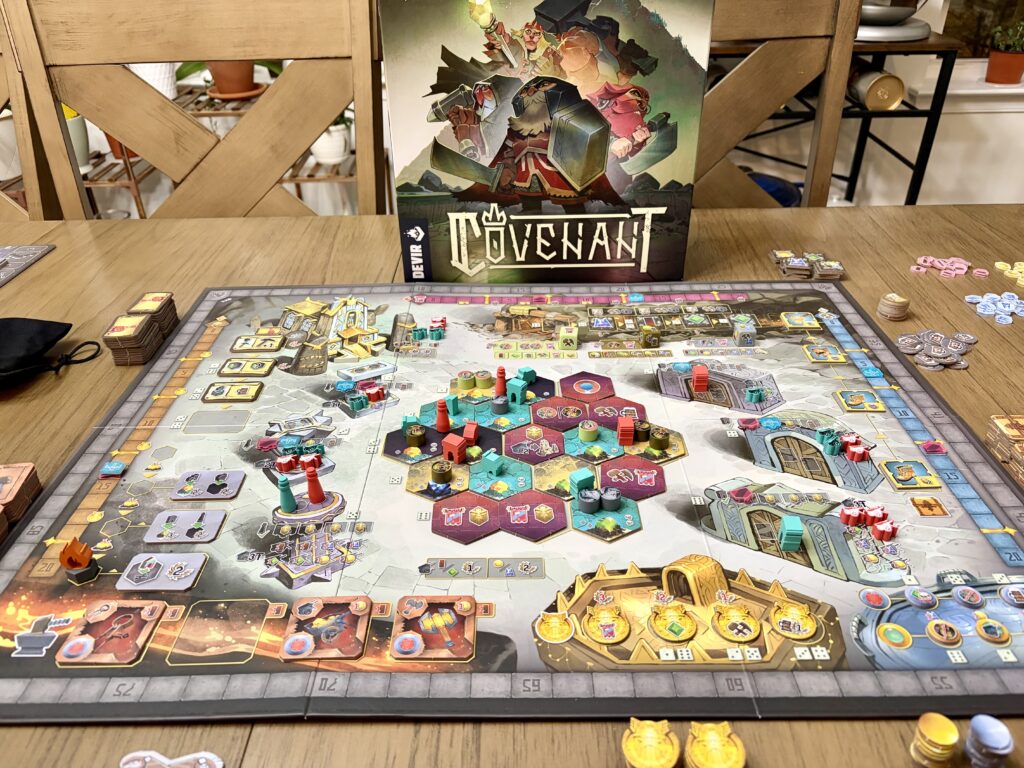
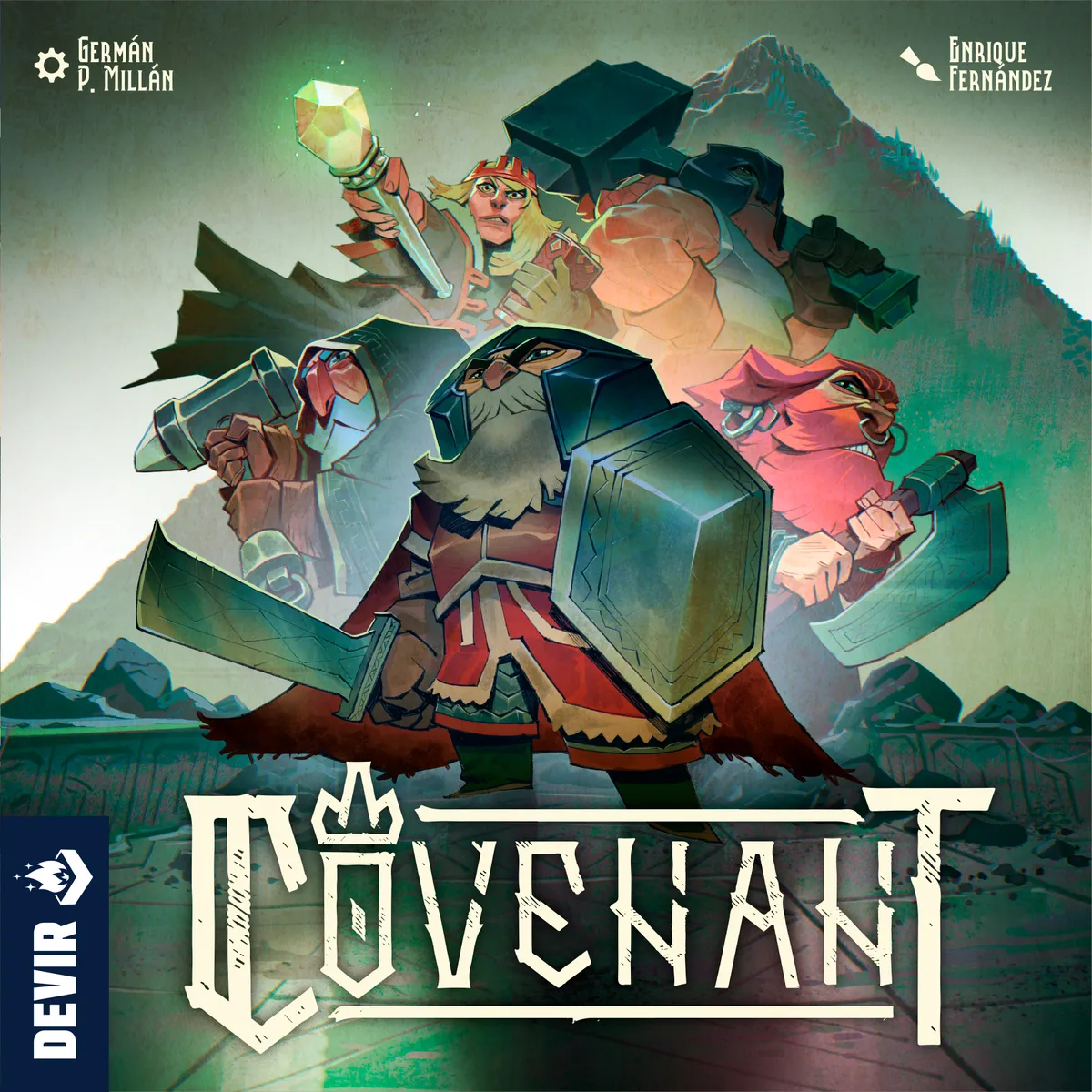
Covenant is designed by Germán P. Millán, who previously designed another popular heavy euro from Devir called Bitoku. In Covenant, players take on the role of Dwarven clans with a mission to reclaim their sacred mountain from their Goblin, Orc, and Troll enemies. The game plays out over three eras, and in each era, players take turns assigning their four dwarfs one of their available tools, which consist of four different available actions. Each dwarf also has an associated strength value, which dictates the relative strength of the performing action.
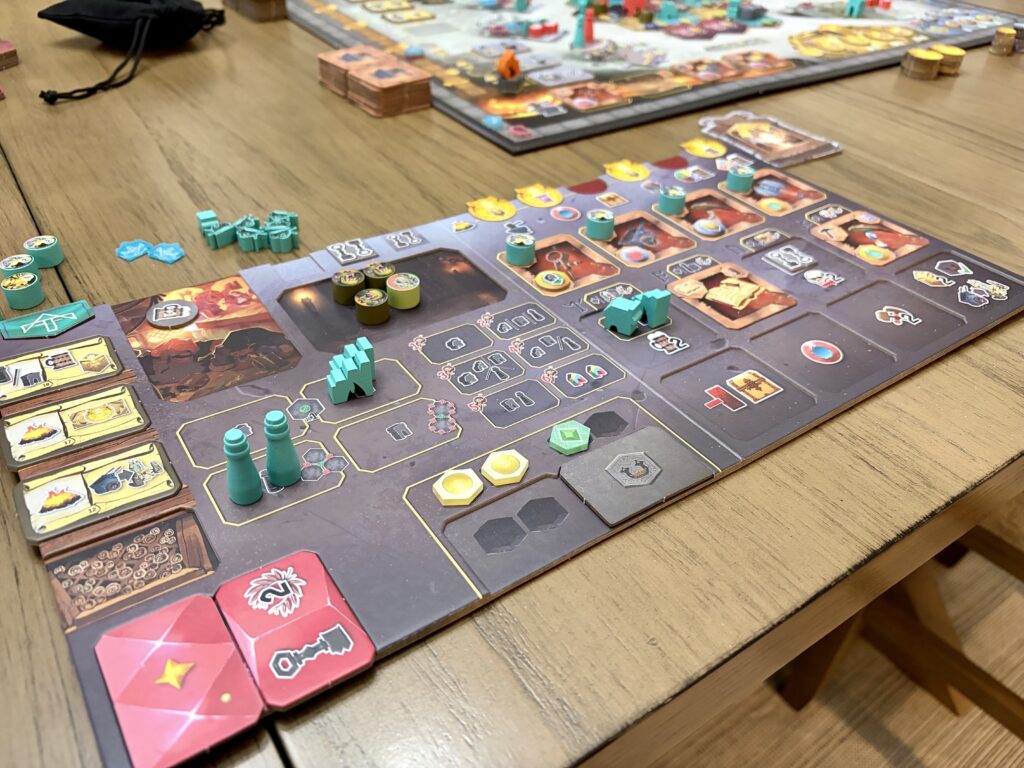
I’ll admit that the Dwarven theme is a bit lost on me, as the game certainly feels more mechanical rather than thematic, but the overall production value of the game is quite high. There are dual-layer player boards that easy allow you to slot in the different rewards you collect. There are a ton of components, with wooden player pieces and nice resource and player markers. The dwarf workers are also a nice touch, with images that change as each dwarf’s strength increases. There are also fairly detailed individual player aids that do a good job of explaining the different actions, turn structure, and icons.
While there are only four main actions, make no mistake that Covenant is a crunchy euro. Whereas as the different actions are relatively straightforward, the complexity is derived by the wide number of choices. Additionally, there are plenty of opportunities to combo actions together. For example, one main action may allow the player to gain resources, which grants them a reward on a specific track, which then grants another reward, which then chains another action together. As you can see, turns can become quite lengthy.
As you might expect, this can lead to a fair amount of analysis paralysis (AP), which is why I would be hesitant to play this game with AP-prone gamers. There can also be a fair amount of downtime between turns, which is why I would prefer to play the game either solo or at two players. As a whole, the solo mode is well done and relatively easy to pilot, and it’s able to simulate a multiplayer game quite well. Overall, if you like games with a lot of interconnected elements and satisfying turns with many opportunities to combo multiple actions together, I suspect that you’ll enjoy Covenant.
The game can also feel incredibly tight at times. Players only get 12 turns during the game, so you’ll want to make each one count. While you’re often granted multiple rewards during a turn, you’re just as frequently using those rewards to take your next action or reward. As a result, I never felt like I was overflowing with resources.
Since most of the mechanisms are interconnected, I found it challenging to specialize in certain elements. In order to get more tools or deliver resources, you’ll need to dig for resources. To build more structures, you’ll need to find ways to acquire them, and you’ll need to reveal more tiles on the board, opening up more places to build. While you’re often rewarded on your turns, and the game is very much a point-salad style game, points, resources, and items are still difficult to come by. The player markers go up to 200+ points, but I have yet to even break 100 points. I honestly don’t even know how someone could even reach 200 points.
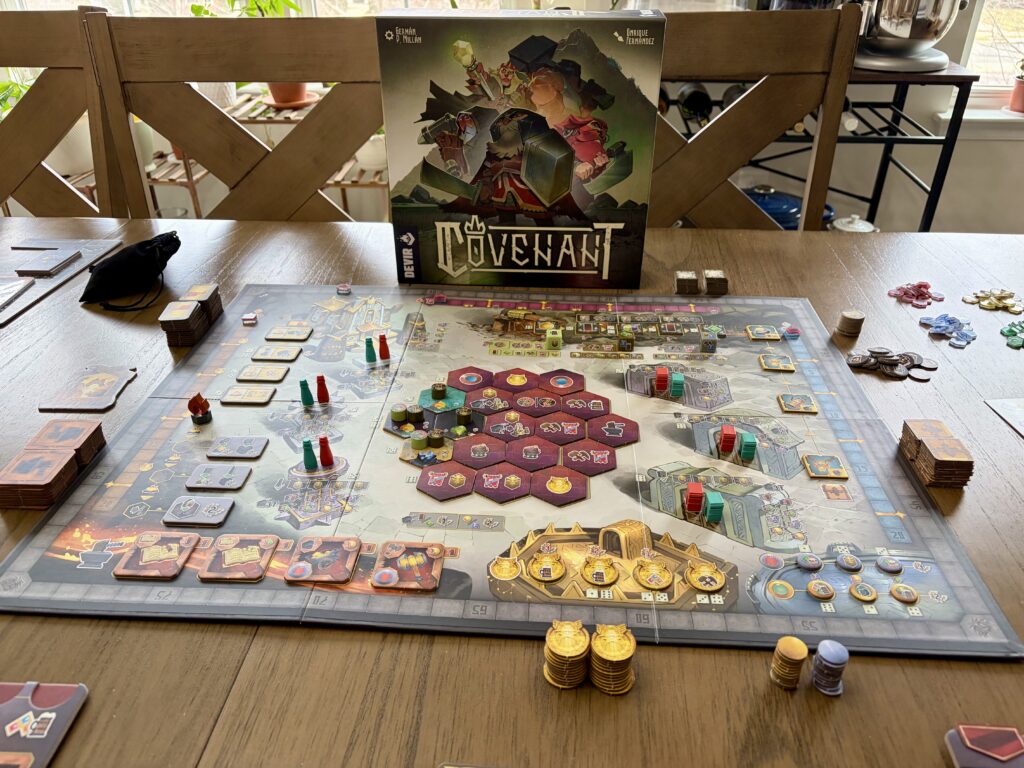
Speaking of, a large percentage of your points are likely to come from the three projects that are scored at the end of each of the three eras. These projects score you points based on the structures you have built on the board, which reward you for building on certain types of tiles. Ignore these at your own expense. These projects often dictate what type of strategy you should follow, and since all players score the same projects, it puts players in direct competition with one another. All players are vying for the same types of tiles, and the game can be cutthroat if one player reveals a good tile and then the next player builds on it.
I already mentioned the potential downtime and AP-inducing moments, but another reason that I prefer this game at lower player counts is the lack of meaningful player interaction. I just mentioned the cutthroat nature of the project tiles, resulting in direct competition over the best tiles on the map. Another element of player interaction comes from the enemy tokens, which get placed on tiles when they’re revealed. At the end of the game, each structure that touches a tile containing enemies will cause you to lose victory points. However, since there are many instances where multiple players are touching the same tile, the point differential from enemies between players isn’t that noticeable. This can also make the skirmish action feel less appealing compared to the other three main actions. The enemies are an interesting concept, but I found that they didn’t have a large impact on the game overall.
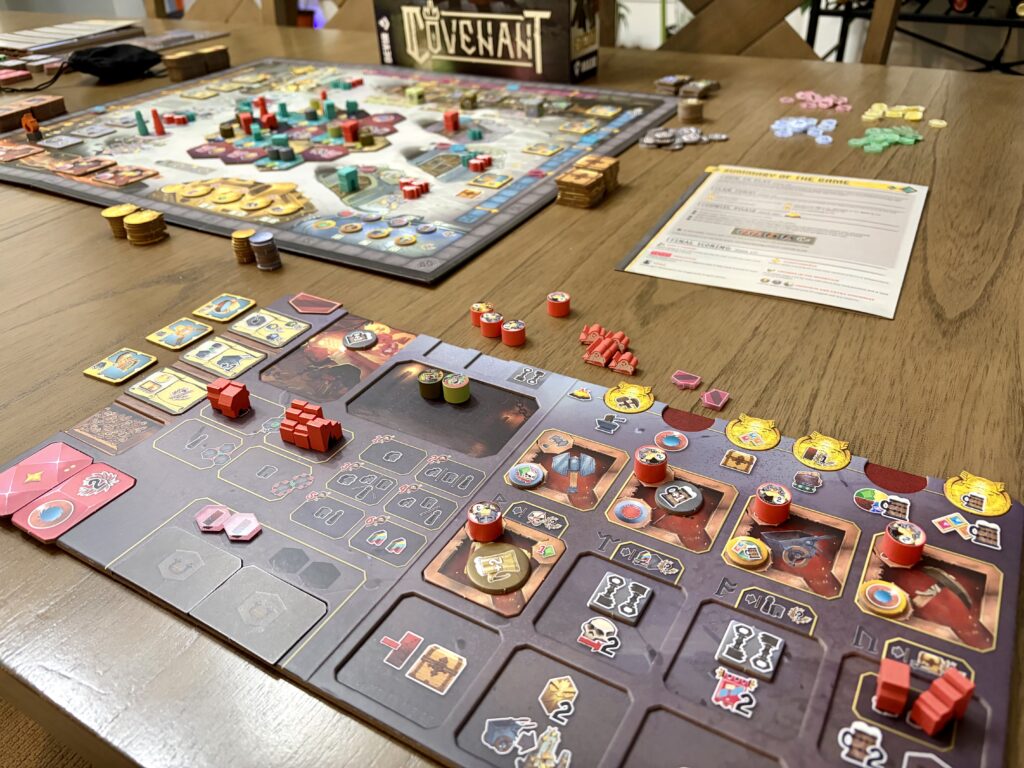
To summarize, Covenant is a bit of mixed bag. The production value is quite high, and if you’re someone that enjoys complex euro games with opportunities for plenty of combos on your turn, then I suspect you’ll enjoy that here. However, be warned that this game can cause a lot of AP, and the project tiles can have a large impact on your strategy. I would be happy to play Covenant if someone wanted to play a two or maybe three player game, but I wouldn’t seek the game out, and I’m not sure that I enjoy the game enough for it to stay in my collection.
With that, I’ll wrap up this week’s review! If you’ve played Covenant, what are your thoughts on the game? And what are your favorite combo heavy games? I’d love to hear your thoughts on any of the games I’ve mentioned or future content suggestions in the comments below. Happy gaming!
If you liked this post and want to be notified when new content is released, then follow me on Instagram @themeepledigest.
Leave a Reply