Welcome to this week’s review! This week I’m taking a look at a new game from a first-time designer. So, without further ado, let’s jump into it.
Disclosure: A review copy of this game was provided to The Meeple Digest in exchange for an honest, unbiased review. This review is not intended to be an endorsement.
Trial of the Forest
- Designer: Giancarlo Spinelli
- Publisher: Rebel Studios
- Complexity: Medium
- Time: 60-120 Minutes
- Players: 2-4
- Main Mechanisms: Worker Movement, Storytelling
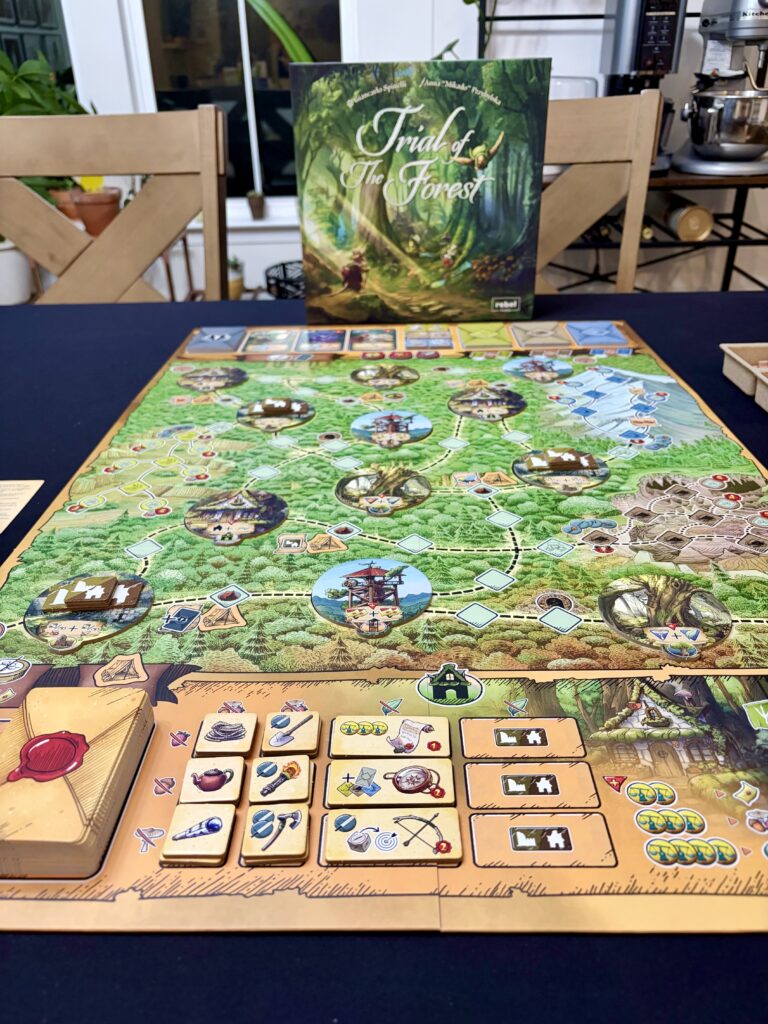
Trial of the Forest is the first game from designer Giancarlo Spinelli. In the game, players take on the role of woodland creatures who embark on a four-day journey through an ancient forest. Throughout the game, players visit locations, fulfill deeds, and embark on expeditions, in order to score the most points and become the Guardian of the Valley.
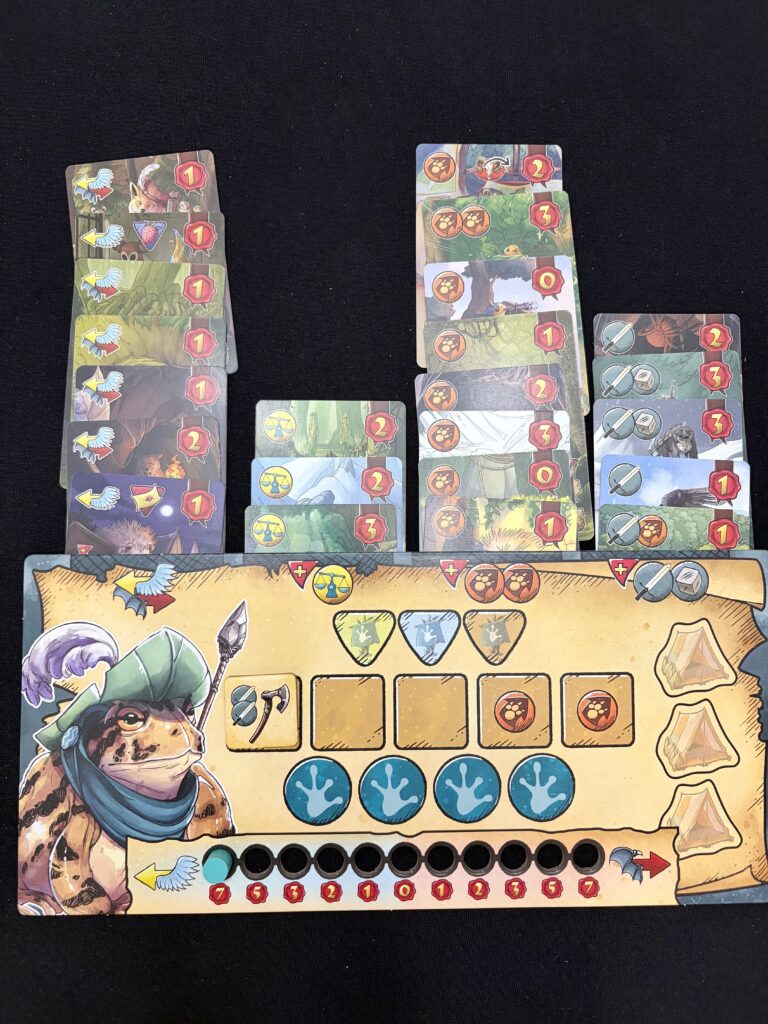
First off, while I was initially skeptical of another woodland creature-themed game, I’m happy to report that the theme is smartly integrated with the game’s mechanics. When you complete a deed card, that card becomes part of your tableau, and each deed card provides different icons that help you throughout the rest of the game. It doesn’t take too much imagination to think of these deeds as small stories throughout the game’s journey. For example, a deed card could require you to spend some resources to help strangers in need, and then for the rest of the game, that deed could provide you with an extra market icon, which helps you when you visit stores. Therefore, in this case, your good deed might represent you gaining reputation with the local merchants.
Another captivating mechanism in the game is how the forest can change throughout the game. There’s an interesting morality system, with some deeds offering either a morally good or bad choice, and sometimes the bad choice can lead to locations being altered. For example, a deed card could involve the player burning down a location, which permanently alters that location for the rest of the game until someone uses a different deed to restore that location. In addition, when players rest at the end of the day, they have to secretly place one of their tents on the map. Whenever another player rests at that same location, they get to reveal that tent and gain any bonus it provides. There’s also dueling other players, and all of these systems provide variable ways to interact with other players.
My favorite part of the game is likely the early rounds. There’s certainly a fairly linear progression in that the early game is focused on gaining resources and items, so that you can fulfill a few deeds and then embark on the three different expeditions. This early planning and discovery add to the overall theme and feeling like you’re preparing for the difficulties that lie ahead.
I’m always a fan of multi-use cards in games, and the deed cards here offer an alternative use beyond fulfilling them to add to your tableau. Each card has additional symbols that provide immediate benefits when discarded during actions. For example, when you visit a grove to gather resources, you can discard up to two deed cards from your hand and gain the associated extra resources on them. This creates an extra layer of decision-making. Should I wait to complete the card as a deed, or spend it now for an immediate benefit?
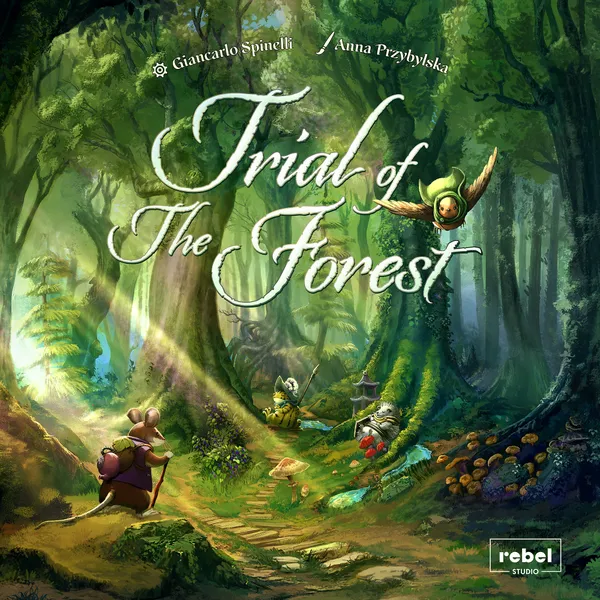
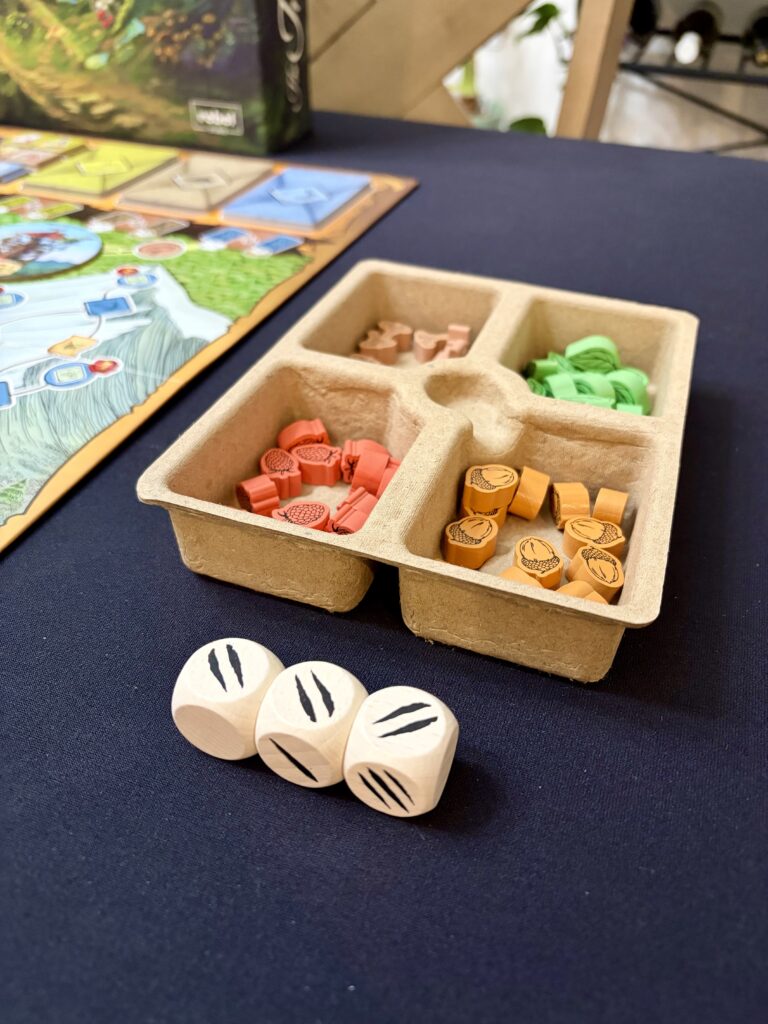
It’s also worth mentioning that the game is one of the best-looking games I’ve played this year. The artwork on the board and cards is quite striking, and the game has quite a strong table presence. While there are not necessarily any elaborate production elements, the resource tokens are screen printed and the cardboard bits are quite chunky. Overall, the production is great, particularly the artwork.
Moving onto a few negatives, first off, while I mentioned I enjoy the early parts of the game, I find that the back third or so of the game tends to drag. Once you’ve filled up your backpack with items, completed a number of deeds, and finished the three expeditions, there’s not much more to accomplish. The game certainly has a fairly defined arc, and it can lead to repeat games feeling fairly similar to one another. I’ll touch more on this in a bit regarding the expeditions, but it feels too easy to accomplish so much; there might have been a better balance if the game was shortened by one round. I personally like it when games leave you feeling like you just didn’t quite complete everything you wanted, which leads to tradeoffs and more replayability.
Next, the expeditions feel both paramount and also too easy once you’ve gathered some items and built up your tableau. There are three different expeditions that you can partake during the game, and while there are a few differences between them, they all involve drawing and resolving cards from their own deck. Often the expedition cards will require you to carry a certain item or you might have to fight a creature to proceed. Most of these cards allow you to gain them to your tableau when you complete them, which not only makes you stronger, but also provides points at the end of the game. This makes it so that completing expeditions is practically necessary in order to win the game, just on the points those cards give you.
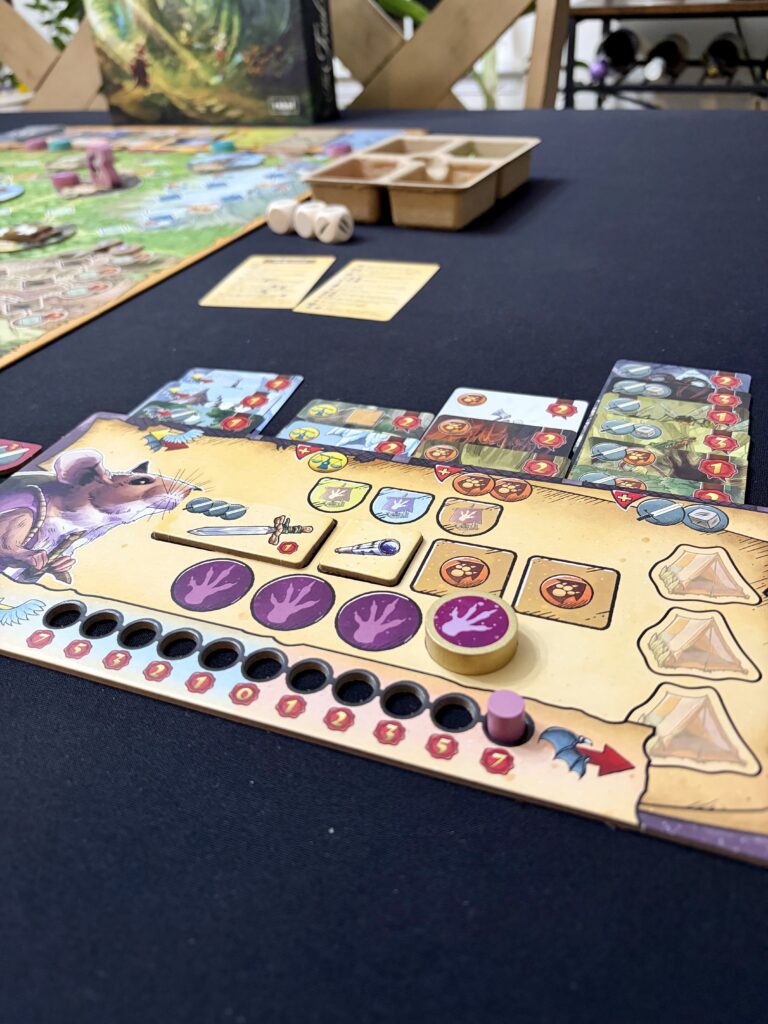
There’s also an element of luck with the expedition cards. Sometimes you’ll draw a card that is either easy to complete, or you have the exact item the card requires. While other times, you could get unlucky and draw a card that requires the exact item you don’t own. Also, since the victory points vary on each card, even if you could complete most of the expedition cards in the deck, you could draw cards that give fewer points than another player. While I think the concept of the expeditions is cool, I think they could have used a bit more refinement and balancing.
I mentioned early how there are some fascinating player interaction elements, like how locations can change as a result of players’ deeds. However, since there is no real player scaling, these types of moments don’t crop up very often when playing with fewer players. I haven’t played the game yet at the full four players, but I can imagine that the player interaction shines through much greater, with the caveat being that you’ll end up with a much longer game. It would have been nice to see some player scaling, either through a bot simulating another player’s actions like changing locations and dropping tents or even just condensing the map when playing at lower player counts.
Lastly, I have a minor complaint with the production. While the rules weren’t too difficult to comprehend, and there are player aids for each player, these player aids omit some key rules like the different action types, the two card limit for discarding deed cards, and how expeditions work. While it’s helpful to have most of the icons explained on the reference aids, it would have been nice to see a few more rules included on them.
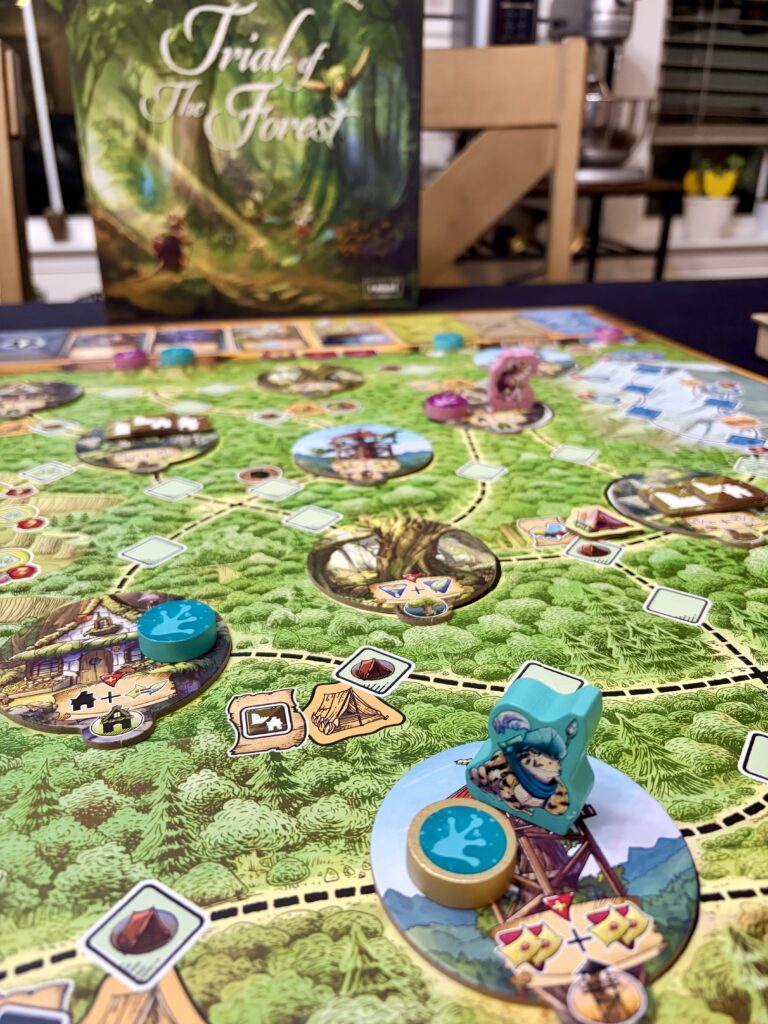
Overall, Trial of the Forest has some really cool ideas, and while the woodland creature theme isn’t the most unique, the theme does come through quite strong with the game’s mechanics. I also love the game’s artwork. A few issues I have are around balancing concerns regarding the expeditions, a general linear feeling I get from repeated plays, and wishing there was player scaling to help the player interaction shine through at lower player counts. Also, while there’s no solo mode included, I think this game could work quite well as a solo game. I’m on the fence to whether Trial of the Forest will be staying in the collection, but if you’re someone that enjoys euro games with a bit more theme, I’d definitely recommend giving this one a look.
With that, I’ll wrap up this week’s review! If you’ve played Trial of the Forest, what are your thoughts on the game? And what are your favorite narrative euro games? Happy gaming!
If you liked this post and want to be notified when new content is released, then follow me on Instagram @themeepledigest.
Leave a Reply