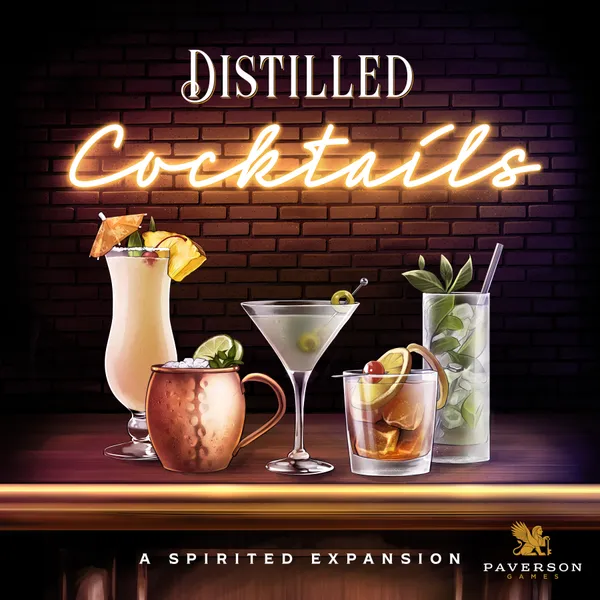
Welcome to this week’s review! This week I’m taking a look at the newest, big-box expansion for Distilled. If you missed my previous review of the other two expansions for the game, Africa & Middle East and Cask Strength, you can check it out here. So, without further ado, let’s jump into it.
Disclosure: A review copy of this game was provided to The Meeple Digest in exchange for an honest, unbiased review. This review is not intended to be an endorsement.
Distilled: Cocktails
- Designers: Dave Beck, Richard Woods
- Publisher: Paverson Games
- Complexity: Medium
- Time: 45-150 Minutes
- Players: 1-5
- Main Mechanisms: Hand/Card Management
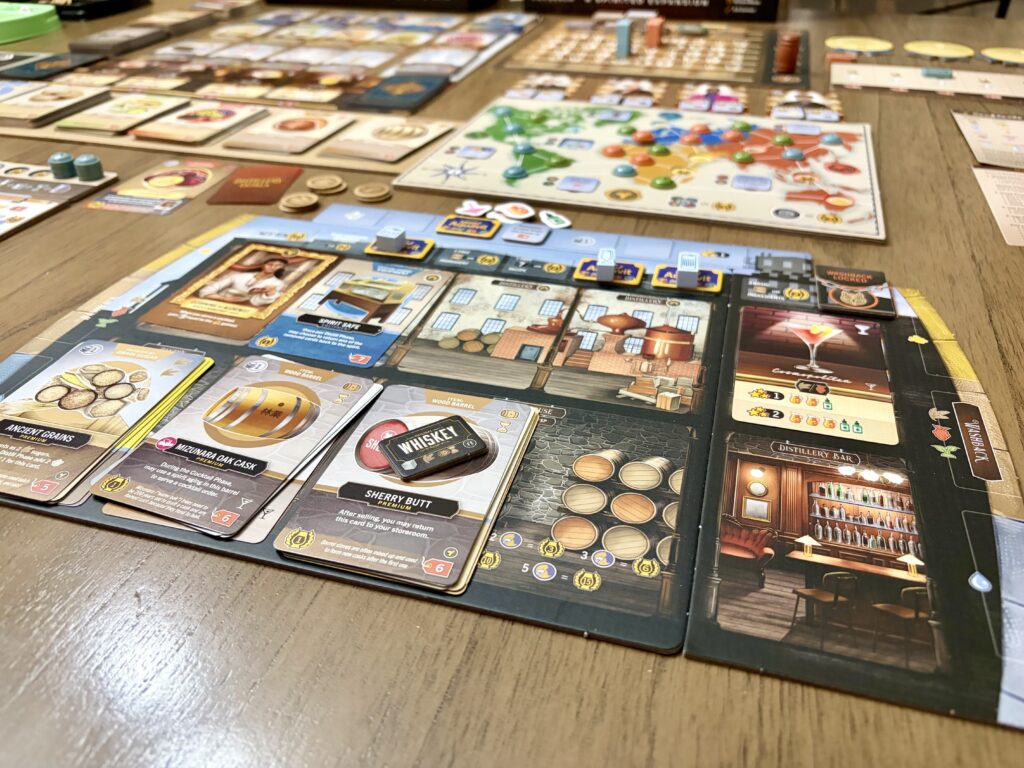
Distilled: Cocktails is the latest expansion for Distilled which is a game about running your own distillery. With Cocktails, your distillery continues to expand by adding a second washback, enabling you to produce more spirits. In addition, you get to open your own cocktail bar, allowing you to add mixers to your in-house crafted spirits to serve to patrons.
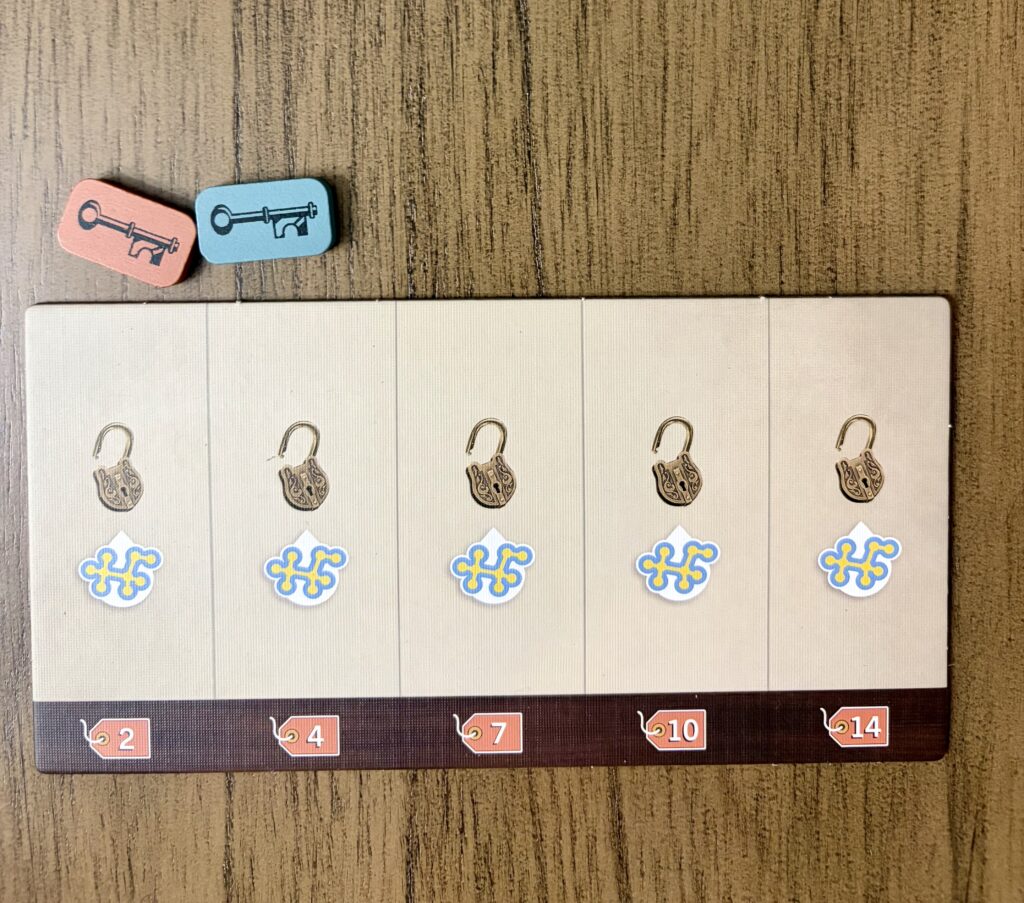
My favorite new addition in Cocktails is the addition of a second washback. During the market phase, you can choose to spend money to unlock your second washback, which allows you to distill a second spirit in the same round. Once you’ve used your second washback, it becomes locked again, and you have to spend increasing amounts of money to unlock it again.
While adding a second washback is relatively straightforward, I’ve found that being able to produce more spirits opens up a plethora of new strategies. One of my issues with the base game is that games often played out in a fairly similar, linear manner. In the first couple of rounds, you might produce low-quality spirits that you can immediately sell. And as the game progresses, you’d transition to producing more aged, higher-quality spirits.
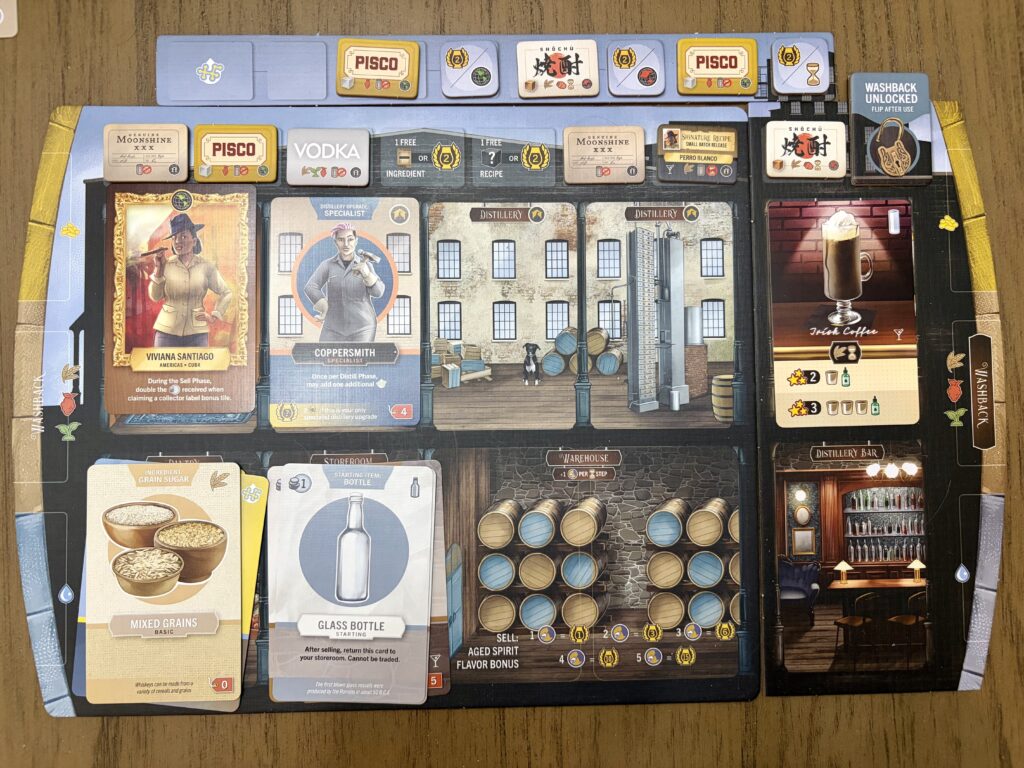
Now with the second washback, it’s much easier to diversify from that strategy. You can now focus on producing a lot of lower quality spirits for an influx of cash. In addition, previously it was very challenging to produce aged spirits early because you would be forced to forgo selling in the same round. Now, you can produce both an aged and non-aged spirit in the same round meaning it’s much more viable to produce an aged spirit early and let it age for most of the game.
In addition, the second washback also provides another avenue of luck mitigation. One of my complaints with the base game is that while the process of removing the top and bottom cards from your spirit stack is thematic and interesting, it does introduce luck which can be quite punishing. While the core mechanism hasn’t changed, being able to distill more than seven spirits each game does help counteract that luck element, as one bad draw isn’t quite as punishing.
While I haven’t played enough games to form a definitive opinion, it feels like the second washback is fairly balanced because the cost to unlock it increases each time you use it. You’ll likely want to use your second washback at least a couple times, but I suspect unlocking it every round would be quite challenging since money is still really tight. In addition, one nice feature with the second washback mechanism is that you can use it in games of Distilled without needing to include the cocktail elements from this expansion. I enjoy the second washback so much that I’ll likely opt to include it every game going forward, even when teaching to new players.
Moving onto the cocktail cards, these new cards that can be purchased during the market phase. These cards specify the type of spirit required, as well as whether it must be an aged spirit. Once purchased, they are slotted into your cocktail bar until you fulfill the requirements. In addition to the spirit, each cocktail requires certain types of mixers which must be added to the spirit. Each spirit label you’ve claimed can be used once to make a cocktail, although you’re limited to only making one cocktail each round.
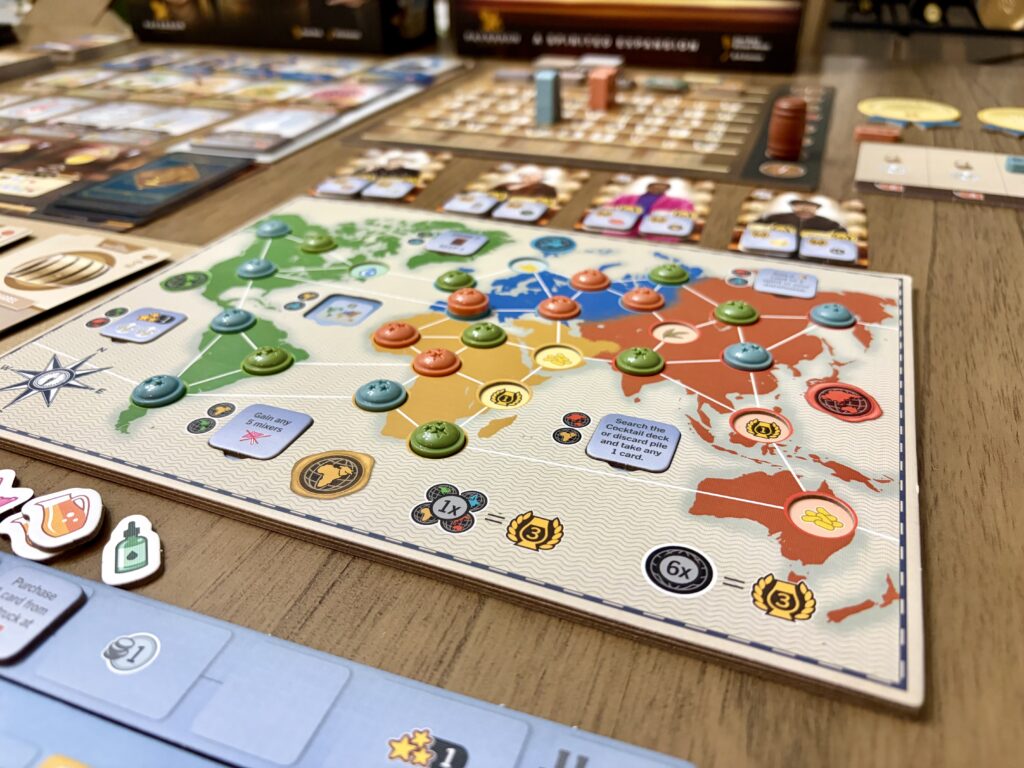
These cocktails act as a pseudo contract, and once you complete one, you’re rewarded with renown points that are used to place markers on a world map board. When you place one of your markers, you’ll receive a minor reward, such as a coin or a certain type of ingredient. In addition, your renown tokens will score points at the end of the game based on the amount and location.
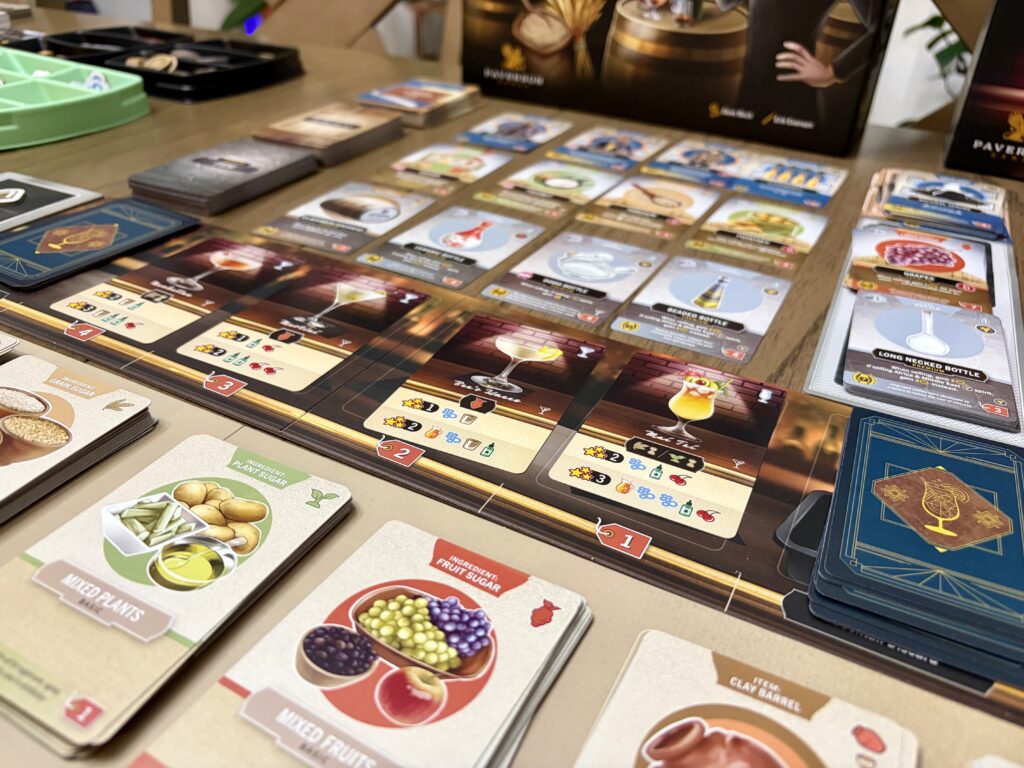
While I enjoyed making the cocktails themselves because they added another layer of decision-making, as you’ll want to pair cocktails with the types of spirits you make, the act of placing tokens on a map was a bit less exciting. Also, while it’s fun to see a lot of different types of cocktails included in the game, the only difference between them is the type of spirit, mixers, the amount of renown they reward, and the type of glass they’re served in (which is another end-game scoring opportunity).
Another new addition with this expansion is the introduction of collector cards. These are added during setup, and when you sell a spirit, you can choose to sell it to one of these collectors, provided you satisfy their requirements. For example, a collector might want a bronze level spirit, worth a minimum number of victory points. If you satisfy their requirements, you receive a few extra coins, and you will also collect a tile that provides end-game scoring, such as providing a certain number of victory points for each type of spirit label you’ve collected at the end of the game. While the collectors don’t drastically shake up the game, they do act as another milestone to aim for.
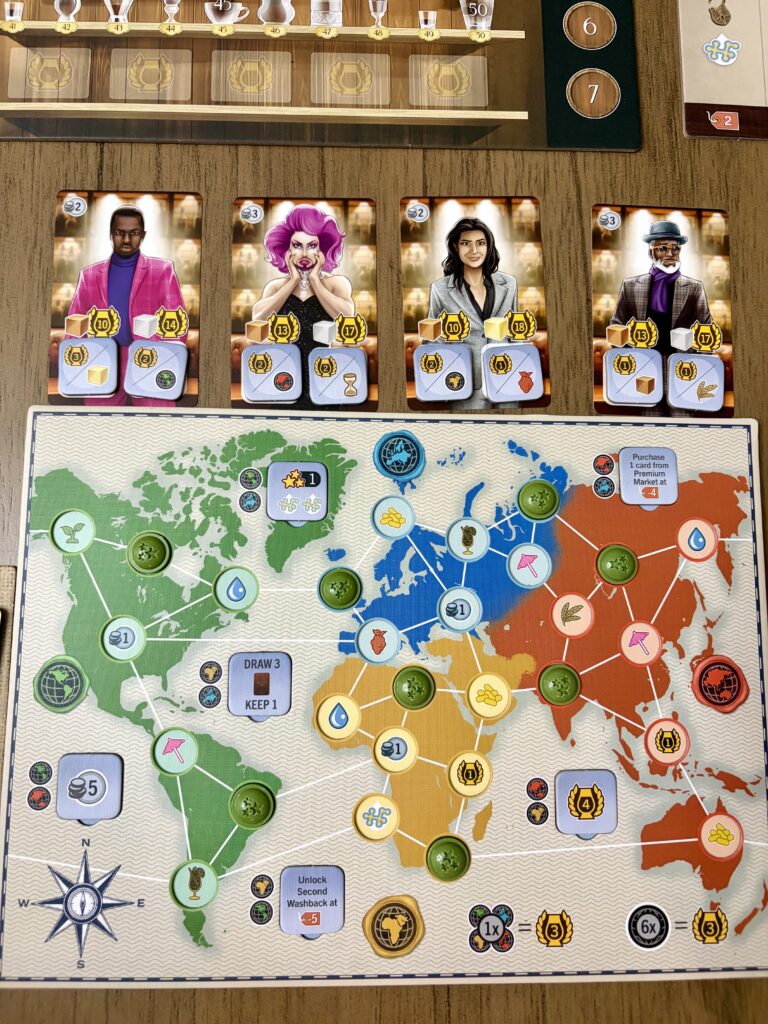
Like the base version of Distilled, Cocktails is also excellently produced. The world map where you place your renown tokens is dual-layered; there are custom dice with the different mixers on them; and there’s a token organizer to hold mixer and glass tokens.
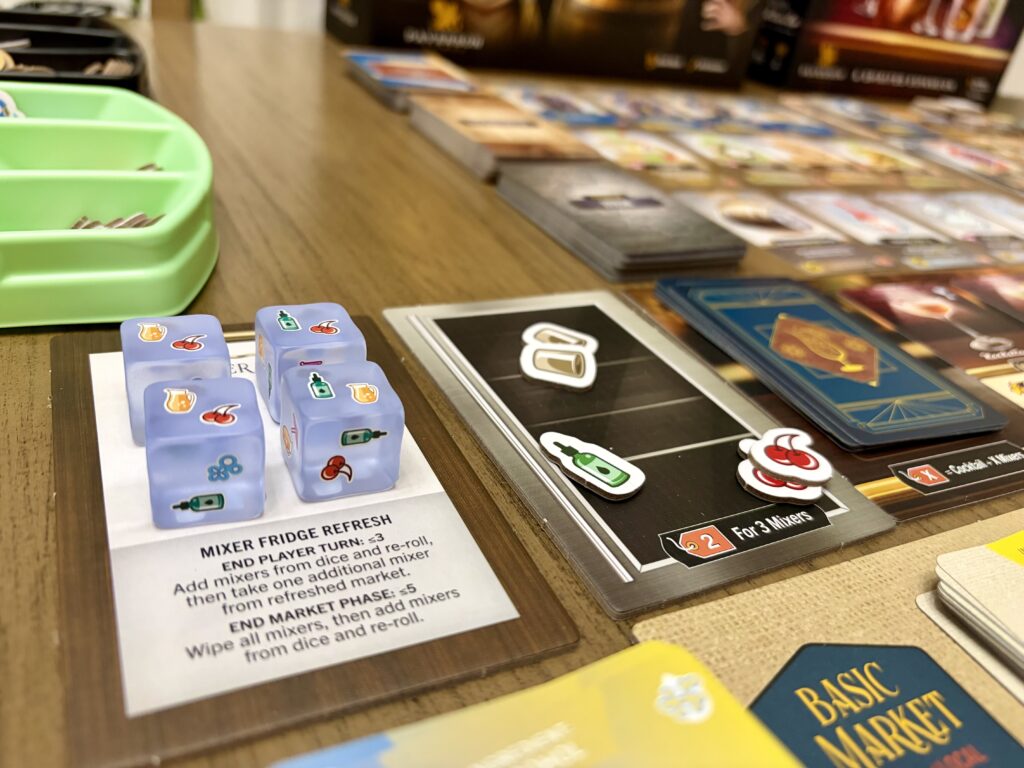
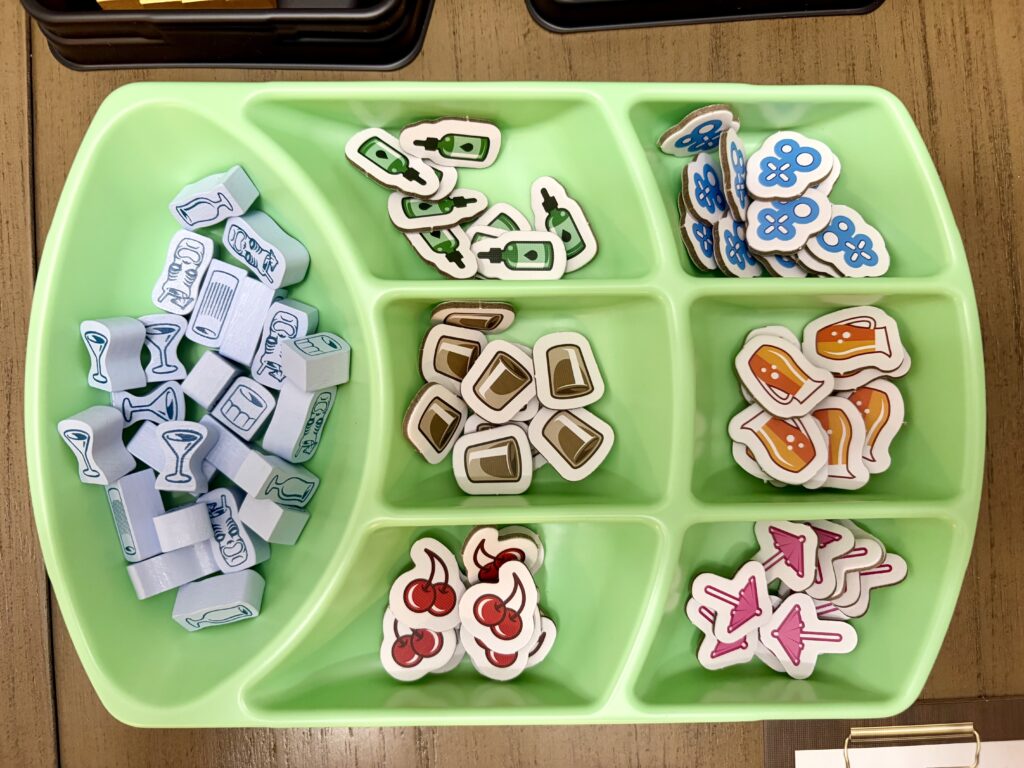
Moving onto a few caveats – to start, when playing with this expansion, Distilled becomes even more of a table hog. In addition to second washback for each player, you now also have to fit the display of cocktail and collector cards, as well as the world map board. Even with just two players, my oversized table was quite full, and I can’t imagine the table you’d need in order to play with five players.
Next, since each player can now distill up to two spirits each round, as well as the inclusion of the cocktail phase, playing with this expansion does add to the game’s length. You’ll also need to factor in the greater setup and teardown time with all of new additions. While I didn’t find the game to drag with two players, I’d be hesitant to play it with four or five. Finally, while minor, this expansion doesn’t fit in the base game box, unlike the Africa & Middle East and Cask Strength expansions.
Overall, while a bit unexpected, my favorite part of this expansion is the second washback. While the cocktails are quite thematic, the rest of the expansion I could take or leave. They do add a bit more decision space, but additions like placing tokens on a world map wasn’t as interesting. I do like that you can choose how much you want to engage with the mechanisms in the expansion, as money is still tight, and you’ll have to make tradeoffs on which elements to pursue. Do you purchase that cocktail card or that premium bottle? If I were to compare Cocktails with the other two expansions, I would still likely recommend Cask Strength first as it’s small, but adds a lot of depth to the game. Then between Africa & Middle East and Cocktails, it will likely come down to whether you want more variety versus new mechanisms.
With that, I’ll wrap up this week’s review! If you’ve played Distilled or any of the expansions, I’d love to hear your thoughts on the game. And what are your favorite cocktails to make? Happy gaming!
If you liked this post and want to be notified when new content is released, then follow me on Instagram @themeepledigest.
Leave a Reply