
Welcome to this week’s review! This week I’m taking a look at an expansion for the game I reviewed last week. So, without further ado, let’s jump into it.
Disclosure: A review copy of this game was provided to The Meeple Digest in exchange for an honest, unbiased review. This review is not intended to be an endorsement.
Dune: Imperium – Bloodlines
- Designers: Paul Dennen, Phil Amylon, Andy Clautice, Caleb Vance
- Publisher: Dire Wolf
- Complexity: Medium
- Time: 60-120 Minutes
- Players: 1-6
- Main Mechanisms: Worker Placement, Deck Building
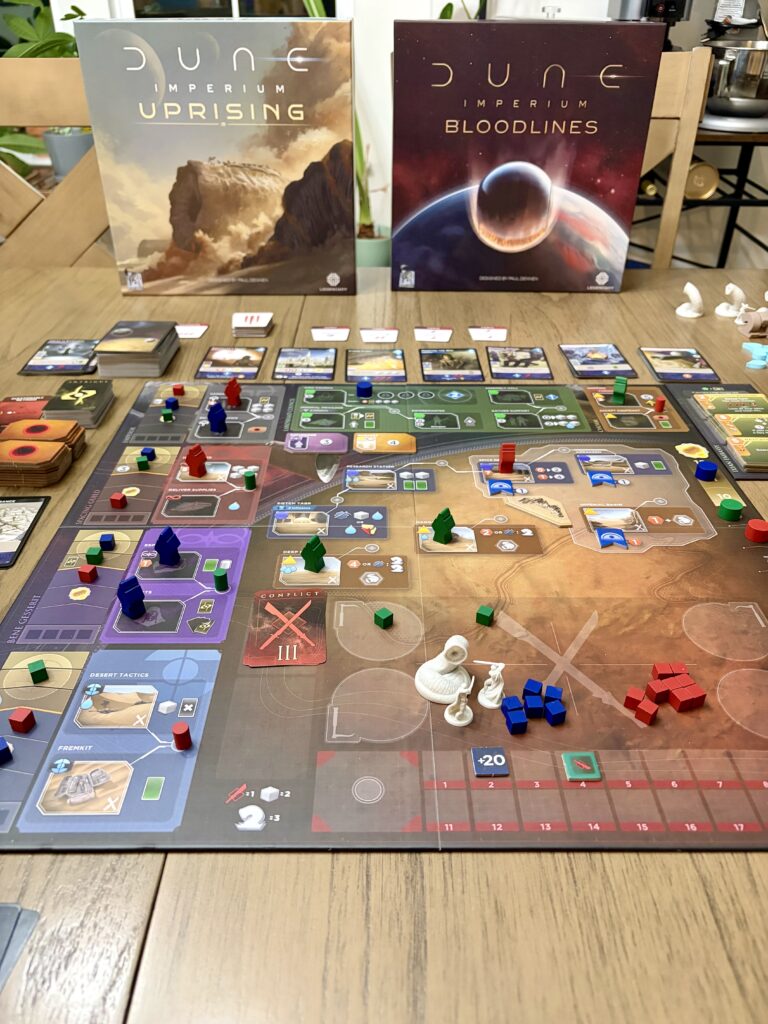
While Dune: Imperium – Bloodlines can be integrated with either the first Dune: Imperium or Uprising, this expansion was designed with Uprising in mind. Uprising adds additional Imperium, intrigue, conflict, and leader cards, but the primary new additions are Sardaukar Commanders and tech tiles.
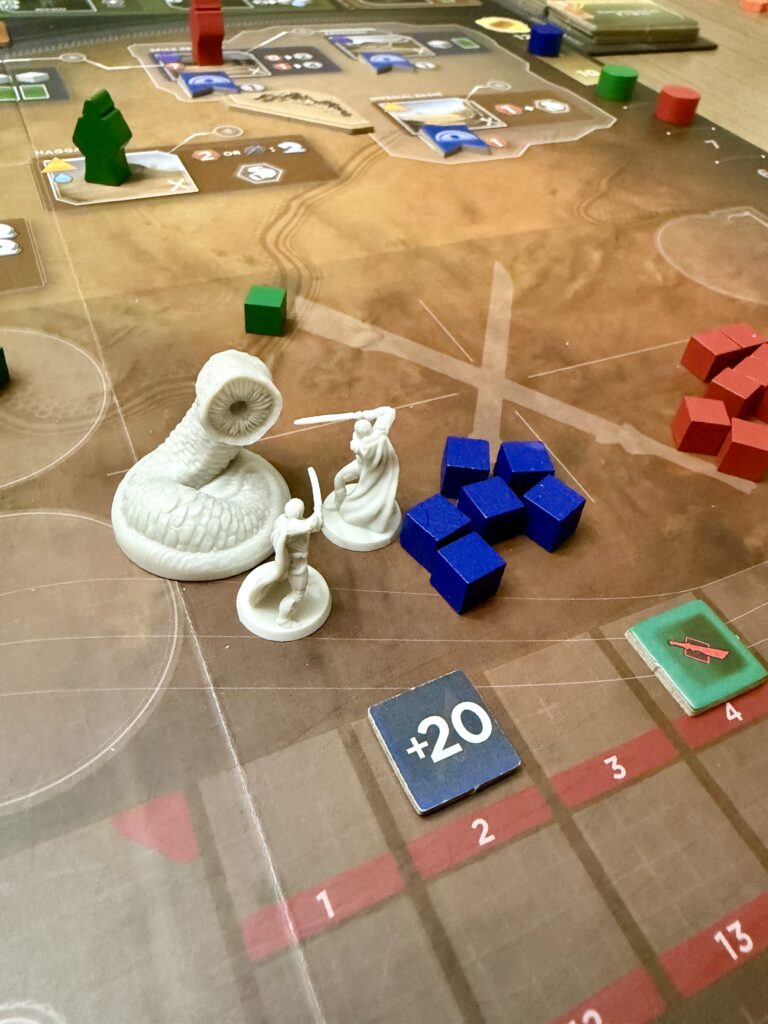
During setup, Sardaukar Commanders are placed on a number of different locations on the board. When a player visits a location with a Sardaukar Commander, they have the option of spending two Solari to recruit one. These Sardaukar act as an additional unit worth two strength, which can be deployed to a conflict like any other troop. In addition, each time a player acquires a Sardaukar Commander, they get to claim a Sardaukar Commander Skill. Whenever a player has at least one Sardaukar Commander in a conflict, they get to activate all of their Sardaukar Commander skills. There are a number of different types of effects, but some of them provide additional troops or combat strength. After a conflict is resolved, all Sardaukar Commandars deployed return to the player’s supply, and the player has the option of recruiting them in the future by paying two Solari again.
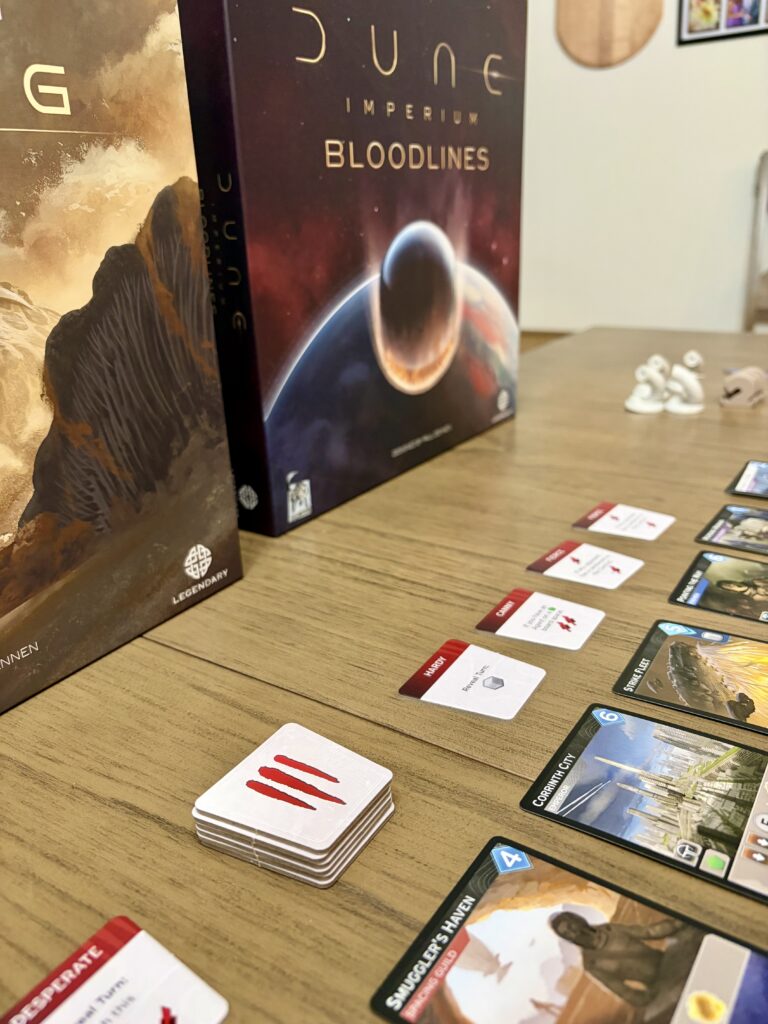
Overall, I really enjoyed the new Sardaukar Commander mechanism. Since there are a limited number of Commanders available, it creates a race to be able to claim them before other players, and I found myself debating whether to prioritize these Commanders, a council seat, or my third swordmaster early on as Solari is limited. I also liked that Commanders still had the same amount of strength as normal units, making their power derived from their skills rather than from a high base amount of strength. This allowed more flexibility to tailor the benefits they provided to my overall strategy in the game. It can be especially powerful if one player is able to recruit a majority of them, as only one Commander is needed in a conflict in order to activate all of the player’s skills. I can imagine some interesting strategies focused around racing to claim as many Sardaukar Commanders as early as possible.
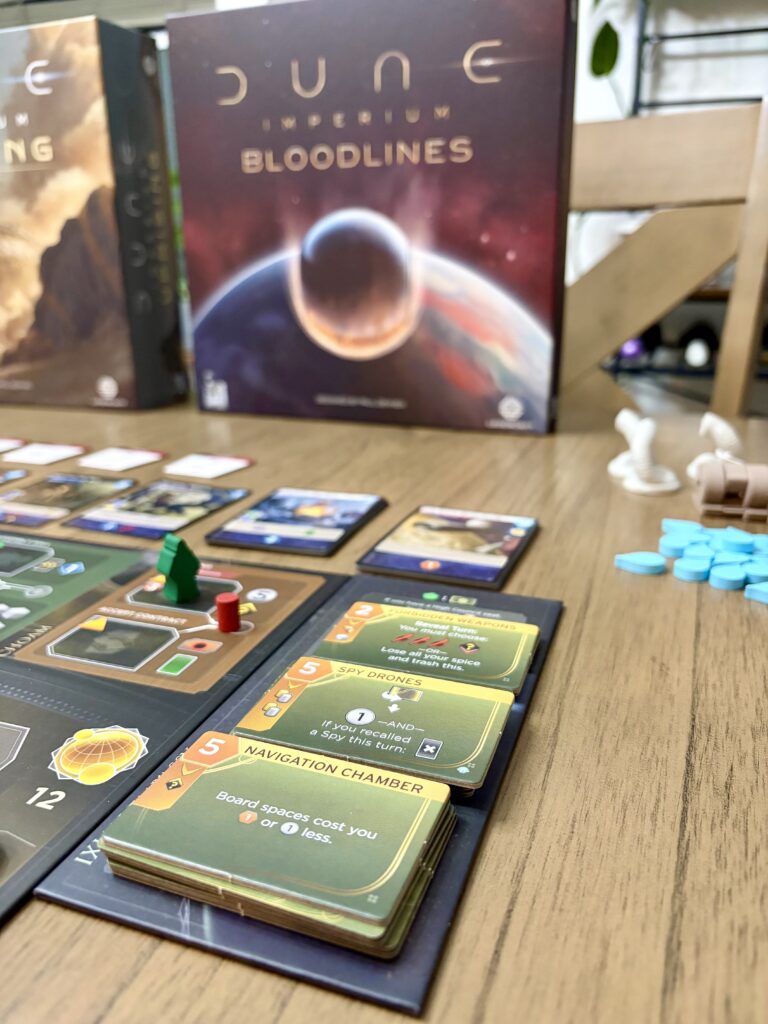
The next big addition is the reintroduction of tech tiles. Tech tiles were initially introduced as part of the Rise of Ix expansion, and in Bloodlines, they operate similarly. However, instead of dedicated locations for acquiring tech tiles, whenever a player visits a green pentagon board space, they have the option of spending spice to acquire these tiles. As with Ix, I enjoyed the tech tiles, and as like Sardaukar Commander skills, the tech tiles added some additional variety and open up other strategies, as well as providing another option for spending spice. I also liked the change from Ix in making them part of the base board spaces, as it gives players more incentive to visit them outside of just claiming a council seat or swordmaster. Having a council seat also permanently reduces the cost of claiming tech tiles by one spice, making a council seat strong for players focusing on tech tiles.
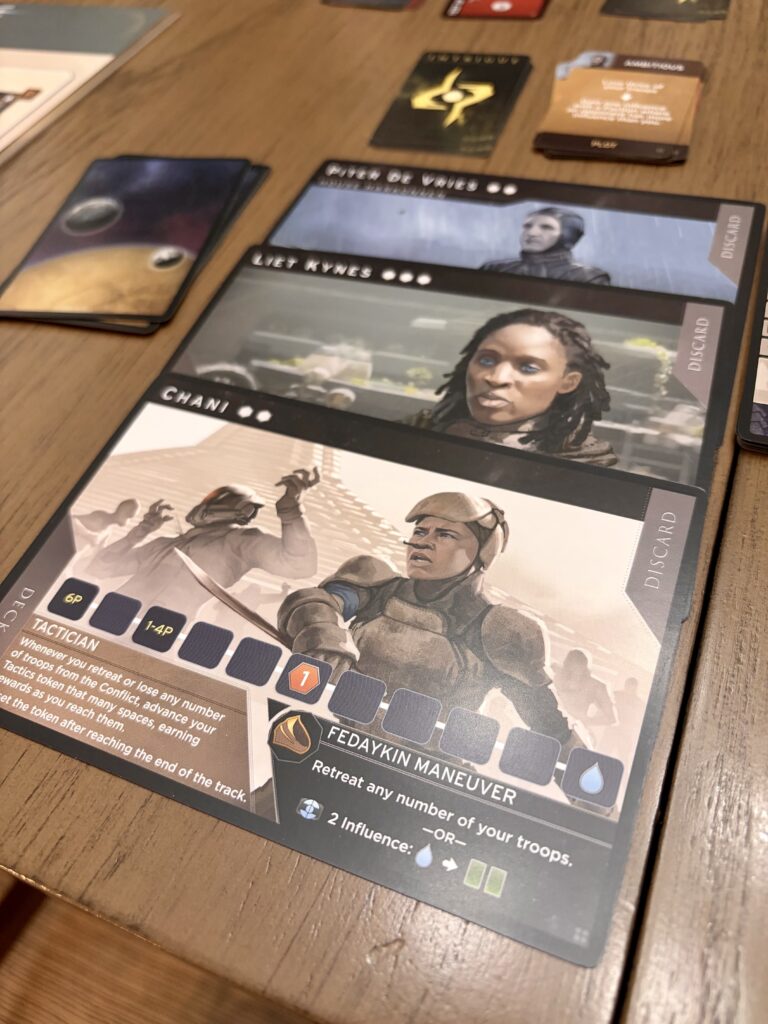
Bloodlines also adds nine new leaders, which add some nice variety to the game. While there are still some relatively less complex ones for newer players, the expansion adds some really unique ones as well. For example, Piter De Vries has their own set of intrigue cards, which they draw from at the beginning of each round. I haven’t tried all of the new leaders, but considering there are now a total of 18 leaders just between Uprising and Bloodlines, there is a lot of variety here.
Like how I compared Uprising to the original Dune: Imperium, Bloodlines feels like an updated version of the Rise of Ix expansion. The reintroduction of tech tiles is the obvious similarity, but even the Sardaukar Commanders feel like an updated version of the dreadnaughts. The main complaint I’ve heard with the dreadnaughts was that they felt overpowered, and while players need to be wary of allowing one player to claim a majority of the Sardaukar Commanders, they feel more balanced from a combat perspective, while also adding a new layer of strategy with the skills.
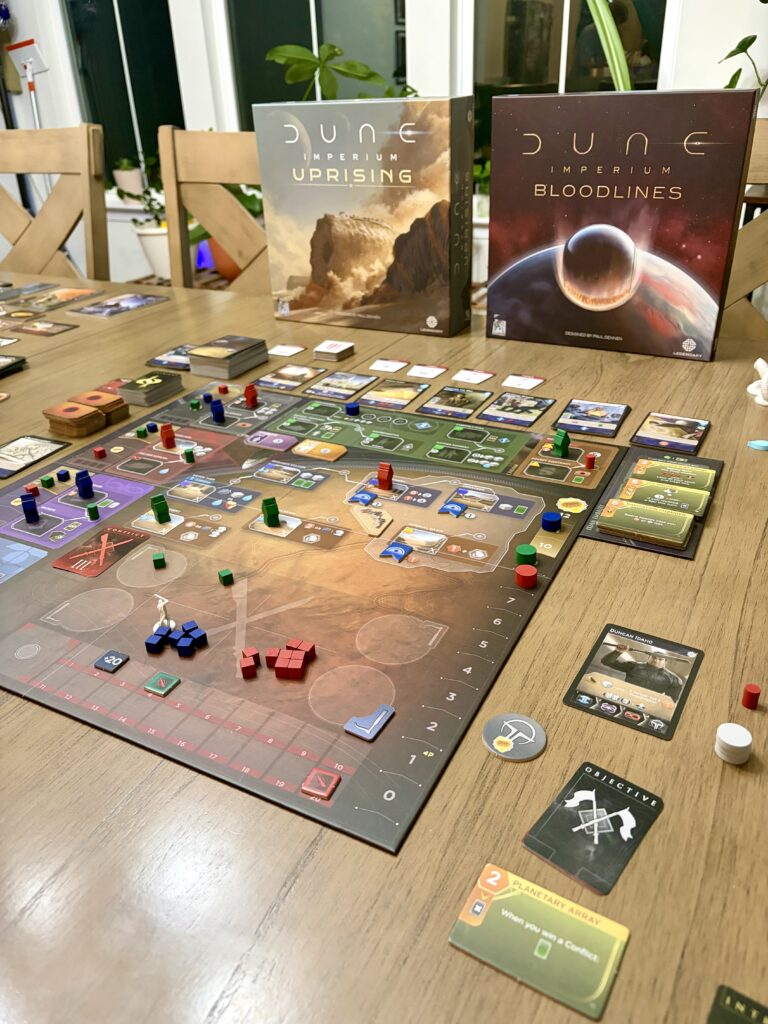
Overall, I am really enjoying the Bloodlines expansion. While I wouldn’t consider it essential, I’ll likely opt to always play with it when using Uprising, as it adds more variety and different strategy options to the game. I mentioned in my review of Uprising, that I would likely still prefer the original Dune: Imperium + Ix to base Uprising, but with Bloodlines, I think I’ll be leaning towards Uprising + Bloodlines more often. While in some aspects Bloodlines feels like an updated version of Ix, I’d definitely recommend it to fans of Uprising, particularly if you don’t already own Ix. In other news, I’m looking forward to both Dune: Part Three later this year, along with the upcoming Dune: Imperium – Conspiracy expansion. And while I wouldn’t say I’m itching for another standalone Dune: Imperium game, I wouldn’t be surprised if there is another Dune game on the horizon focused around the third film.
With that, I’ll wrap up this week’s review! If you’ve played Bloodlines, what are your thoughts on the expansion, and are you looking forward to the upcoming Conspiracy expansion? Happy gaming!
If you liked this post and want to be notified when new content is released, then follow me on Instagram @themeepledigest.
Leave a Reply