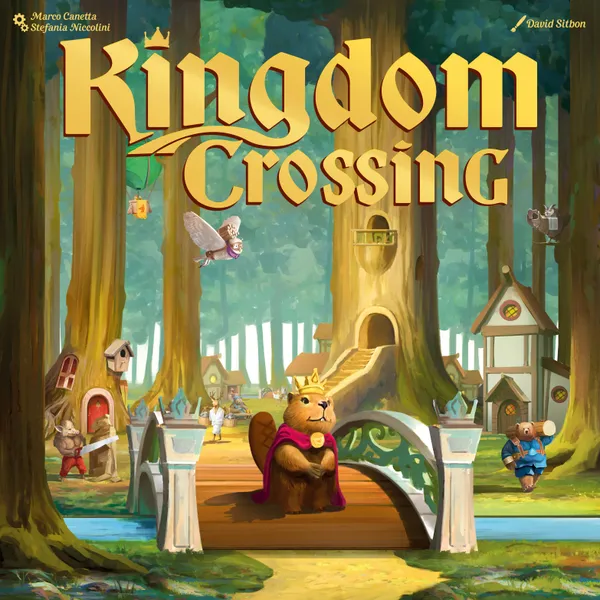
Welcome to this week’s review! This time I’m taking a look at a game inspired by a historical mathematical problem. So, without further ado, let’s jump into it.
Disclosure: A review copy of this game was provided to The Meeple Digest in exchange for an honest, unbiased review. This review is not intended to be an endorsement.
Kingdom Crossing
- Designers: Marco Canetta, Stefania Niccolini
- Publisher: Pandasaurus Games, Sorry We Are French
- Complexity: Medium
- Time: 45-90 Minutes
- Players: 1-4
- Main Mechanisms: Area Movement, Set Collection
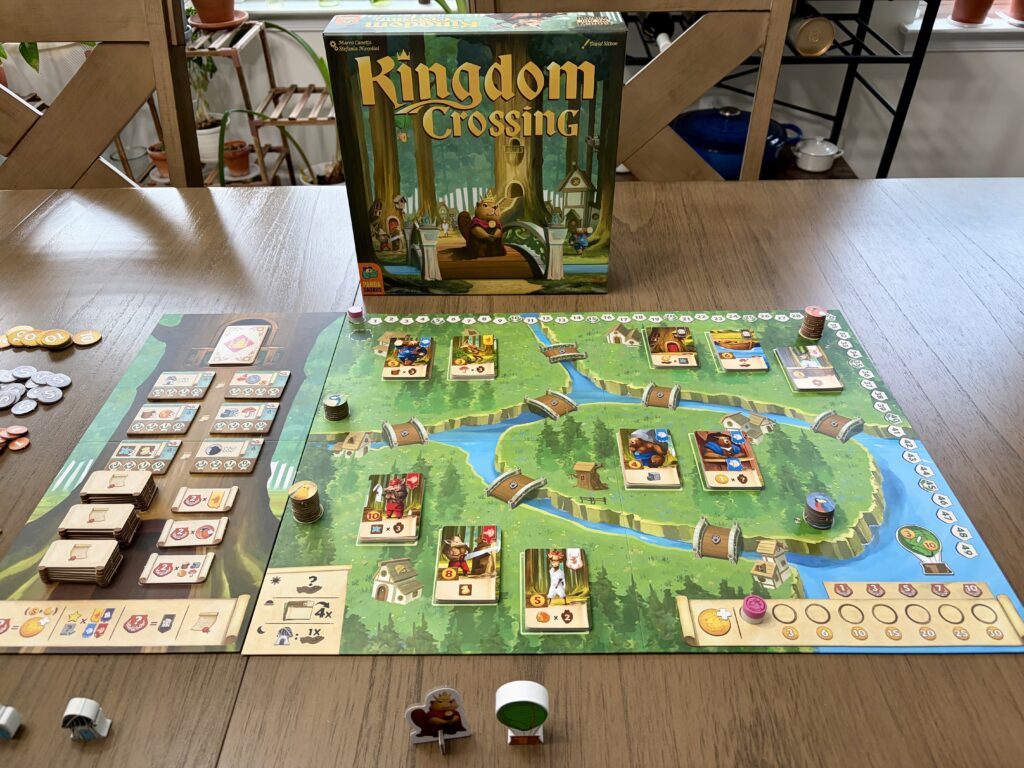
Kingdom Crossing is based around the “Seven Bridges of Königsberg”. If you’re unfamiliar with the math problem, there’s a city that is separated into four districts connected by seven bridges. The goal is to devise a path through the city that crosses all seven bridges without crossing over the same bridge twice. Spoiler alert: there is no mathematical solution using only seven bridges, and the problem can only be solved by adding an eighth bridge.
That is the hook for Kingdom Crossing, and in the game, players are competing for the honor of building the eighth bridge. The game takes place over four rounds, and in each round, players perform four actions. On a player’s turn, they select one of their six action tiles, with all but one allowing the player to cross between one to three bridges that turn. As stated in the math problem earlier, players cannot cross over the same bridge twice in a round. In whichever region the player ends up, they must purchase a card from one of the two to three available spots in that section. These cards provide either immediate or ongoing effects, with most of the cards corresponding to one of five different suits of cards. There are four resource tracks corresponding to four of the five suits, and there is a multiplier for having a lot of the same suit and advancing on the associated track.
There’s a bit more to the game, but the core gameplay loop is relatively streamlined, and once I had played a few rounds, I rarely had to check the rules except for the occasional icon clarification. Kingdom Crossing is by no means a light game; I’d compare it to something like Everdell in terms of complexity, but the challenge comes from choices the game presents, rather than from the rules themselves.
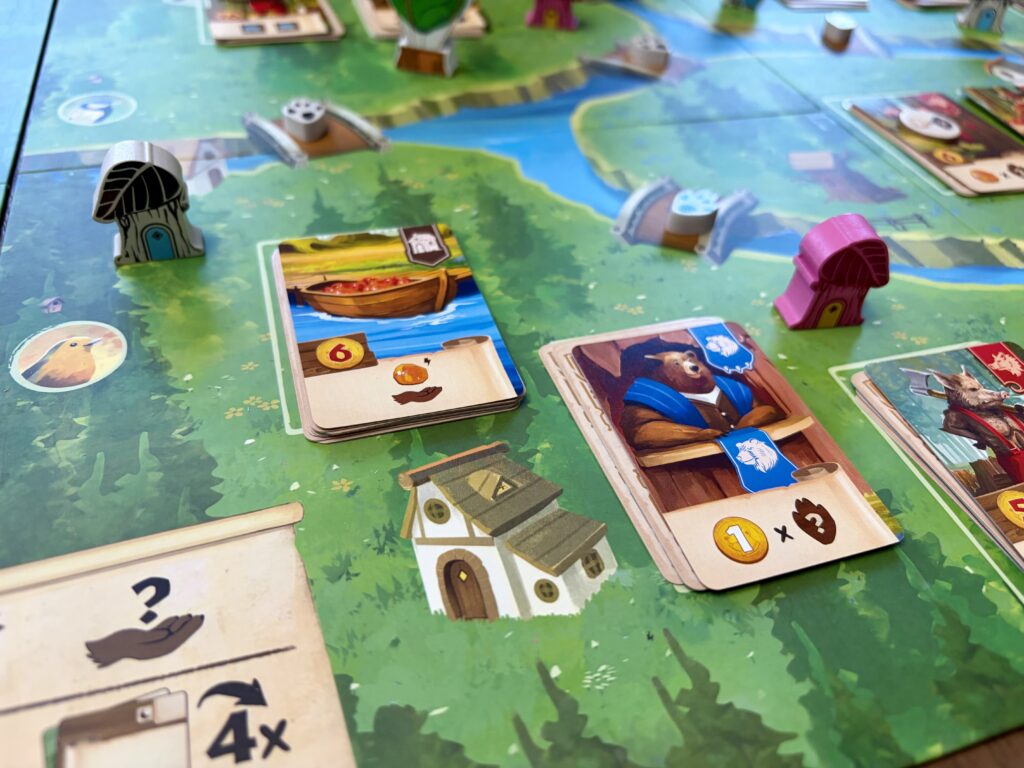
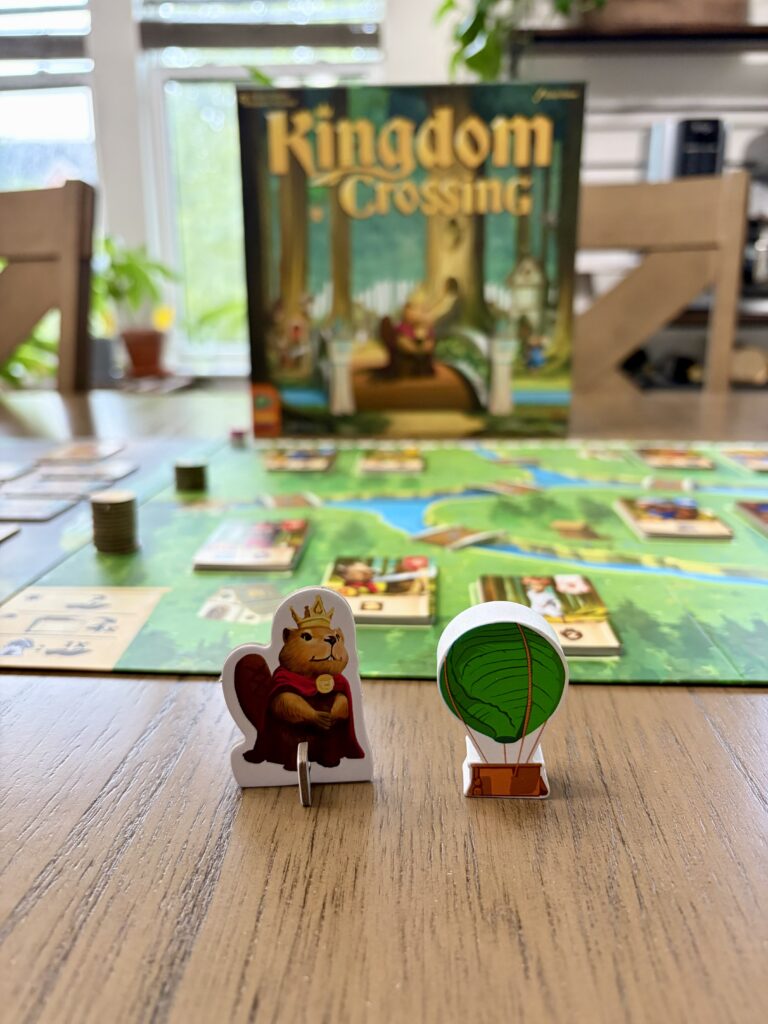
I’d be remiss if I didn’t mention the game’s excellent production quality. The cutesy animal theme could easily be replaced by something else, but the artwork makes the game pop on the table, and the screen-printed player pieces add a nice touch. And while some individual player aids might have been appreciated, there is a nice summary on the back of the rulebook, and the boards do provide clear iconography that job your memory. There’s also an appendix in the back of the rulebook that clearly explains each card, icon, and tile.
The game doesn’t provide much player interaction (more on this in a bit), but I did enjoy the game’s solo mode. The AI opponent is relatively easy to pilot, and it helps to cycle cards, so that the board doesn’t become stagnant. In the handful of games I played, I did find the AI’s scores did vary fairly significantly even on the same difficulty level. I think this is partly due to luck in how often the AI’s rest tiles come out, which effectively skips part of their turn. The rules weren’t entirely clear, but I shuffled the solo tiles at the beginning of each round, and since not all of the solo tiles are played each round, there is some luck as to how often the rest tiles appear.
There are four resource tracks, but the only tangible resource in the game is money, which is used to purchase cards each turn. I found that money in the game is extremely tight. On a player’s turn, instead of crossing bridges and purchasing a card, they can choose to rest and collect money, but all things being equal, it is almost always better to purchase a card instead of having to take a rest turn. Some of the cards do provide a small injection of money, and I found that I heavily prioritized those cards when money got tight.
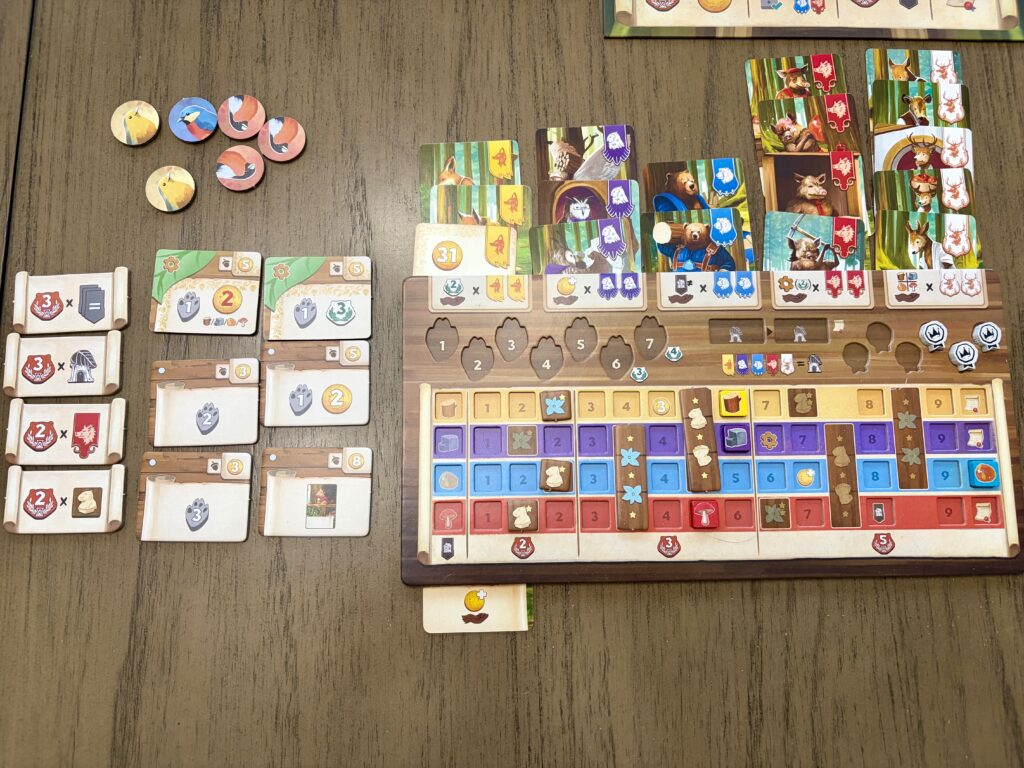
This leads into my next slight con for the game, there is an element of luck depending on which cards come out. You could end up in a situation where all of the cards on the board are quite expensive to buy and/or the icons/suit doesn’t align with your strategy. It would have been nice to see the cards cycle a bit more frequently, particularly when playing the game at two players. Though I imagine you could add a house-rule that refreshes all or some of the decks at the beginning of each round.
I hinted at the lack of player interaction earlier – the only real interaction in the game comes from someone taking a card you wanted or claiming a public objective first. Since the game can be prone to analysis paralysis (more on this shortly), I think the game is best suited at lower player counts or even solo.
Speaking of analysis paralysis, I imagine players’ enjoyment of the game will come down to how well they resonate with the seven bridges problem. The game heavily incentivizes players to cross all seven bridges in a round, since players earn three points if they cross at least six bridges and another four points if they cross all seven. Since there is no solution to the seven bridges problem, the only method of successfully crossing all seven bridges is to hire the hot air balloon token in the game, which again costs money. The balloon allows players to move regions before or after taking their bridge movement, which allows them to successfully cross all seven bridges in a round. While I enjoyed solving this problem the first few times, my enjoyment did start to wane after more plays. I like solving problems, but once I solve something, I generally want to move onto something else. That’s sort of how I feel about Kingdom Crossing. I enjoyed my first few plays, but it’s not a game I’m itching to return to.
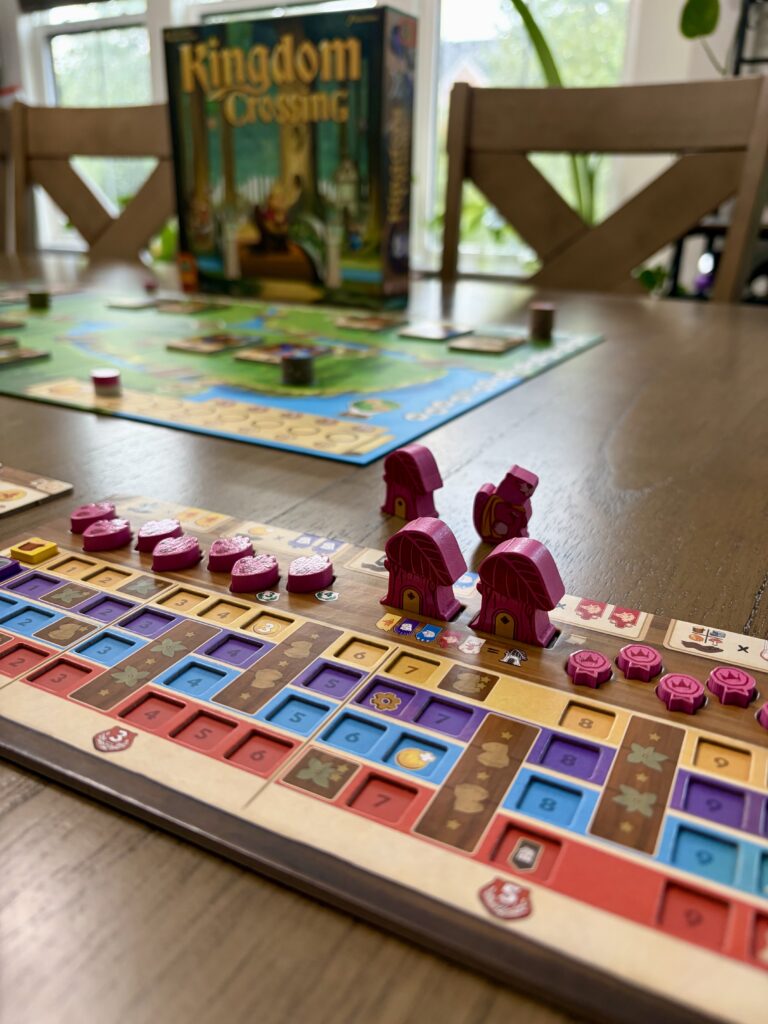
I generally prefer tactical games, and the main reason that I don’t enjoy Terra Mystica is that I feel like I have to plan my entire strategy at the beginning of the game. In Kingdom Crossing, since crossing all seven bridges each round is heavily rewarded, I feel like I have to plan my entire round out. This creates a fair amount of analysis paralysis, and it can feel deflating when another player accidently takes a card you needed or moves the balloon unexpectedly, causing your entire strategy to unravel. At higher player counts, this problem is intensified, which leads to having to recalculate strategies between turns causing more analysis paralysis.
Once you get past the bridge problem, the rest of the game is a fairly standard euro game affair of advancing up tracks, fulfilling objectives, and collecting cards. And once the novelty of the bridge problem starts to wane, there aren’t enough other mechanisms in the game that pull me back in.
I know it may sound like I’m being a bit harsh, but let me be clear, I did enjoy my time with Kingdom Crossing. The introduction of the bridge problem feels very unique, and if you’re someone that enjoys these types of mathematical problems, I think you’ll enjoy this game. While the game isn’t very thematic, the overall production quality is quite solid for the price point. Personally, once I solved the bridge problem a few times, I wasn’t itching to jump back in. I’d be happy to play the game if someone else brought it out, but it’s not a game that will be sticking in the collection.
With that, I’ll wrap up this week’s review! If you’ve played Kingdom Crossing, I’d love to hear your thoughts on the game. And if you haven’t, do you plan on checking it out? Happy gaming!
If you liked this post and want to be notified when new content is released, then follow me on Instagram @themeepledigest.