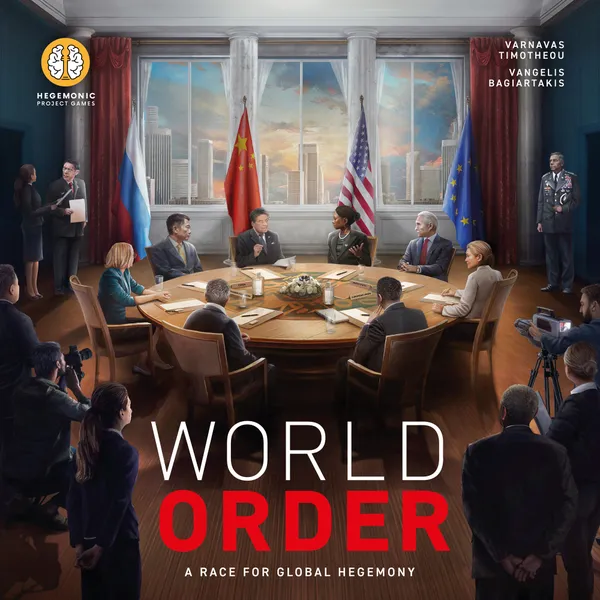
Welcome to this week’s review! This time I’m taking a look at one of my most anticipated games. So, without further ado, let’s jump into it.
Disclosure: A review copy of this game was provided to The Meeple Digest in exchange for an honest, unbiased review. This review is not intended to be an endorsement.
World Order
- Designers: Vangelis Bagiartakis, Varnavas Timotheou
- Publisher: Hegemonic Project Games
- Complexity: Heavy
- Time: 120-180 Minutes
- Players: 2-4
- Main Mechanisms: Area Control/Majority, Hand Management, Deck Building
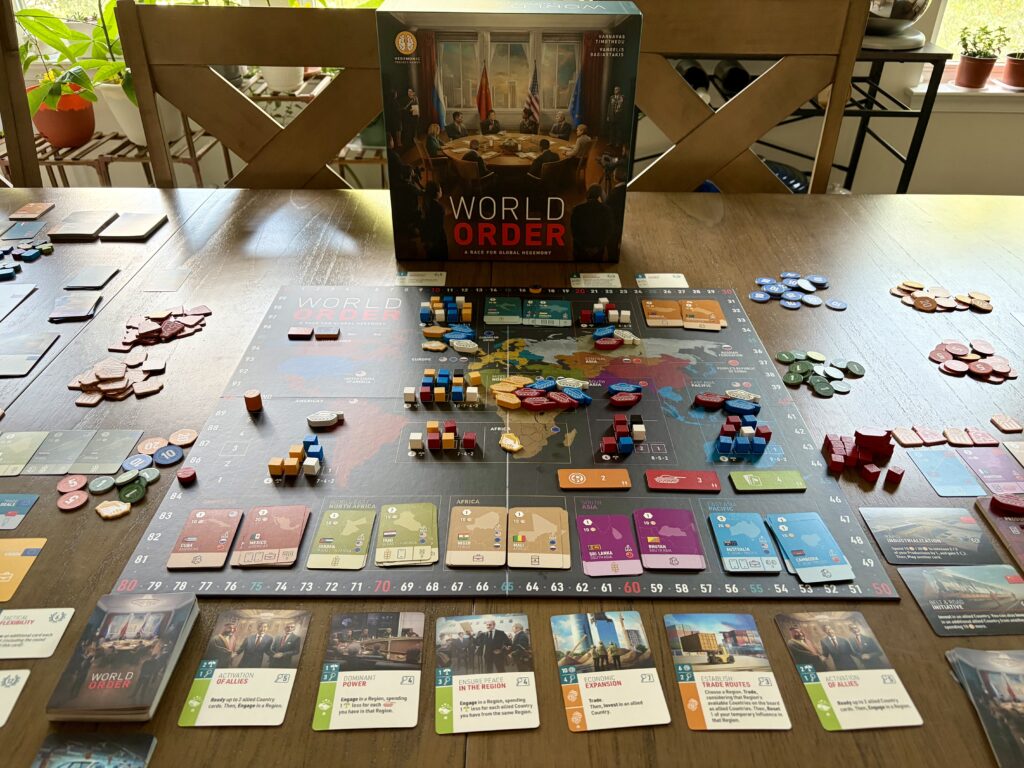
World Order is the follow up to Hegemony: Lead Your Class to Victory and is from the same designers and publishing team. I’ll be making some comparisons between the games, but while both share a few mechanical and thematic elements, they are very much different games. From a thematic lens, Hegemony is more focused on the domestic politics of running a country, whereas World Order is concentrated on the international dynamic between world powers.
In World Order, each player takes on the role of a global superpower: United States, European Union, Russia, and China. The game lasts six rounds with four turns each round. During a turn, players play one card from their hand and perform the associated action(s) on the card. This mechanism of playing a card and performing the relevant action reminds me of Hegemony, and since cards are only redrawn at the start of each round, players will only have a limited number of actions available each round.
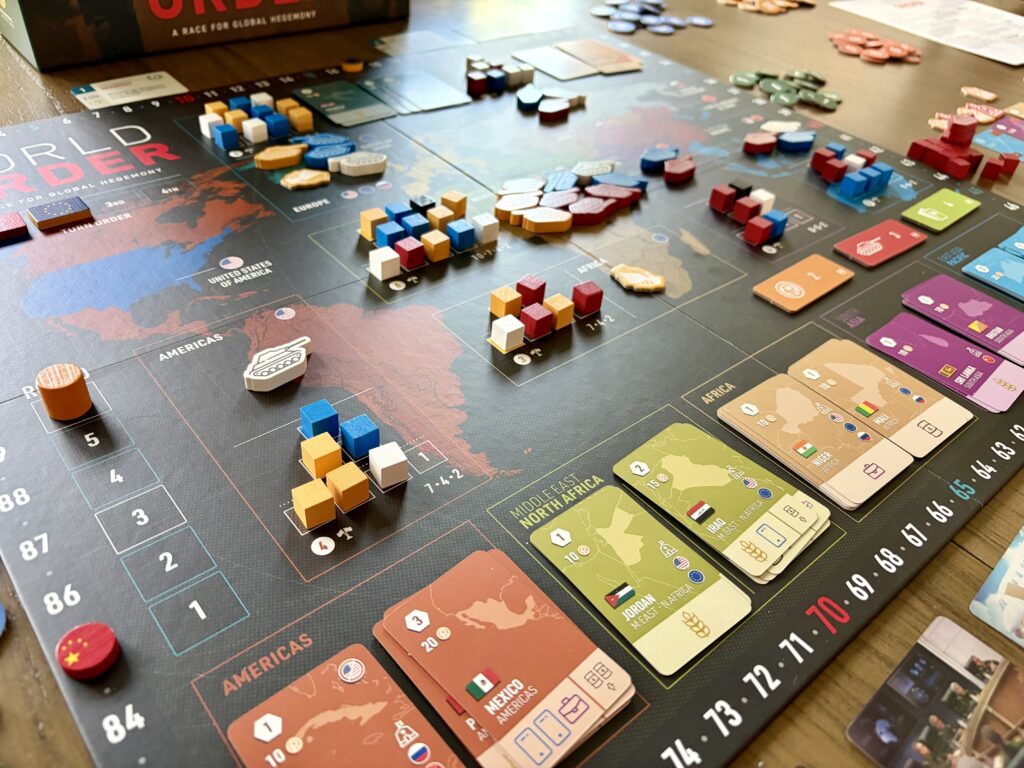
One of the key ways players score victory points is through an area majority system that has the four superpowers vying for influence across seven geographic regions. At the end of the third and sixth rounds, players score victory points based on the amount of influence they have in the region, as well as their relative majority compared to the other players. One neat implementation is the use of permanent and temporary influence, with each having a limited number of spots in each region. The difference is that permanent influence can never be removed, whereas temporary influence can be knocked off by other players once all the available spots are filled.
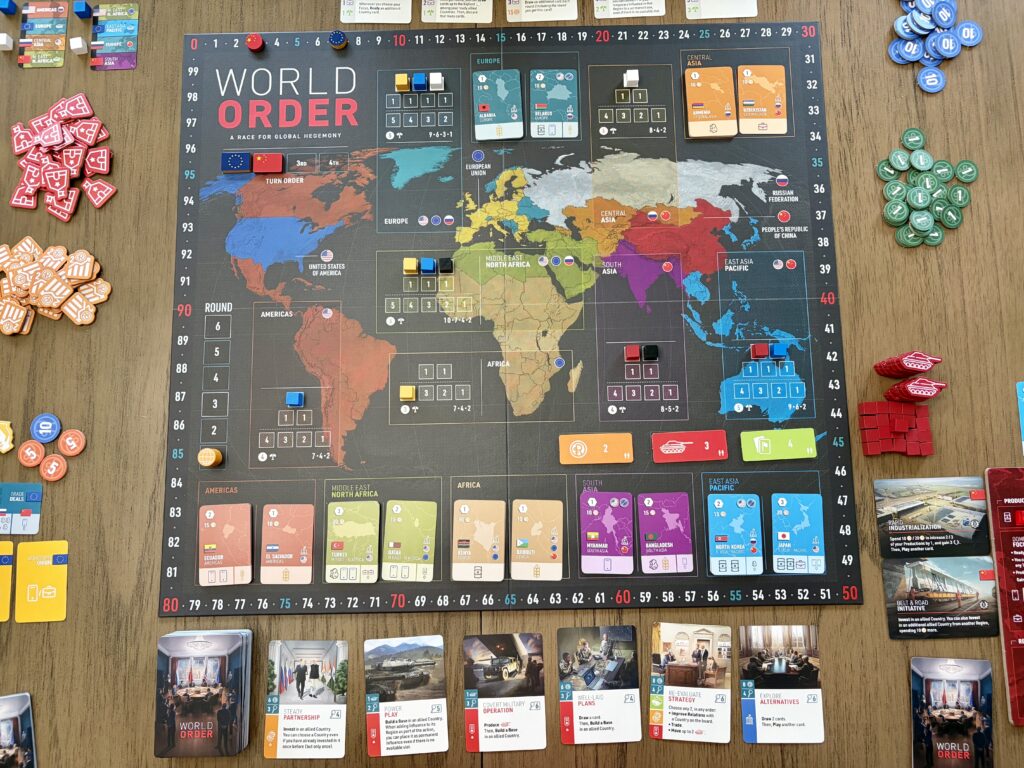
Area control/majority isn’t one of my favorite mechanisms, but I enjoy the tactical strategy of determining which regions to focus on, while being forced to adapt to the other players as well. The introduction of permanent and temporary influence also adds another element to consider when placing influence, with there being a rush to claim the limited permanent influence spots early.
Speaking of mechanics, I always enjoy the use of multi-use cards, and there are a couple instances of that here. First off are the country cards that players can claim through way of improving relations in that region. These country cards can be exhausted to claim other country cards, as well as to reduce the cost of engaging in a region, to invest in that country, or to build a base in that country, which all reward influence in the associated region. The country cards act as another form of resource that can be used in a variety of ways.
The other form of multi-use cards are the ability cards, which players play to perform actions on their turn. In addition to be used to perform actions, at the end of each round, players use the remaining cards in their hand to gain a few resources and purchase additional cards to add to their deck. I especially enjoy games that leverage deck-building elements, and I’m happy to report that it’s done well here. This mechanism of purchasing new cards reminds me a bit of Dune: Imperium, except that the new cards go on top of your deck instead of into your discard pile. Since the cards dictate which actions you can perform, placing new cards at the top of your deck helps to mitigate some of the luck of the draw. That’s not to say you can’t have a poor draw that limits your ability to take the actions you need, but there’s a fair amount of luck mitigation here through other cards that allow you to draw/discard additional cards from your deck. Players will still need to be cognizant of the cards they add to their deck, but I rarely had rounds where I felt extremely constrained.
In terms of complexity, World Order feels mechanically more approachable than Hegemony. In Hegemony, each of the social classes have their own varied actions and goals, and while each of the four playable countries in World Order are asymmetric in a few ways, they all share the same action pool and have similar goals of having the most influence in the majority of regions with the exception of how they reach those goals. For example, China is more focused on trade, whereas Russia is heavily encouraged to focus on military by having the most armies in regions. Compared to Hegemony where playing as the Working Class feels tremendously different from playing as the Capitalist Class, World Order does not have as extreme differences.
While Hegemony can be played with fewer than four players, I personally consider Hegemony a four-player only game. Although I also prefer World Order with the full four players, the game still plays relatively well at lower player counts due to auto-influence cards that simulate other players placing influence and armies in the different regions. All in all, I’m much more likely to play World Order with less than four players than I am to play Hegemony.
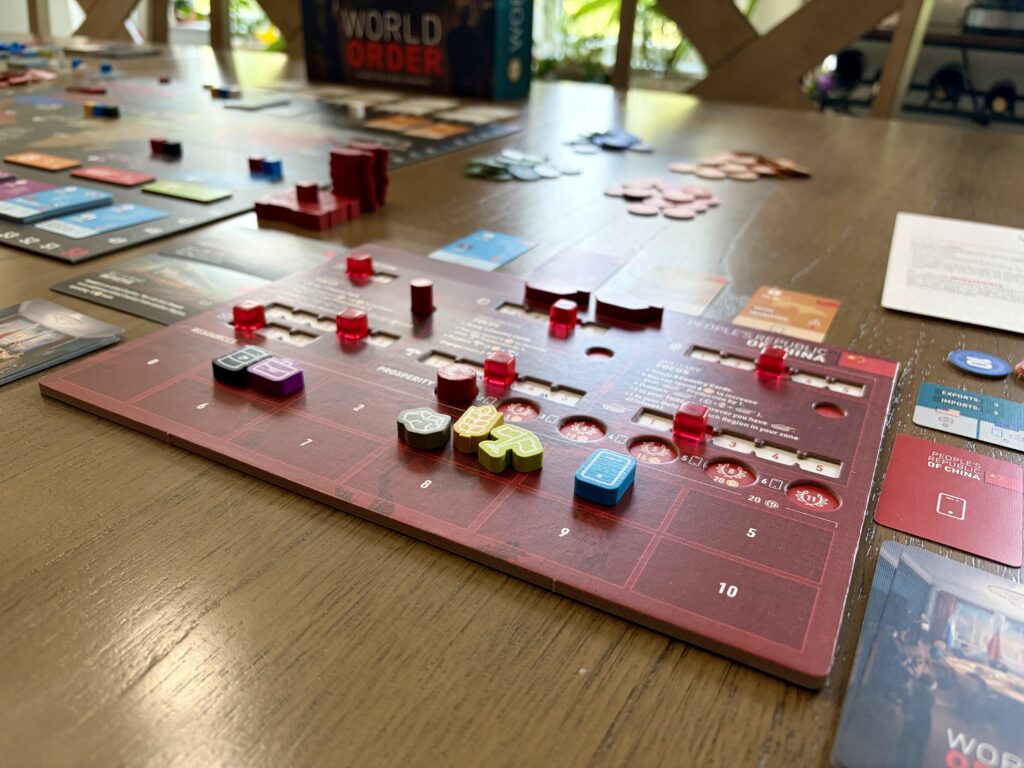
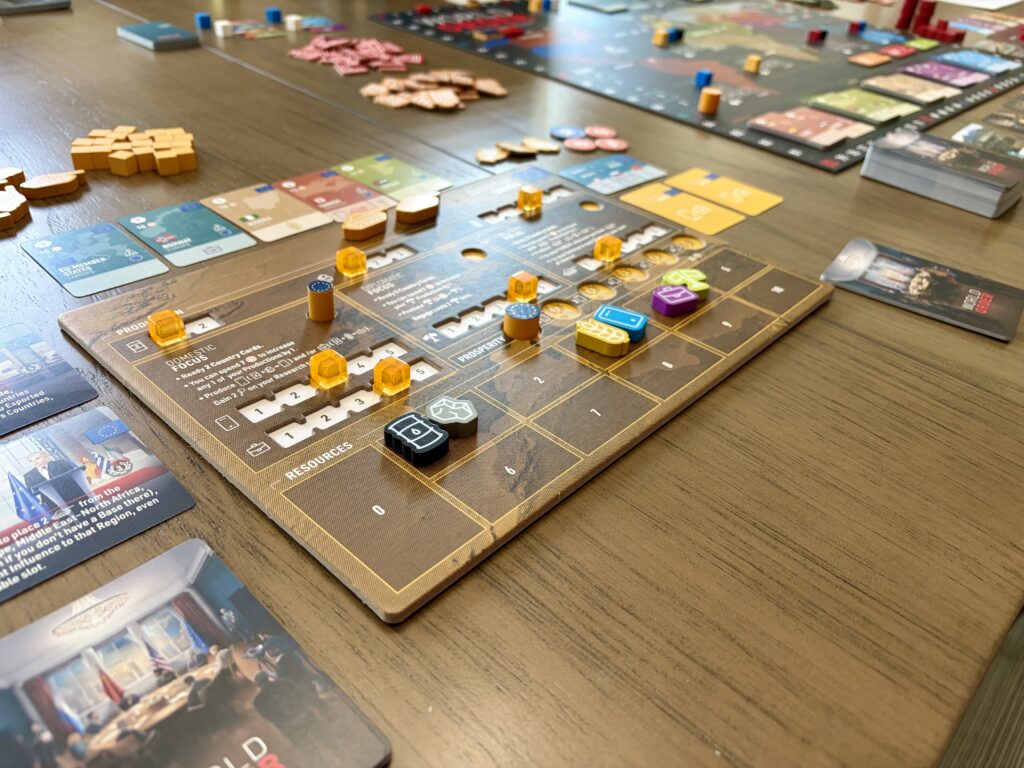
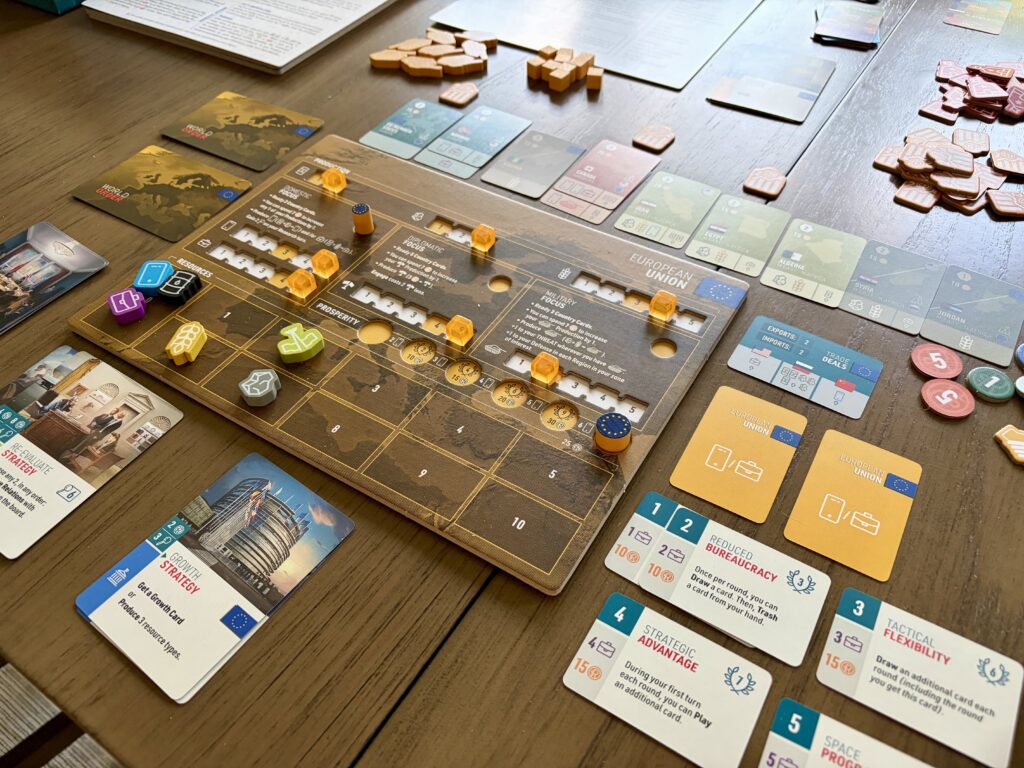
Finally, like Hegemony, the overall production value is quite solid. There are dual-layer player boards with resource markers to make it easier to manage the different resource types. Also, the screen-printed army tokens that look like tanks are a nice touch. Lastly, the individual player aids for each of the different countries does a nice job of including almost all of the key rules.
Moving onto a few negatives, the biggest issue I have with the game is its length. Look, Hegemony is also a long game, but the length feels justified given the experience. In World Order, the game can feel like its dragging at times. One cause is that the game can suffer from analysis paralysis at times, particularly for players that are new to the game. The second is that whereas in Hegemony you’re constantly negotiating and paying attention to what other players are doing, in World Order, there’s less player interaction outside of the influence and armies on the board. And third, by the later rounds, the game can feel a bit repetitive in that players are performing the same mechanical loop of mostly doing the same actions to place influence on the board. I would have loved to see if the game could have been shortened by a round or two to cut down on the length.
I’ve alluded to this a bit, but another slight disappointment is the player interaction. Whereas Hegemony is one of best examples of player-interaction in a heavy euro game, World Order is a bit more standard. The main areas of player interaction involve competing on region majority in both influence and armies. Compared to the player interaction in Hegemony where almost every decision will impact the other players, World Order feels a bit lacking. While I appreciate that there is no downright “take-that” mechanisms in the game, in a game themed around geopolitics, I would have liked to see a bit more areas to influence the other players.
Speaking of theme, whereas the gameplay in Hegemony is centered around the unique social, economic, and political structure in running a country, the theme in World Order feels more abstract. That’s not to say the game is devoid of theme; I personally really appreciate how thematic the country cards feel. For example, certain countries won’t ally with other countries and countries have different resource specializations. When you notice these elements, the theme feels much stronger; you just have to go searching a bit.
Overall, World Order is a solid second game from the team behind Hegemony. The game feels more approachable from a mechanical standpoint, and I enjoy some of the area majority and card play mechanisms. The game’s length is my biggest gripe which will likely keep it from hitting the table often. It’s tough to compare World Order to Hegemony which is one of my top 3 favorite games of all-time. And while World Order doesn’t reach the same highs, it is still a fun game in its own right, and it’s grown on me the more times I’ve played it. World Order will comfortably be remaining in the collection.
With that, I’ll wrap up this week’s review! If you’ve played World Order, I’d love to hear your thoughts on the game. And if you haven’t, do you plan on checking out the game? You can check out the game here. Happy gaming!
If you liked this post and want to be notified when new content is released, then follow me on Instagram @themeepledigest.