
Welcome to this week’s review! This time I’m taking a look at the latest expansion for a popular racing game. So, without further ado, let’s jump into it.
Disclosure: A review copy of this game was provided to The Meeple Digest in exchange for an honest, unbiased review. This review is not intended to be an endorsement.
Heat: Legends
- Designers: Asger Aleksandrov Granerud, Daniel Skjold Pedersen
- Publisher: Days of Wonder
- Complexity: Light-Medium
- Time: 60-120 Minutes
- Players: 1-7
- Main Mechanisms: Racing, Hand Management

I’ve been playing a lot of Heat: Pedal to the Metal this year and have recently reviewed another expansion for the game – Heat: Rocky Roads. While I’ve had some mixed thoughts on that expansion since I regularly use the AI opponent Legends from the base game to fill out my races, I was eager to get the newest expansion, Heat: Legends, to the table.
Outside of a few extra sponsorship cards that can be shuffled into the base game, this entire expansion is dedicated to rounding out the experience when using Legends. I’ll touch on this more in a bit, but the expansion is designed to make the Legends feel more like human opponents. Now they can benefit from the Adrenaline, slipstream, and other bonuses.
One complaint with the Legends in the base game is the minimal ability to tailor the difficulty level beyond just adjusting the Legends’ top speed. With this new expansion, the Legends deck from the base game has been replaced by three new Legend decks that offer five different difficulty levels. The new Legend cards also support up to 12 cars to make this expansion compatible with both past, as well as future Heat expansions, which increase the number of cars in the game. I’m not sure that I would personally want to play Heat with 12 cars, but to each their own.
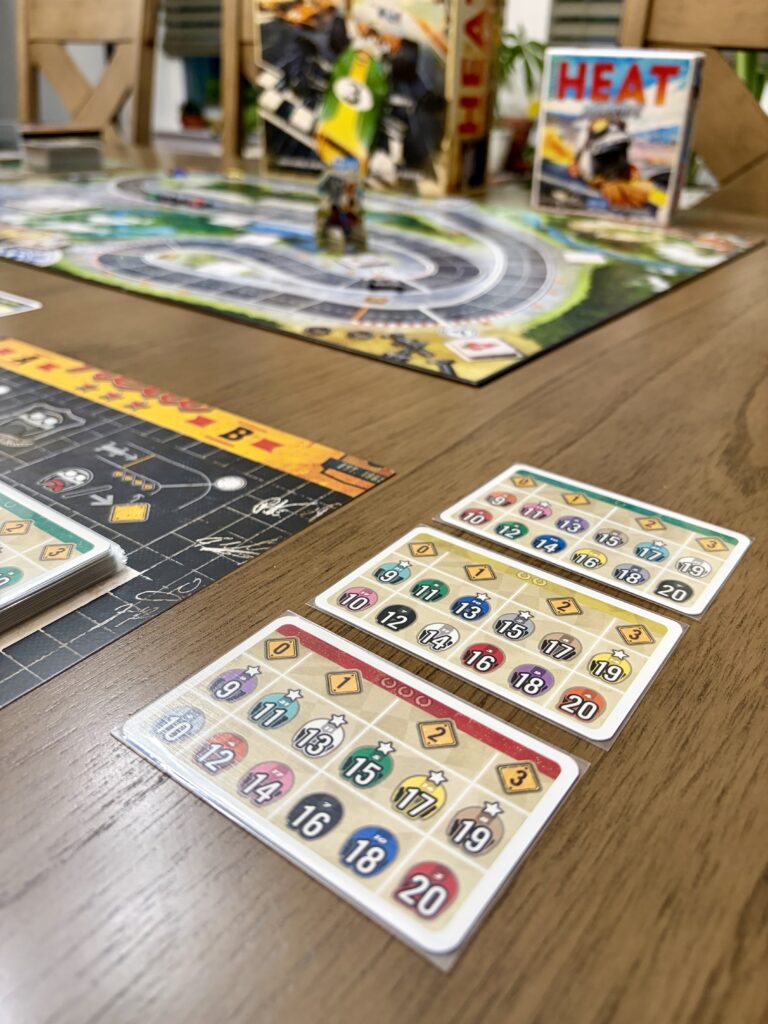
I particularly appreciate that the three new Legend decks can be adjusted to allow five different difficulty levels. For example, there are three different colored decks (green, yellow, red) that scale the difficulty by increasing the likelihood that Legends can use a certain ability (slipstream, drafting, additional movement, etc.) that round. The rules suggest using just the green deck for the first race in a Championship series and then increasing the difficulty by one for each of the next races to mimic how players’ cars improve as they gain more upgrade cards. I’ll admit that I’m not great at Heat, but I personally found that once you start to incorporate the yellow deck, as well as the rival bonuses (more on this next), the AI Legends certainly put up a challenge. I can’t imagine how tough the higher difficulties are.
In addition to the new Legend decks, there is also a fairly sizable deck of Power Up cards, which the Legends can use to take advantage of the different abilities in the game. Each round, one of these cards is revealed, which have both a primary and secondary ability. For example, some of the abilities are slipstream, extra movement, blocking, etc. If the Legend card revealed has a star icon next to the car, that car gets to activate the primary ability on the Power Up card. In addition, in each race you can designate two rival Legends, which also get to activate the secondary ability on the Power Up card for the round. And if that Legend is both a rival and has a star icon on the Legend card, they get to activate both abilities. For a single race, the two rivals become the two frontmost cars in the race, and in a Championship series, the two rivals are the two highest ranked cars in the series.
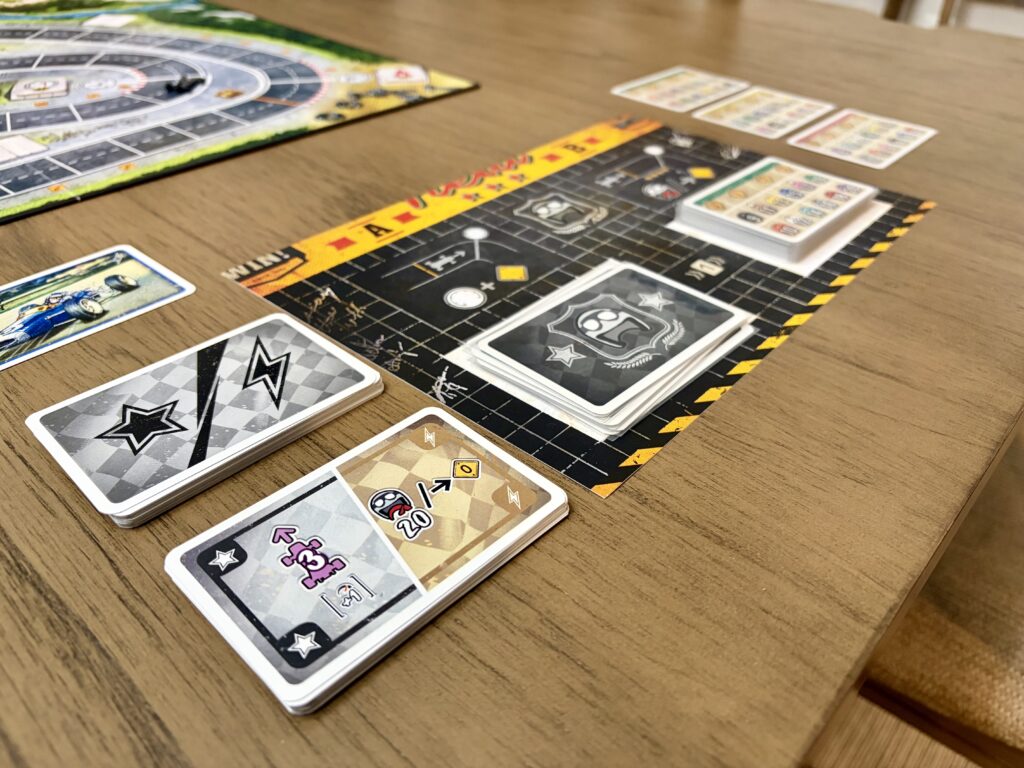
If the Legend and Power Up cards weren’t enough, adding the rival abilities crank up the difficulty even more. While I appreciate the extra drama the rivals bring, from my experience playing a Championship series, what ended up happening was that the two rivals were battling with me at the top of the standings, whereas the rest of the cars were very much in the rear of the pack. I almost wish the rival abilities had been applied to the cars furthest behind in the series to make it more likely that those cars could catch up in points; although I suppose I could always house rule this.
While the expansion adds a bit more complexity to operating the Legend cars, I found them still relatively easy to pilot. There were a couple of edge cases where I wasn’t one hundred percentage confident that I had applied the abilities correctly. And while the rules specify to resolve abilities in the order that moves the car furthest, I would have appreciated a few more examples and a bit more explanation in the rules.

Heat: Legends is a relatively small expansion considering it’s essentially just a few decks of cards. With that said, I would consider it to be borderline essential if you’re someone who plays Heat solo or regularly uses more than a couple Legends to fill out a race in multiplayer games. The new Legend and Power Up cards now do a better job of simulating human opponents, and there are plenty of difficulty options to tailor the experience to fit your preferences. I’ll be using the new Legend decks every time I play Heat moving forward, and I strongly recommend this expansion to fans of the game.
With that, I’ll wrap up this week’s review! If you’ve played Heat: Legends, what are your thoughts on the new additions? If you haven’t, are you planning to pick up this expansion – why or why not? And what are your general thoughts on Heat: Pedal to the Metal? Happy gaming!
If you liked this post and want to be notified when new content is released, then follow me on Instagram @themeepledigest.