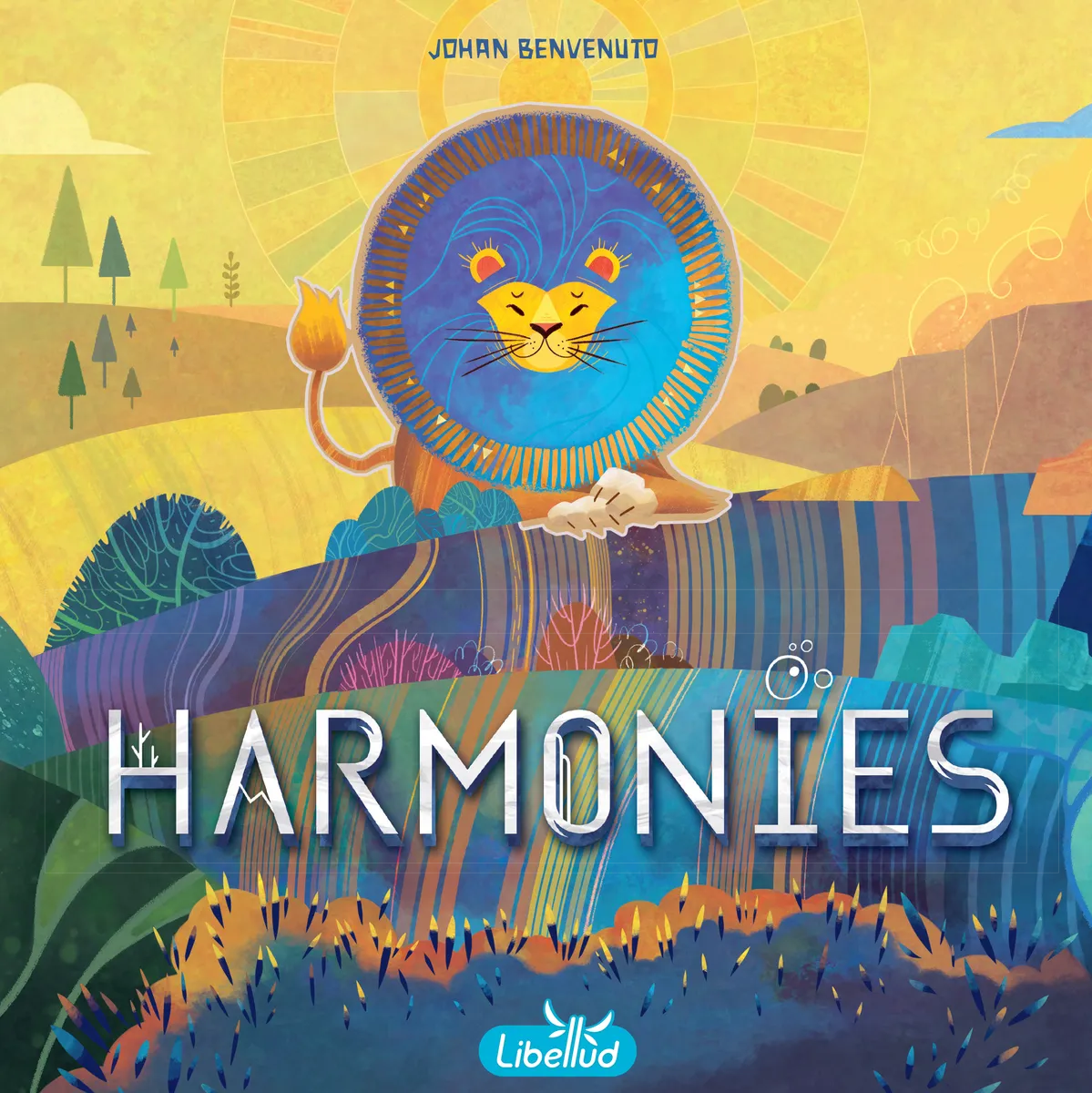
Welcome to this week’s review! This time I’m taking a look at a relatively recent, popular tile-laying game. So, without further ado, let’s jump into it.
Disclosure: A review copy of this game was provided to The Meeple Digest in exchange for an honest, unbiased review. This review is not intended to be an endorsement.
Harmonies
- Designer: John Benvenuto
- Publisher: Libellud
- Complexity: Light
- Time: 30-45 Minutes
- Players: 1-4
- Main Mechanisms: Tile Placement
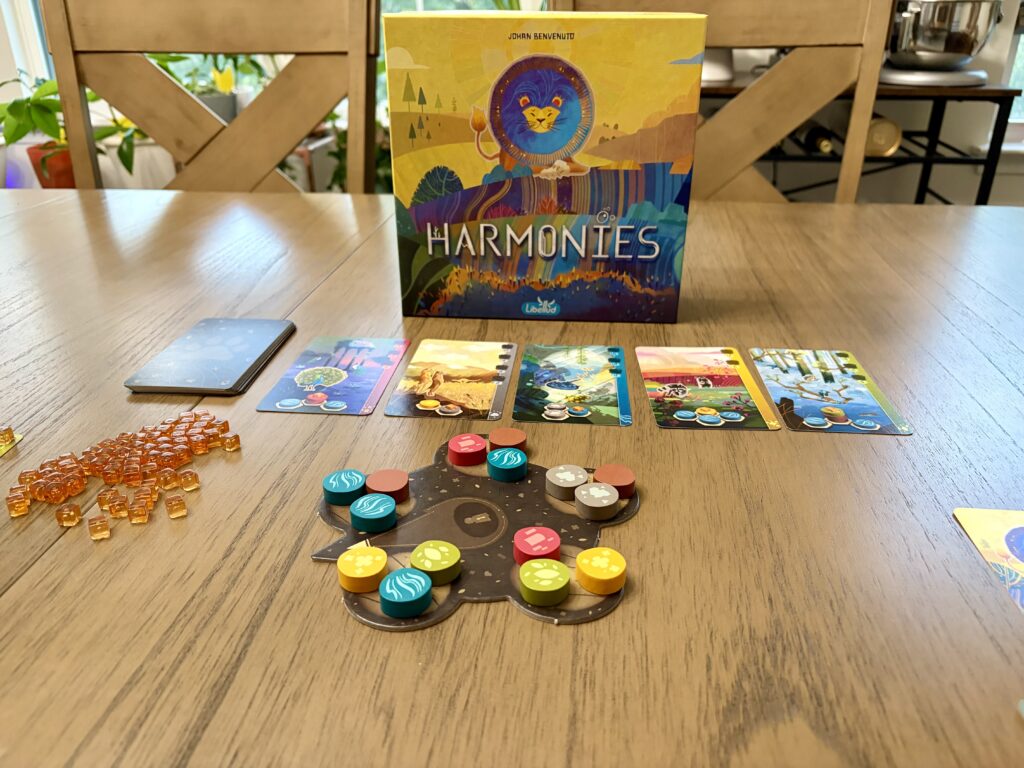
Harmonies is an abstract tile-laying game where players compete to build the best natural landscapes by placing animal tokens and terrain tiles. If you’ve played games like Azul or Cascadia, you’ll immediately notice the similarities. In Harmonies, players take turns selecting and placing three terrain tiles from one of the five central spaces, and the tiles represent five different terrain types: mountains, trees, water, fields, and buildings. In addition to placing three terrain tiles each turn, players can also take and place one animal card and token. These animal tokens require specific tile placements on their player board and score victory points at the end of the game based on the specific animal card and the number of tokens placed.
Harmonies is very much a point salad game in the sense that every tile and token you place scores differently. Whereas in Cascadia, each of the different animal types have specific scoring conditions for that game which apply to all players, in Harmonies, players claim animal cards from a display of five cards with each player scoring their animals individually. Each animal card comes with two to five tokens that can be played on the player’s board once they satisfy certain tile placement. For example, a dessert fox might require two mountain tiles adjacent to a field. At the end of the game, players score points based on how many of each animal they’ve placed on their board, and typically, the more tokens of the same animal you place, the more points each one of those tokens will be worth.
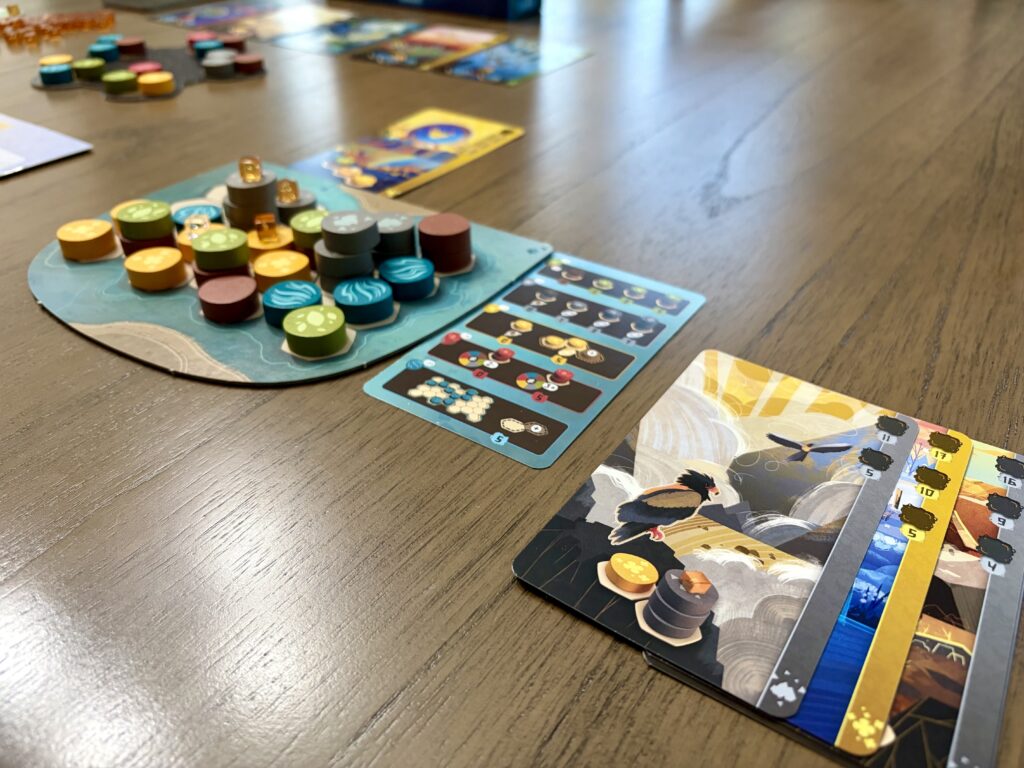
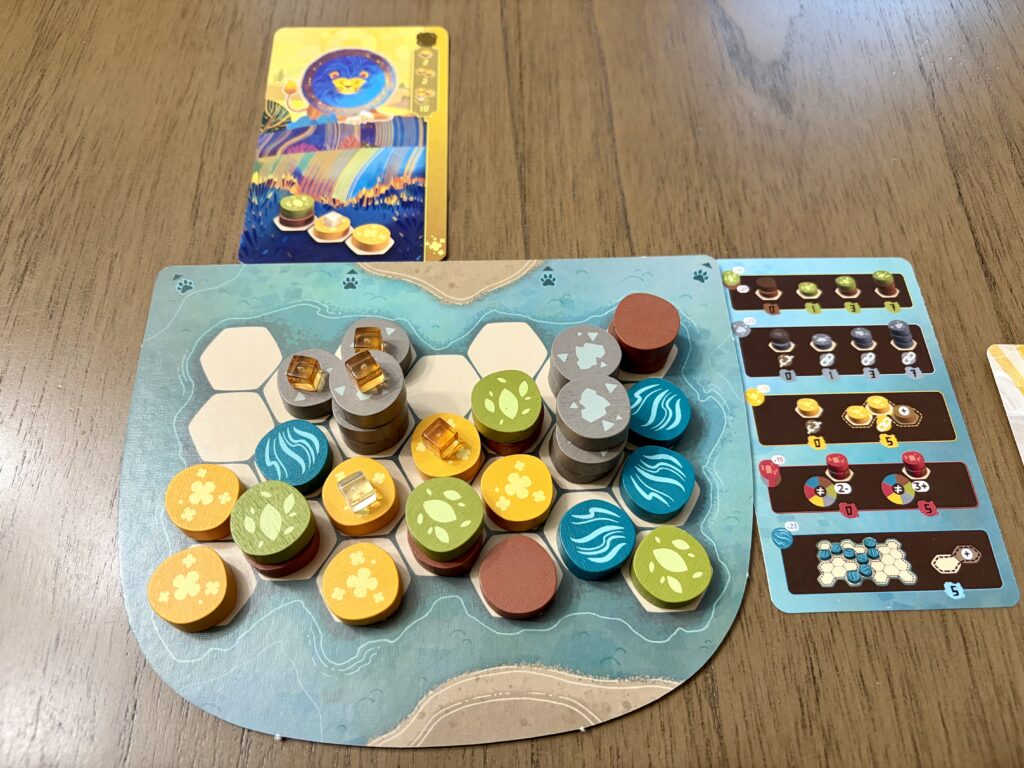
I mentioned that the game is very much a point salad because in addition to the animal cards, players also score points based on their terrain tiles on their player board. Each of the five tiles have their own way of scoring. For example, mountains need to be adjacent to other mountains to be able to score, and the taller mountain, the more points. On the other hand, buildings are required to be adjacent to three different types of terrain in order to score. These scoring conditions remain the same from game to game, except for water tokens, which have two different ways of scoring depending on which side of the player boards are in play.
Since there are a plethora of different ways to score points, I found myself having to constantly juggle both prioritizing how the terrains score, as well as trying to place animal tokens. Sometimes these can be at odds with one another because once you place an animal token, you’re unable to place another terrain tile on top of it. Trying to min/max your points can cause a bit of analysis-paralysis in what is otherwise a very light game; however, I had the most fun when I wasn’t trying to run a bunch of calculations in my head to determine the best combination of animal cards/tokens and terrain tiles, but rather focusing on the fun of building out a unique landscape each game.
Speaking of variety, the 32 different animal cards lend itself to the overarching plethora of options. In addition, there are also another optional ten nature spirit cards, and each player can select one at the start of each game. These operate similarly to the animal cards, except they offer additional ways of scoring points at the end of the game, like having groups of buildings or water tiles. Overall, I found there to be a good amount of replayability and different strategies. In one game, I found myself focusing on building higher terrains, whereas in another game, I built horizontally instead of vertically. Since there is a lot of variety in the animal cards, no two games are guaranteed to play out the same.
The game is also relatively easy to teach, and I was able to finish games with my wife in roughly 30 minutes including setup and teardown. While game complexity is always subjective, I think I could confidently teach this game to pretty much any type of gamer without much difficulty. It also doesn’t hurt that the artwork on the animal cards look gorgeous.
Moving onto some slight negatives. First off, there’s very little player interaction outside of claiming an animal or terrain token that another player wanted. Players are mostly focused on building out their individual player boards. Next, there is an element of luck based on which types of animal cards come out; for example, sometimes you could draw a card that already matches what you’ve already built or you might be out of luck and not draw the right cards. And there of course is some luck of the draw based on which terrain tiles get pulled from the bag. For instance, in one game, my wife had a spirit card that rewarded field tiles, but there weren’t any drawn for most of the game. I didn’t find either of these to be too big of an issue since the game is relatively light and short, but keep in mind of the luck aspect.
While the artwork and components are quite solid, the general nature theme is definitely abstract. The theme is set around building natural landscapes and placing animals, but I think it would be relatively easy to swap the theme out with something different and still have a similar game. If you’re primary looking for a highly thematic nature game, I think there are other games that weave the nature theme with their mechanisms better. Harmonies is primarily a tile-laying game first and a nature game second.
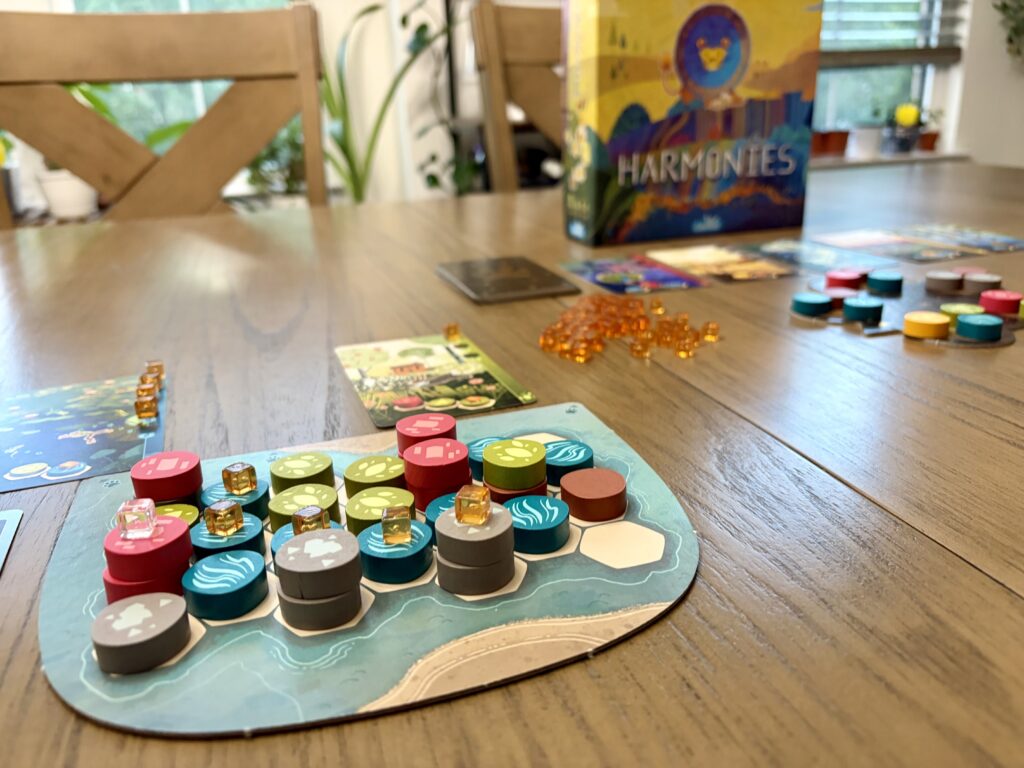
Even with these slight negatives, I can still confidently recommend Harmonies to gamers who like games like Cascadia or Azul. The game is quick, easy to teach, and can be played with all types of gamers and families. If I were to compare it to similar games, I definitely think I prefer Harmonies because of the variety that the animal cards provide. Is it a game that I’ll want to play repeatedly? No. But it’s a game that I wouldn’t hesitate to bring out when I’m looking for something light and quick, or if I’m looking for a game to teach to my non-gamer friends.
With that, I’ll wrap up this week’s review! If you’ve played Harmonies, what are your thoughts on the game? And what are your favorite tile-laying or gateway-level games? Happy gaming!
If you liked this post and want to be notified when new content is released, then follow me on Instagram @themeepledigest.