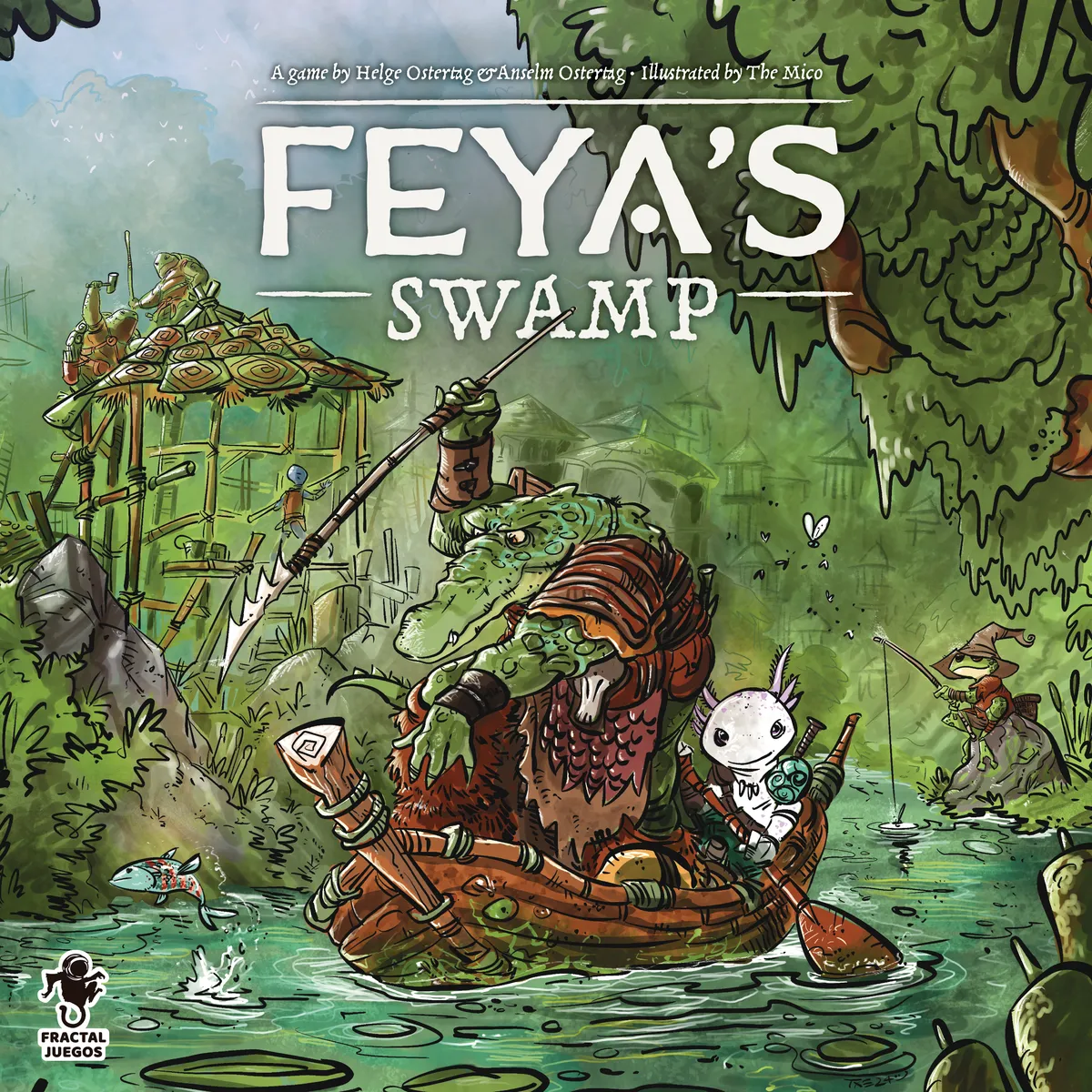
Welcome to this week’s review! This time I’m looking at a reimplementation of a 20+ year old game. So, without further ado, let’s jump into it.
Disclosure: A review copy of this game was provided to The Meeple Digest in exchange for an honest, unbiased review. This review is not intended to be an endorsement.
Feya’s Swamp
- Designers: Helge and Anselm Ostertag
- Publisher: Fractal Juegos
- Complexity: Medium
- Time: 80-100 Minutes
- Players: 2-4
- Main Mechanisms: Worker-Placement
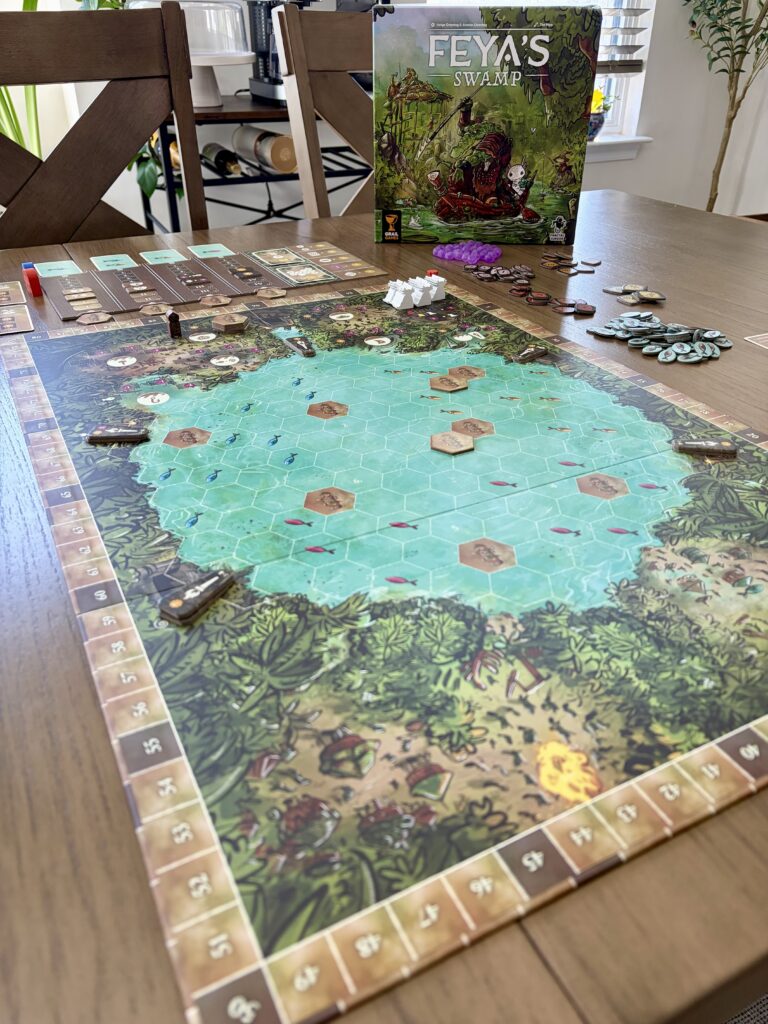
Feya’s Swamp is a reimplementation of 2005’s Kaivai, which I’ve never played, and is from the same designers, Helge and Anselm Ostertag. You may recognize the name Ostertag, as Helge codesigned Terra Mystica and the spinoffs Gaia Project and Age of Innovation. Feya’s Swamp is very much a different game from Terra Mystica; although there is one mechanism I’ll touch on in a bit that does remind me of it.
In Feya’s Swamp, players take on the role of a swamp clan, such as the crocodile or frog clan, with the goal of becoming the most prosperous group of the bunch. The game takes place over four rounds, and during each round, players place their workers on various worker-placement spots to carry out the associated action. The core of the game revolves around building settlements on a shared swamp board, going fishing, and then delivering fish to settlements to earn money and victory points. Other than a couple of minor elements, the rules themselves are fairly straightforward, and once you get going, the game flows very smoothly.
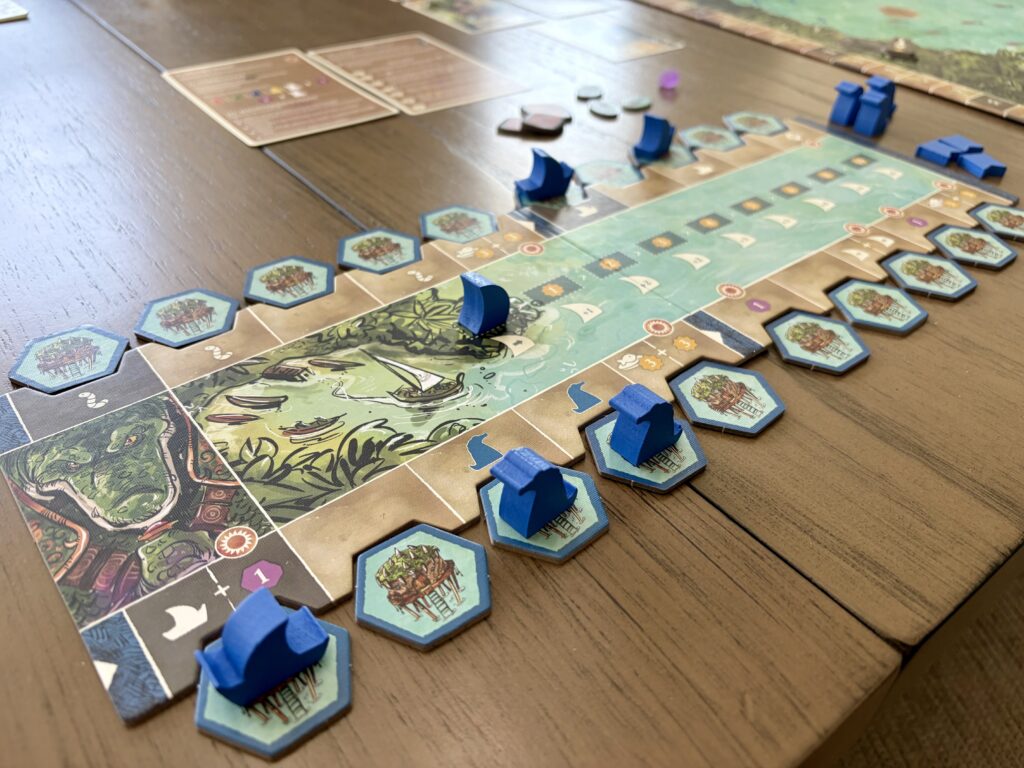
The game also has quite a bit of player interaction. For the most part, I’m happy to report that the interaction is mostly positive. While players can occasionally block others out, I never found the game to become overly cutthroat. If you deliver fish to opposing players’ settlements, you still receive money (necessary to build more settlements) while the other player receives victory points when the island is scored.
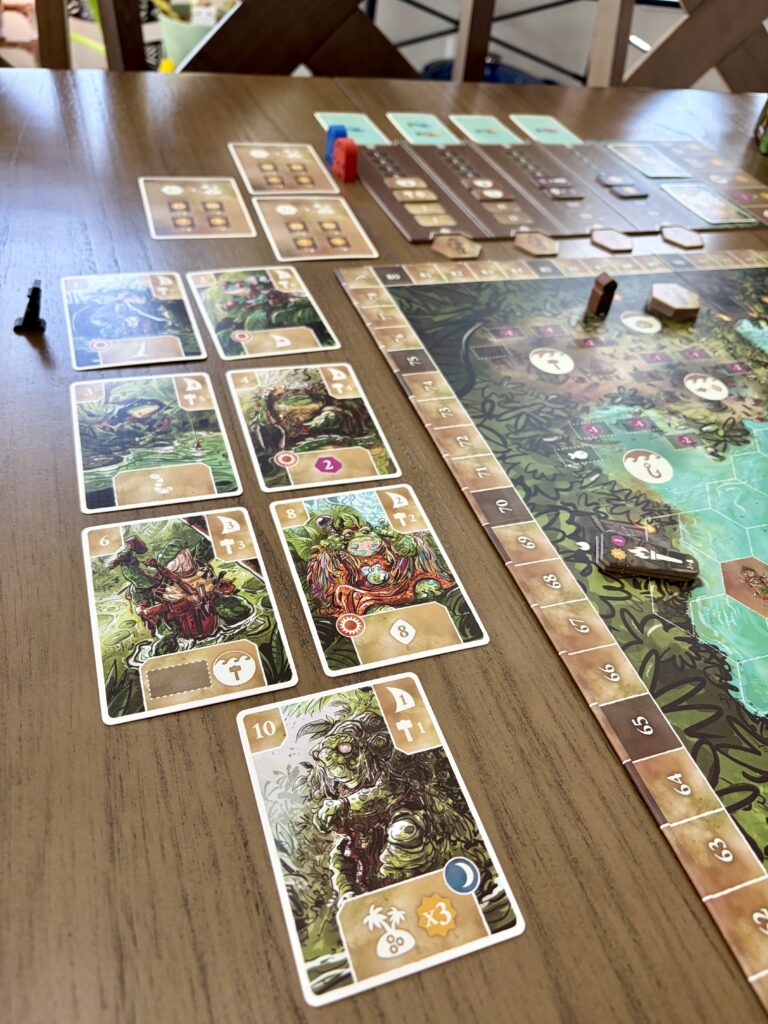
Arguably my favorite mechanism in the game are the guide cards. At the start of each round, players pick one of the available guides, which gives them a special benefit, such as additional income or other ways to score victory points. In addition, the guides determine player order, the player’s sailing range, and the player’s settlement cost for that round. Going back to Terra Mystica, the guides remind me a bit of the bonus cards, as unselected guides receive fish each round to make them more appealing. One caveat with the guides is that I found myself leaning towards only a couple each game. That said, I still found the guides introduced a lot of compelling decisions.
Another interesting element are the fish cards. There are three different colored fish, which correspond to different locations on the swamp board, with like colored fish grouped together. Players can only fish one or two of the three types of fish each round, which encourages players to move around the map more. It’s also a bit of a thematic tie-in to fish migration. Another interesting element to the fish is that settlements can be built on top of fish icons, so over the course of the game, the number of fish spots decreases, introducing a bit more competition over available fishing spots.
Wrapping up the positives on the game, each of the four clans comes with both a symmetric and asymmetric side to add a bit of replayability. While the asymmetric elements aren’t too noticeably different from one another, it does encourage some diversification in strategies.
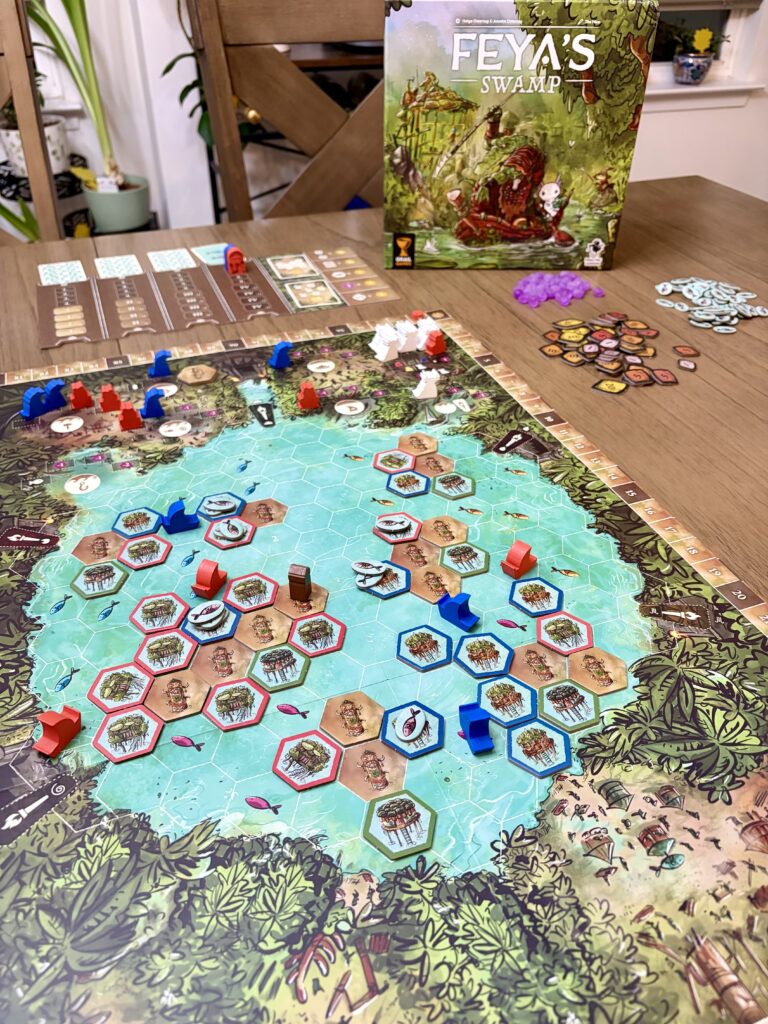
While the asymmetry is appreciated, considering that all players are competing over the same fish spots each round, combined with the race cards, which reward points to the player(s) who completes the objective first, along with the scoring cards at the end of the game, I found that players are forced down similar strategies. While I like when games give you an initial goal, I’m generally less keen when the game’s setup encourages you to go down a certain path. It’s almost like the game is dictating my strategy rather than the other way around, which leads to feeling a lack of agency.
While the theme of building out a swamp clan is interesting, I found the game felt more mechanical rather than thematic, and I suspect that a different theming wouldn’t drastically change the feeling of the game. In terms of production, the art is from “The Mico”, and while there isn’t a ton of artwork, it does help sell the theme a bit more, and the artwork on the guide cards are particularly well done. While the components are fairly standard tokens, the mana gems and player meeples that are shaped like the player’s clan are a nice touch. The only thing to note is that since there are no dual-layer elements, the tiles can be a bit prone to sliding around from a slight bump.
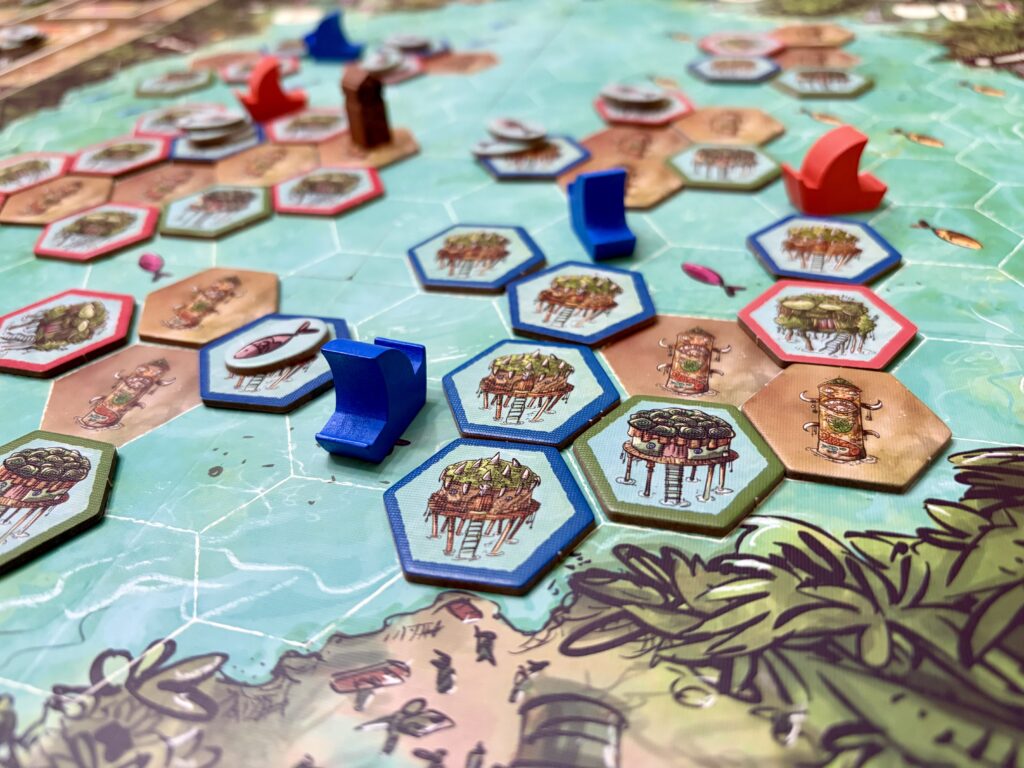
The only other slight negative is that if you struggle early to build out enough settlements, you’ll likely struggle to catch up to the leaders. The earlier you’re able your settlements out, the quicker you’re able to get your engine started. Also, I found that it’s easier to ignore certain actions rather than others. For example, the improve sailing, spirit, and temple actions are a bit more situational, while fishing, trading, and building are almost always good actions to take.
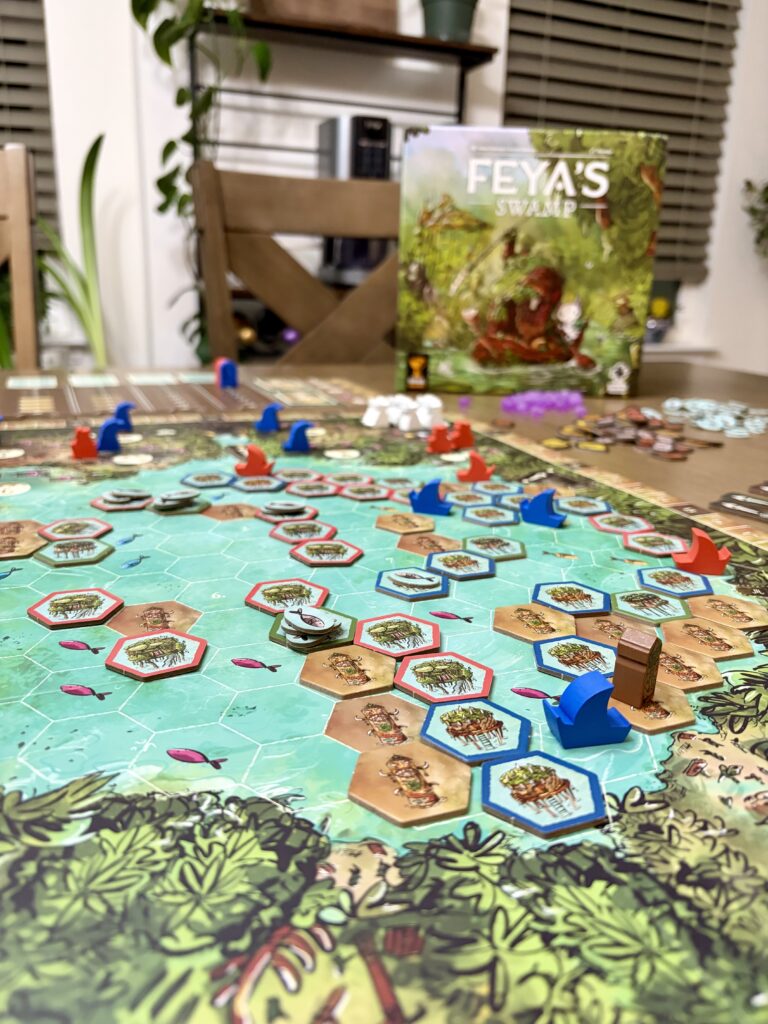
Overall, Feya’s Swamp is a fine game. There’s a nice amount of player interaction that doesn’t feel overly punishing, the gameplay is relatively smooth, and the guide cards are a particular highlight for me. However, with so many medium weight euros out there, I didn’t find Feya’s Swamp doing enough to differentiate itself from others in the pack. I’d still recommend gamers who like a fair amount of player interaction to give it a look, but personally Feya’s Swamp likely won’t be staying in my collection.
With that, I’ll wrap up this week’s review! If you’ve played Kaivai, I’d love to hear your thoughts on either version, and if you’ve played Feya’s Swamp, what did you think of the game? I’d love to hear your thoughts on any of the games I’ve mentioned or future content suggestions in the comments below. Happy gaming!
If you liked this post and want to be notified when new content is released, then follow me on Instagram @themeepledigest.