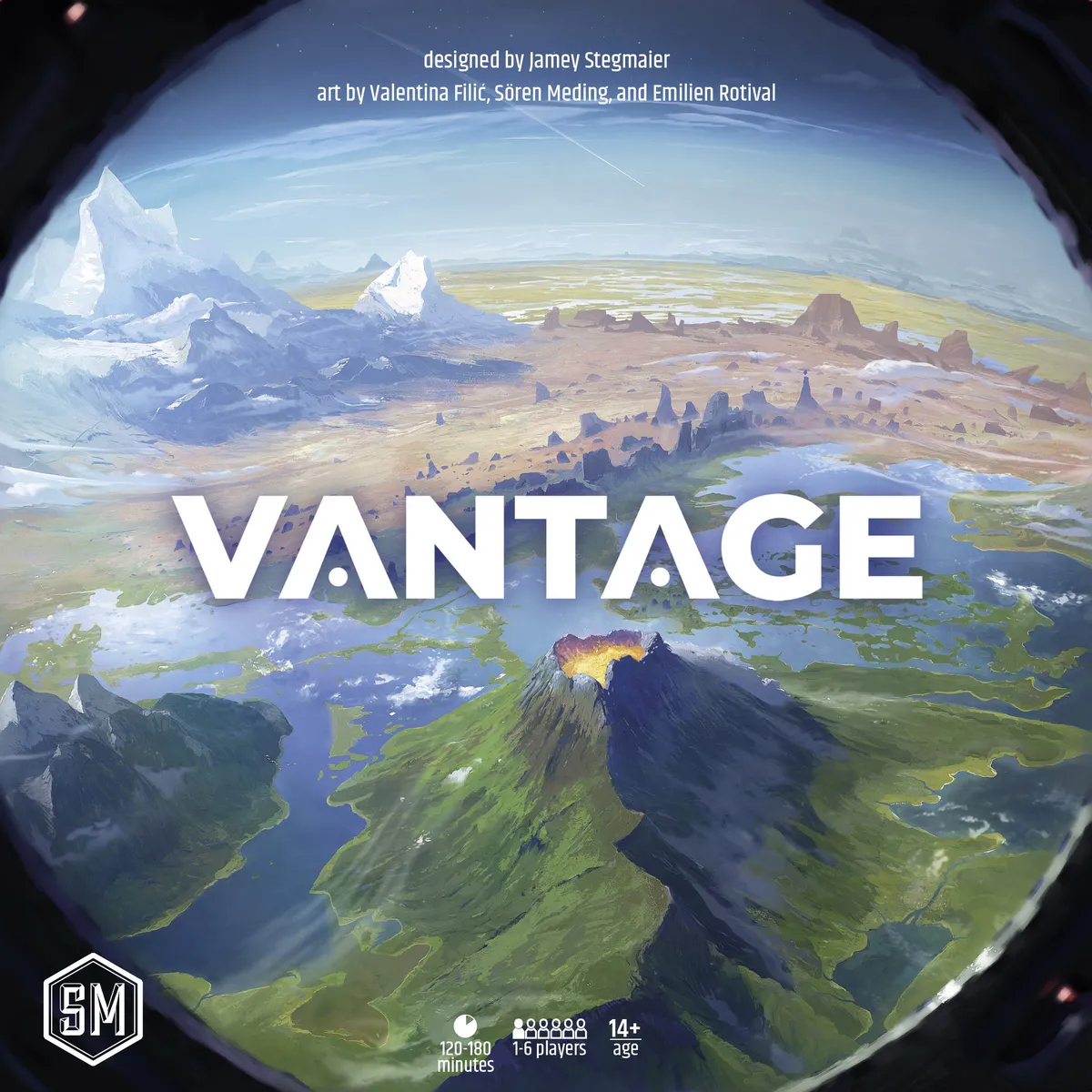
Welcome to this week’s review! This time I’m looking at a new entry in the cooperative, exploration/adventure genre. So, without further ado, let’s jump into it.
Disclosure: A review copy of this game was provided to The Meeple Digest in exchange for an honest, unbiased review. This review is not intended to be an endorsement.
Vantage
- Designer: Jamey Stegmaier
- Publisher: Stonemaier Games
- Complexity: Light-Medium
- Time: 120-180 Minutes
- Players: 1-6
- Main Mechanisms: Cooperative, Open-World, Exploration, Adventure
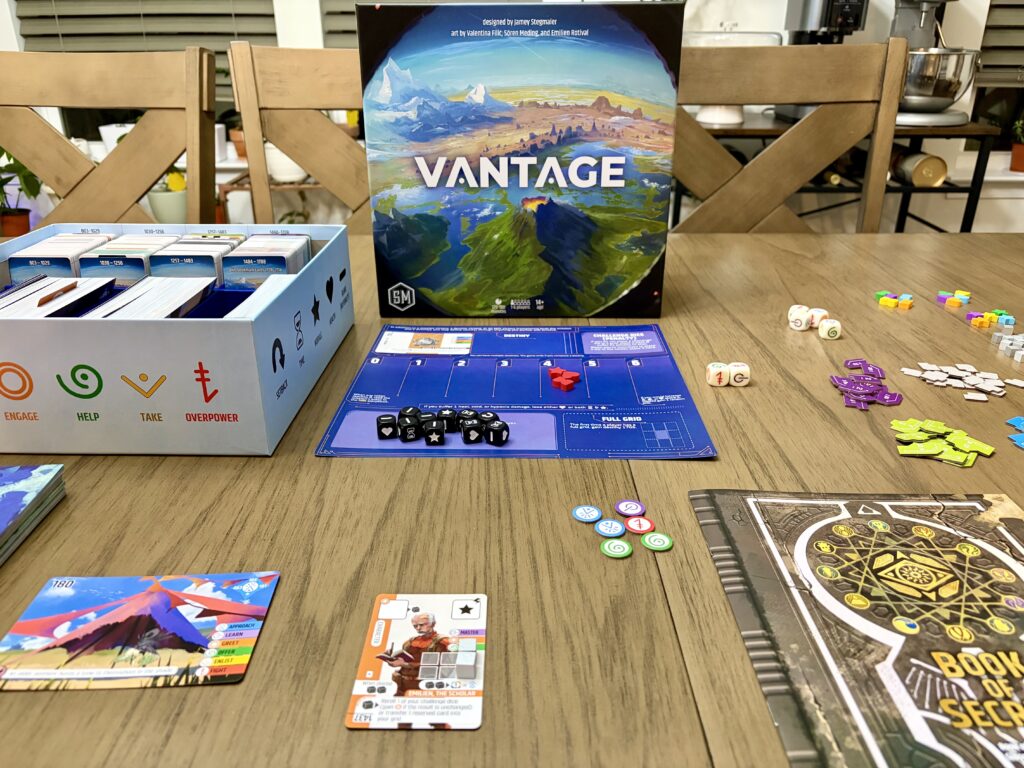
Let me start off by saying, I love Sleeping Gods and Arydia. So, when I heard that Jamey Stegmaier and Stonemaier Games had designed their own take on the cooperative, exploration genre, I was more than a bit intrigued. Plus, when I covered my Top 10 Cooperative Games last year, there were multiple recommendations to try out Vantage. So now that I’ve had the chance to explore the game, here are my thoughts.
Whereas games like Sleeping Gods and Arydia are lengthy campaign games, one of Vantage’s main selling points is that it offers an open-world adventure that can completed in a single gaming session. However, with 800+ locations and another 900+ items, missions, etc., there’s still plenty of content to explore that rivals the games I mentioned above. So there’s a good chance that you’ll be able to play many games of Vantage before you start running into content you’ve seen before.
In Vantage, you and up to five other players take on the role of one of six characters, who each specialize in one of the six main skills in the game. For example, one character is better at move actions and traversing the world, while another is better at strength or combat actions. At the start of the game, each character is randomly dropped on a location in the world with just a vague starting mission to guide them.
The core gameplay loop involves visiting a location and performing one of six actions at the location. Note, some choices will allow you to take multiple actions at the same location, but by default you’re limited to only performing one of the six. This also contributes to the huge variety in the game in that even visiting the same location in different games can lead to different outcomes. Once you’ve chosen one of the six actions, you’re prompted to read a short section in the matching storybook. These prompts require you to perform a matching skill check that can vary in difficulty. You’re able to reduce the cost by spending matching skill tokens, and then you can roll challenge dice for the remaining cost. These challenge dice sometimes require you to lose time, morale, or health, which act as one of the game’s timers. When any of these trackers reach zero, your game effectively ends. Players also build out a grid of up to nine ability and item cards, which are gained from performing actions, and these often allow you to place challenge dice on them to avoid taking penalties. In addition, some cards have matching icons which only allow you to place dice of a matching symbol or when you perform a certain action or skill.
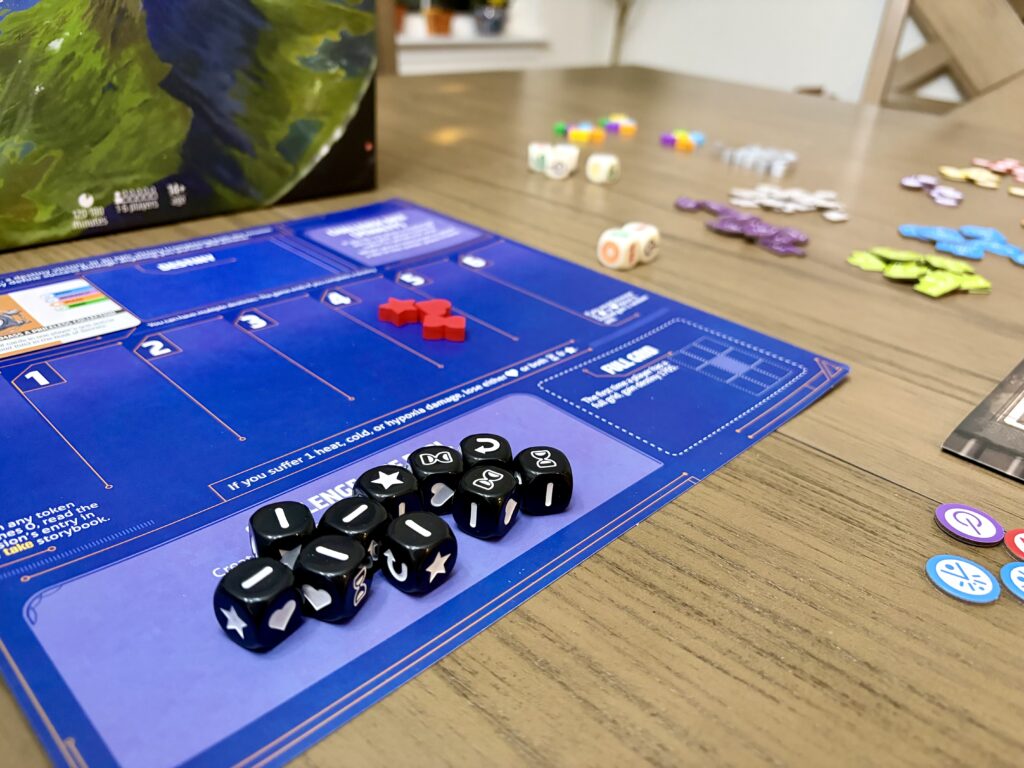
Going back to the game’s selling point, Vantage feels much more approachable than other games of its type. I already mentioned the game’s length, but there’s also very minimal setup and the rules are relatively light. This is quite impressive for a game that still offers a similar amount of content, if not more, than those other games. Another interesting deviation from the norm is that you always succeed when performing an action, with the challenge dice representing the cost to do so. Therefore, you’re always receiving some reward or benefit from completing the action.
Personally, I found the early part of the game to be the most enjoyable as you’re gradually building out your tableau of cards. This is also the most challenging part of the game, as you’re given limited tools to mitigate the challenge dice.
One of the main selling points in this style of games is the chance to get sucked into a thematic and engaging world. With Vantage, I found the theming to be a bit hit and miss. You’re not given much background on the world, and you’ll have to gradually piece together the world over the course of multiple games.
This leads me into my biggest gripe on the game – the game doesn’t give you much direction. I mentioned that you start the game with a random mission; however, the game provides very little information on how to go about completing said mission. For example, in the first game I played, I was tasked with taming animal companions; however, where I was supposed to find said animals was a mystery. I ultimately wandered around from location to location until I happened to stumble upon locations that contained animals. Therefore, how quick or successful you are at competing a mission feels very random.
This random nature continues into the destinies. Completing your mission gives you the option to continue with an associated destiny, and certain locations and actions will also give you additional destinies. Completing both your mission and a destiny results in an epic victory. However, many of the destinies also feel rather random. For example, in one game, I stumbled onto a destiny that required me to rebuild a spaceship that would let me escape from the planet. However, it wasn’t clear where I could find these spaceship parts. In another game, I acquired an item that allowed me to draw additional destiny cards each time I spent a boost token from the associated item, which felt even more random as I essentially kept drawing cards until I found one that I could easily complete.
Sometimes you’re given maps, which allow you to access a page in the Book of Vantages. This is the only time you’re able to see a map of the world, but figuring out even the vaguest idea of where you are on that map at any given time will likely require multiple games of Vantage under your belt. One bizarre rule with the maps is that you’re only allowed to look at the associated page in the Book of Vantages once per boost token you spend. That feels a bit odd and not the most thematic, but I guess you could always house rule it. I suspect that the rule is there to keep the world more of a mystery, but having to keep a notepad handy to take notes instead feels a bit cumbersome.
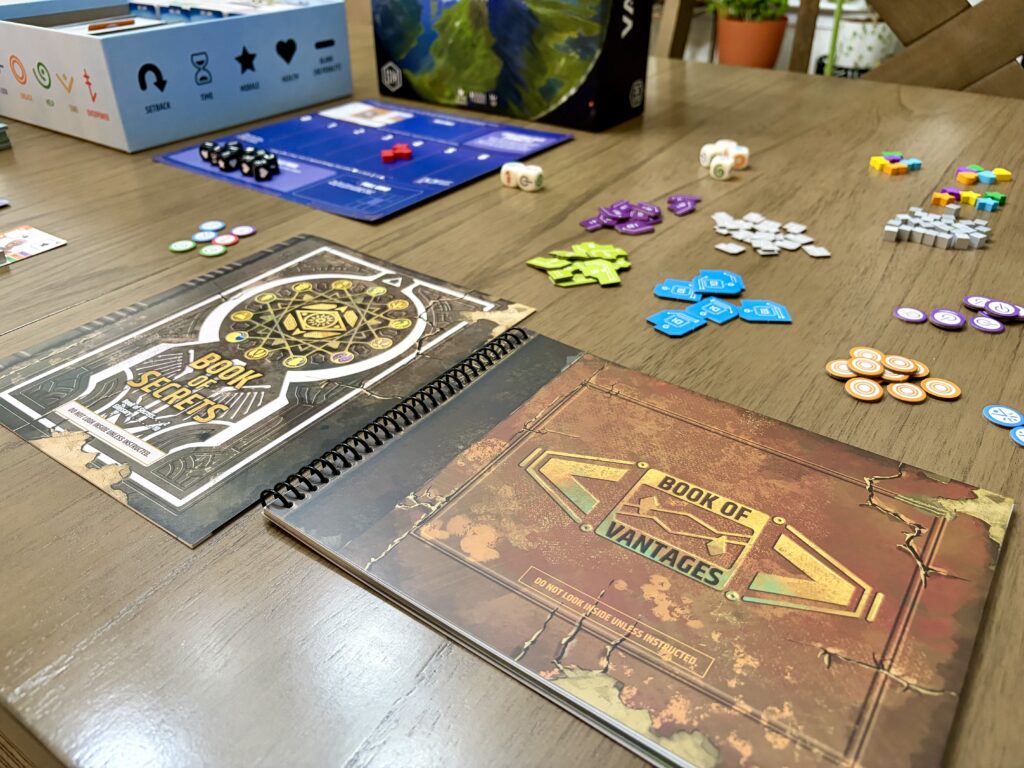
The randomness extends to the location actions. At each location, you are given a choice of one of six actions that each correspond to the six skills. However, you’re only given a single keyword along with the image of the location to help you decide. Piecing together which keyword will result in a certain action is not always entirely clear. What ends up happening is that you often end up picking the action that synergizes well with the skill token and items you already have in order to have a greater chance of mitigating the challenge dice.
In addition, you don’t find out the difficulty of the associated action until after you’ve chosen, so you might randomly get a very challenging action without knowing beforehand. The idea is that you can use the art on the location, along with the keywords to determine the best course of action; however, you’ll likely only pick up on some of those subtleties after more plays, and even then, you might just stumble on something more challenging than you expected.
The challenge dice also contribute to a fair amount of randomness. I mentioned that I found the early parts of the game to be the most enjoyable, but runs can go sideways quickly if the challenge dice don’t fall your way. In one game I played, a couple of early mistakes and difficult challenges quickly led to an early end. In addition, there’s no real difficulty scaling, so after you’ve filled out your grid of nine cards with some upgraded items, you’ll likely be able to pass most challenges with ease. In one game I played, I ended up calling the game early because I didn’t have the patience to continue wandering from location to location until I stumbled upon what I needed to complete my destiny goal.
Finally, another tidbit of randomness, sometimes when you enter a location, you’ll be forced to lose health, moral, or time, and there are only certain cards that will prevent that from happening. That would be fine if you knew that prior to entering those types of locations, but there’s very little of way of knowing.
Going back to the thematic elements, unfortunately the world doesn’t feel very dynamic. Occasionally, actions taken at a neighboring location have impacts on the next location, but I found these to be sparse. Part of that is likely due to the openness of the way the world is designed. Minor spoiler alert: the world is designed as a large grid, but since the way you happen upon different locations can vary, I imagine it’s difficult to design a lot of connected elements. Overall, I miss some of the rippling effects that can happen in games like Arydia or Sleeping Gods which make those worlds feel more dynamic.
I mentioned that you automatically succeed at all actions, which is an interesting take. However, I personally found that this contributed to feeling like the choices I made didn’t particularly matter. I missed that sense of weight to your decisions. In addition, since you can choose to end the game practically at any time, the ending feels very anticlimactic, even when completing an epic victory.
Finally, the game supports anywhere from one to six players. I recently wrote a post on five of my board gaming pet peeves, and Vantage is strong example of misleading player counts. Vantage feels like it was designed as a solo game. Since each player is randomly dropped at a different location in the world, it’s very unlikely that you’ll end up at the same location as another player. There are very few multiplayer elements, so each player is mostly playing their own game of Vantage, except that you have downtime between your turns. I could possibly see you and a partner playing it together so that you can read the stories to one another, but I will likely only play Vantage solo and wouldn’t dare play with five or six players.
Overall, I have mixed opinions on Vantage. In one sense, it feels like a very experimental game that attempts to buck many of the trends in this style of game. And if you enjoy games that have a very open-ended nature, like Breath of the Wild, then I suspect you’ll like this one. I could see myself pulling this out occasionally to get my adventure game fix without having to commit to a long campaign, and if Jamey decides to add additional content for the game, I would personally prefer to see the game provide a bit more direction or connected elements rather than more items or locations. For now though, I’m still on the fence on whether Vantage will remain part of the collection.
With that, I’ll wrap up this week’s review! If you’ve played Vantage, what are your thoughts on the game? And what are your favorite exploration, adventure games? I’d love to hear your thoughts on any of the games I’ve mentioned or future content suggestions in the comments below. Happy gaming!
If you liked this post and want to be notified when new content is released, then follow me on Instagram @themeepledigest.