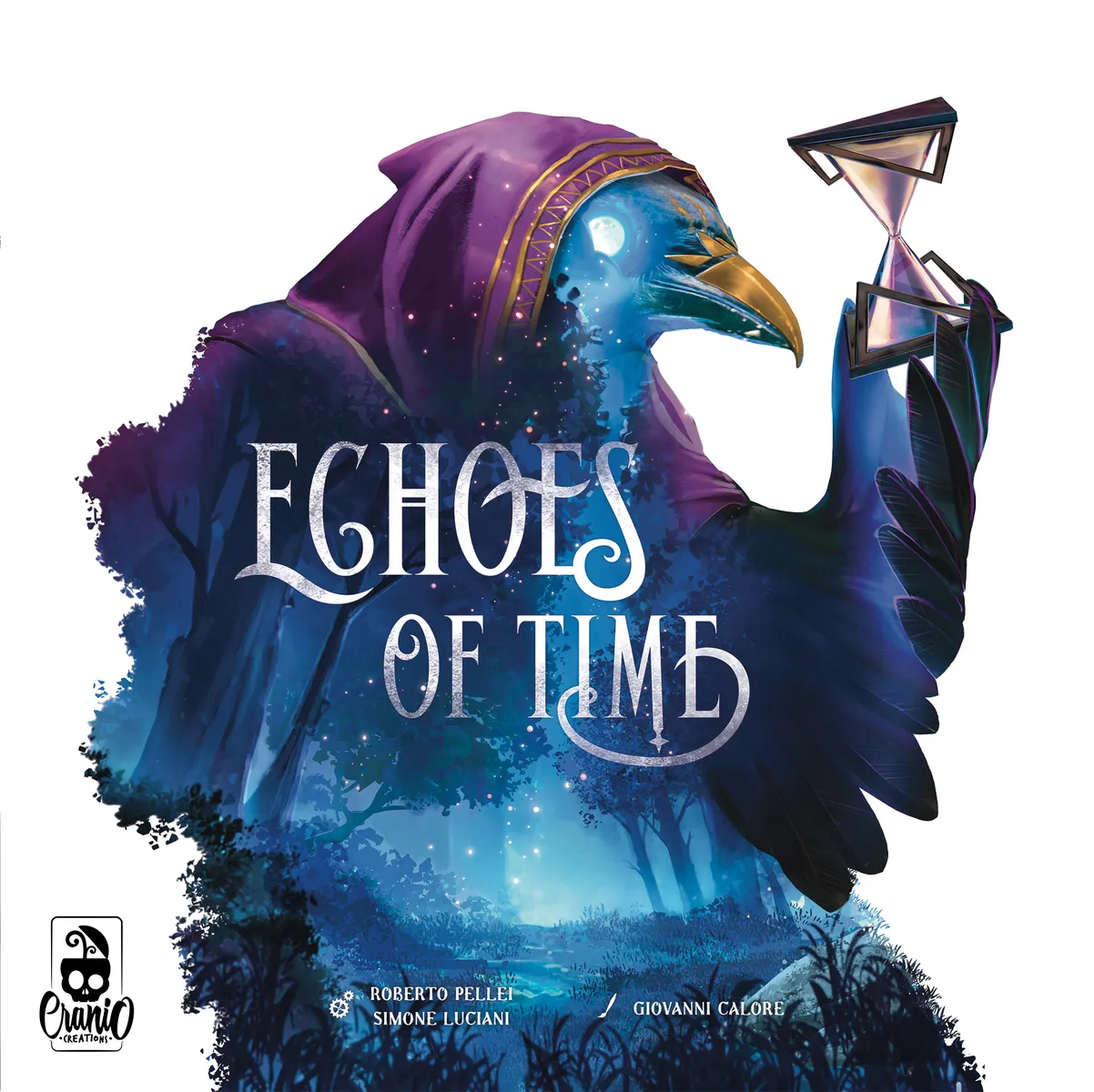
Welcome to this week’s review! This week I’m taking a look at a new tableau-building card game from designer Simone Luciani. So, without further ado, let’s jump into it.
Disclosure: A review copy of this game was provided to The Meeple Digest in exchange for an honest, unbiased review. This review is not intended to be an endorsement.
Echoes of Time
- Designers: Simone Luciani, Roberto Pellei
- Publisher: Cranio Creations
- Complexity: Medium
- Time: 30-60 Minutes
- Players: 2-4
- Main Mechanisms: Tableau-Building
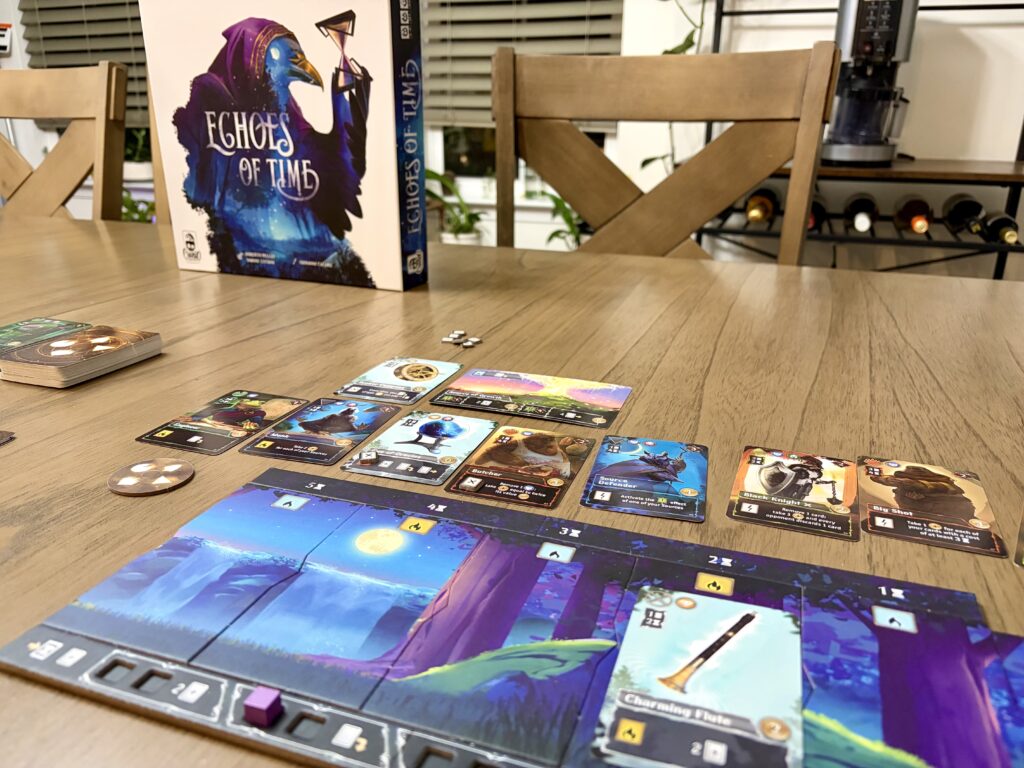
Echoes of Time is a tableau-building card game that shares similarities to games like Race for the Galaxy and Ancient Knowledge. Over a number of rounds, players play cards onto sliding tiles (1-5), as indicated on each card, and the card’s effects and abilities are triggered when the card slides off their last tile and enters their playing area. Each round, all cards slide one position forward, but there are other ways that players can cause cards to move. The game ends when one player has played 12 cards, the victory point supply has been depleted, or all source cards have been fortified (which is done by using the strength value of cards to capture and fortify a central source card).
Overall, the game feels quite streamlined. Each round, players have two actions: they can either draw two cards, play a card, slide two cards one time space or one card two time spaces, or capture/fortify a source. The rules are also relatively easy to comprehend, and the complexity of the game comes from figuring out how best to leverage your cards to build an efficient engine. There are also quite a number of satisfying combos you can chain together. For example, in one game, I focused almost entirely around gaining cards from one specific faction. One of my cards gave me victory points, while another allowed me to draw cards each time I played cards of that faction. By streamlining my tableau to focus on one faction, I was able to maximize the benefits I gained.
In addition, the game requires a lot of tactical decision making. For example, in order to play a card, the player must spend a certain number of cards from their hand. Therefore, players are constantly having to figure out which cards to prioritize and which ones to discard, leading to satisfying decision-making.
As with most tableau-building card games, there is an element of luck of the draw and you may not draw cards that sync with your strategy. Thankfully the games are relatively quick, particularly at two players, which means that you can easily play multiple games in a session to try out different strategies.
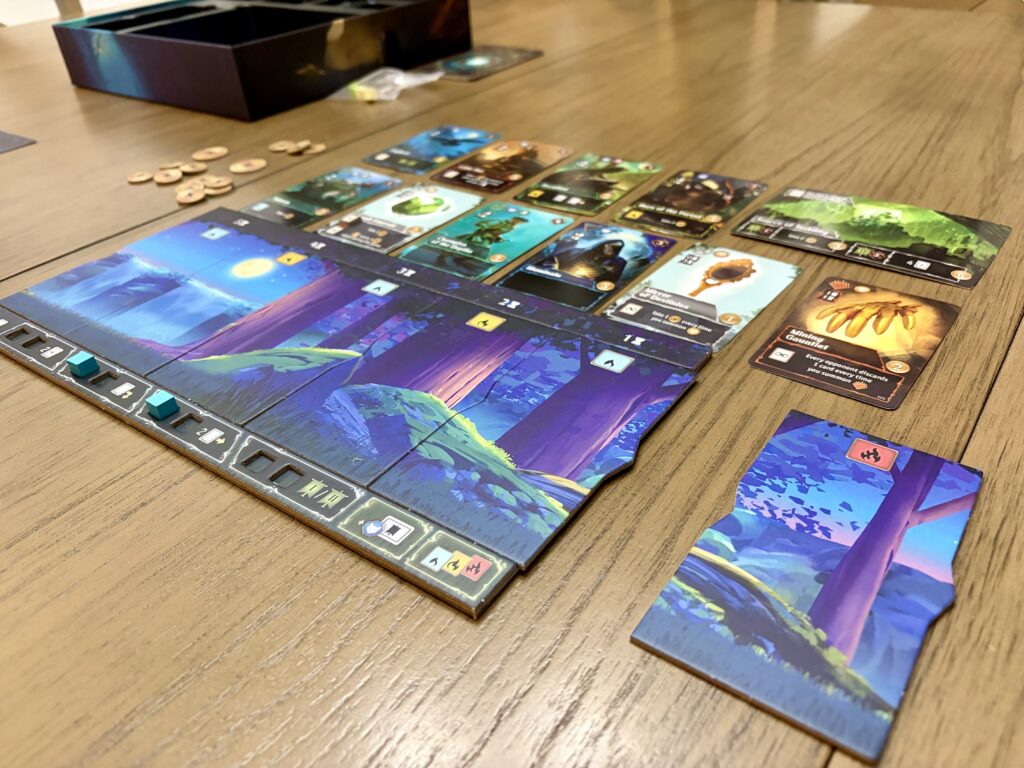
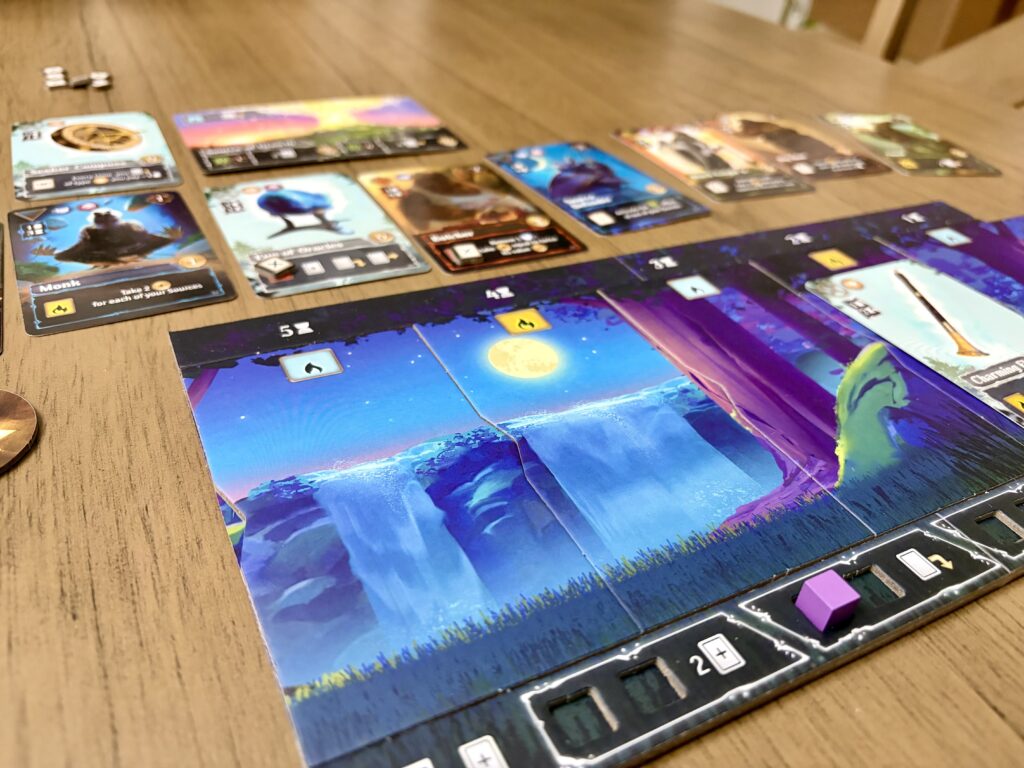
Arguably the most compelling aspect in the game is the use of time as a mechanism. I mentioned that when you play a card, it’s placed on a tile corresponding to the time value on the card, and players don’t get to leverage any of the card’s abilities until it has progressed off their last time tile. In addition, some cards have abilities that can be activated depending on which time tile is currently off your board. There are three ability colors that correspond to one, two, or three instances of time tiles on your board. For example, the red abilities tend to be the strongest, but they have fewer opportunities to trigger. This requires a fair amount of planning to determine what time you need cards to activate, which I found particularly interesting.
The theme of building out a fellowship of fantasy creatures feels entirely pasted on, but the production value is top notch. The artwork is outstanding, especially considering that the artist appears to be new to board gaming. I did notice some slight nicks to card edges after a handful of plays, so if you are particular about keeping cards in pristine condition or you play the game often, then you’ll likely want to sleeve them.
There’s very little player interaction in the game other than competing to conquer and fortify the source cards (there is one source card per player in each game). The only other player interaction comes from some abilities on cards. For example, some cards may force the other player to discard cards or victory points. The rules do mention that you can remove those cards from the game, but the abilities never felt more than a minor inconvenience. However, it’s a shame that the only interaction in the game is negative. In 2025, I would expect games to figure out how to implement player interaction without resorting to “take-that” mechanisms.
Since there is very minimal player interaction, I prefer the game at two players, since adding more players only lengthens the game. If I’m looking for a similar game that fits four players, there are many more on my shelf that I prefer. However, with two players, games only take roughly 30 minutes, which feels like the sweet spot for this style of game.
Overall, I have enjoyed my time with Echoes of Time. The game feels very streamlined, and the time mechanic is quite compelling. However, I’m not sure if the game does enough to distinguish itself from others in the collection, and I suspect I’ll only choose to play it at two players. Echoes of Time is a solid game, and I would recommend it to gamers who like this style of card-tableau, engine-building game. Personally, I’m still on the fence on whether it’ll remain a permanent part of the collection. The game doesn’t necessarily do anything blaringly wrong, it just doesn’t feel incredibly memorable.
With that, I’ll wrap up this week’s review! If you’ve played Echoes of Time, what are your thoughts on the game? And what are your favorite tableau-building card games? I’d love to hear your thoughts on any of the games I’ve mentioned or future content suggestions in the comments below. Happy gaming!
If you liked this post and want to be notified when new content is released, then follow me on Instagram @themeepledigest.