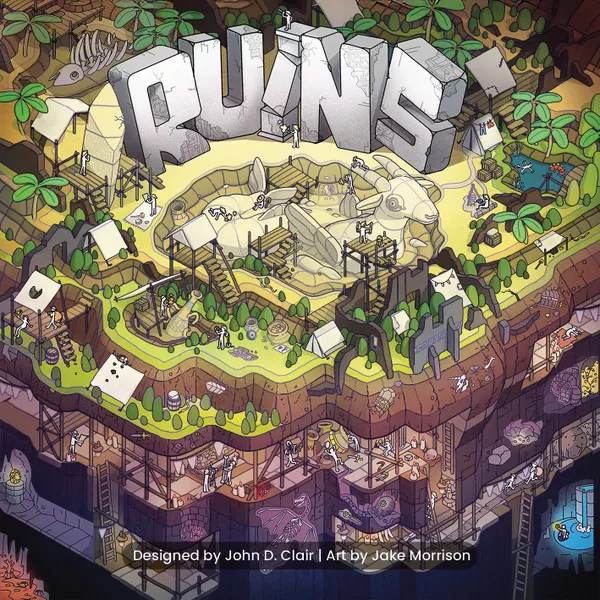
Welcome to this week’s review! This week I’m taking a look at a small box, card-shedding game. So without further ado, let’s jump into it.
Disclosure: A review copy of this game was provided to The Meeple Digest in exchange for an honest, unbiased review. This review is not intended to be an endorsement.
Ruins
- Designer: John D. Clair
- Publisher: Allplay
- Complexity: Light
- Time: 40 Minutes
- Players: 2-5
- Main Mechanisms: Card Shedding, Card Crafting
At its core, Ruins is a card-shedding game. At the beginning of each round, players draw a hand of nine cards with numbers from one to ten. The goal is to empty your hand of cards before the other players. Starting with the first player, the player leads by playing one or more cards of the same rank from their hand. Then in clockwise order, players must follow by playing the same number of cards with equal or higher rank. For example, if one player leads with two twos, then the next player could follow by playing two threes, and so on. If a player can’t follow, then they must pass. Once all players have passed, then the played cards are discarded and whoever last played a card leads the next set. This continues until all but one player has cards left, and then players score points based on the order they went out. The end game is slightly confusing, but typically the game will last between four and five rounds (more on this later).
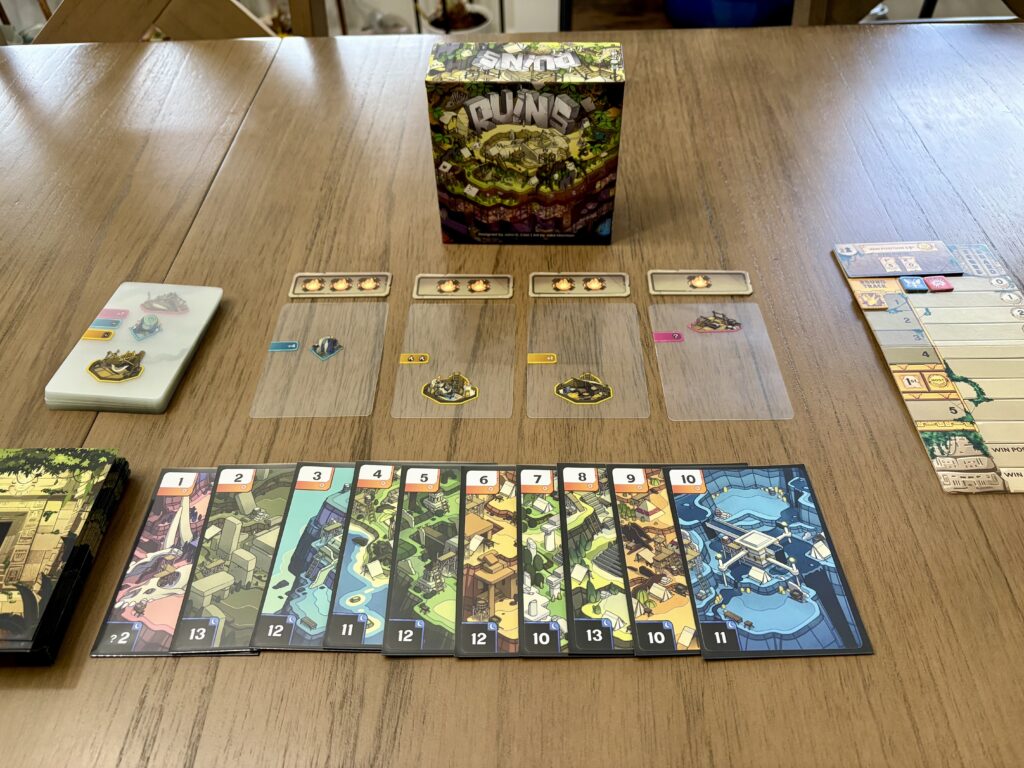
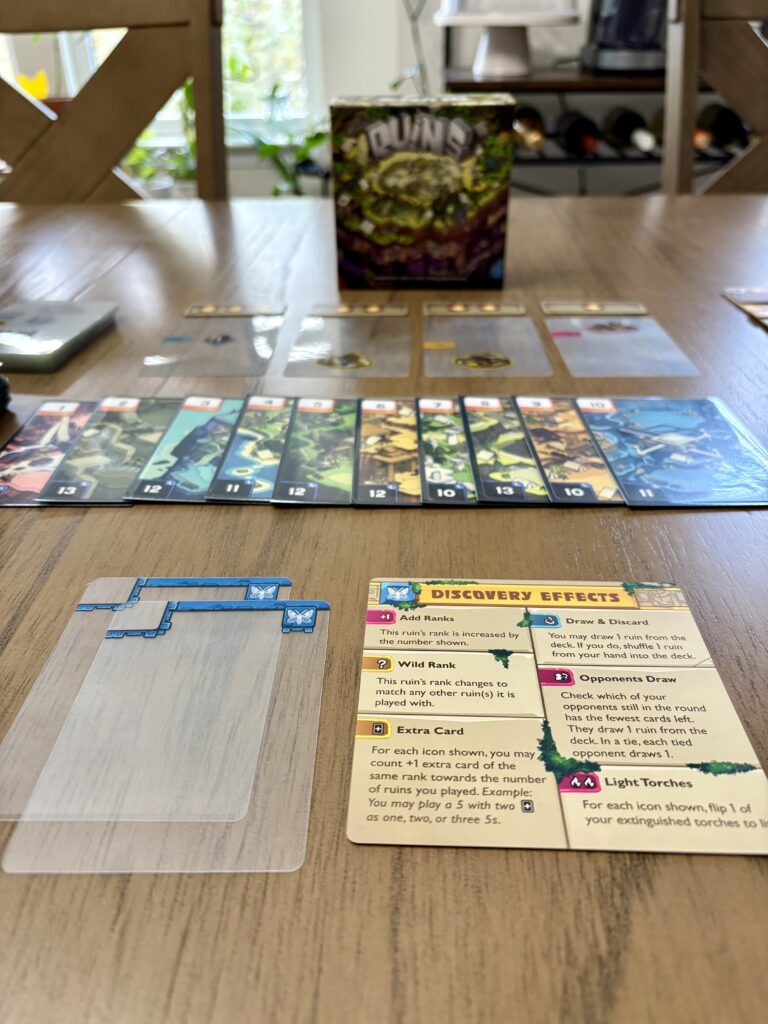
Designer John D. Clair is known for pioneering the card-crafting mechanism through the likes of Mystic Vale. Each card is placed in a sleeve, and in Ruins, players can upgrade cards, by way of adding transparent cards to the card sleeves. For example, some upgrades increase the rank of a card or make the card a wild rank. These upgrades stay on the cards for the rest of the game, so over the course of the four to five rounds, the deck becomes quite unique. Additionally, at the start of each round, players can flip one of the cards in their hand to the opposite side. Each card is double-sided with the alternate version either changing the rank and/or applying an upgrade to the card. Finally, players can claim cards, so if that card is drawn by another player at the start of a round, then they must pass that card to the player. This is an advantage if there is a very powerful card that has been upgraded multiple times, but I’ve also found that you need to be selective on which cards you claim as they add an additional card that you now have to shed.
Overall, I enjoy the puzzle of figuring out which upgrades to apply and which ones will maximize my chance of going out. Each round, players will have three torch tokens, which are spent to apply upgrades from a display of four cards varying in cost from one to three torches. Additionally, while there aren’t a ton of different effects, there is some nice variety, and at the end of each game, the deck will end up slightly different from game to game. The upgrades can only be applied to cards when they are played, so there is a nice amount of decision-making to determine when to use them.
Another positive for the game is that it comes in a relatively small box, and the rules are fairly light. Additionally, the box specifies 30 minutes, which I think is fairly accurate, and I wouldn’t expect games to take longer than 45 minutes even at higher player counts. This wouldn’t be my first choice to bring to a game night, but I could see it being a game to wind down a gaming night or to use as a slightly longer filler.
The card-crafting is easily my favorite part of the game, but there are also some issues I had with the design that are worth mentioning. First off, there is a large amount of luck in the game. Yes, you add upgrades to cards, but at the end of the day, if someone draws a stronger hand, they are more likely to go out earlier.
Additionally, I’m not generally a fan of turn skipping in games, and in Ruins, if a player follows by playing the same rank and number of cards as the previous player, the next player in turn order must pass. It’s never fun to have your turn skipped, and overall I felt like this mechanism felt out of place. There is no way to know whether the next player has the same rank and number of cards as the previous player, so it ends up just adding another random element. I suppose I could always house-rule this out, but it seemed like an odd addition.
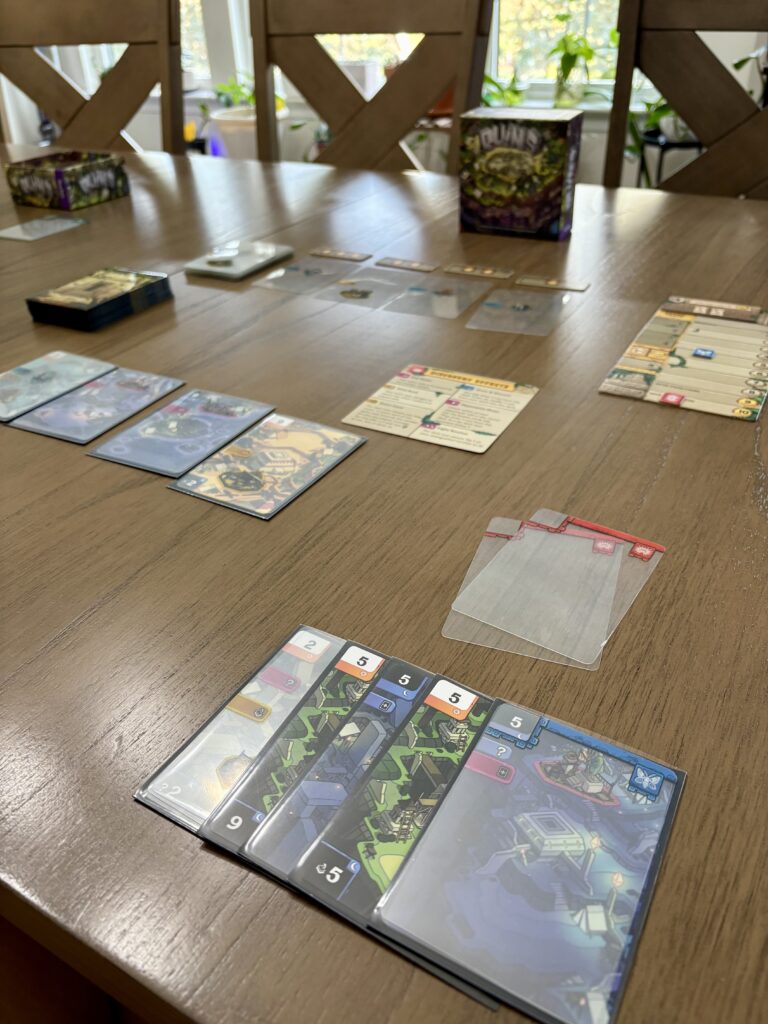
Next, having played the game at both four and two players, I would never choose to play the game at two again. With only two players, the game ended up feeling flat, and I think four is likely the optimal number of players. With four, the deck becomes more interesting since there are more cards and chances for upgrades to happen.
I also found the end of the game to be a bit odd. A player can win by starting a round with nine or ten victory points and then going out first in that round. Otherwise, if no player has won after four rounds, then the player with the most points and the player who went out first in round four play one additional round. Whoever goes out first in that round becomes the winner of the game. While I guess the chance of the showdown gives players who are further back something to play for in the final round, I’m also not the biggest fan of playing an extra round where not all players get the chance to participate. At least the showdown is fairly quick, but it does end of feeling a bit anticlimactic.
Finally, while the card-crafting is fun. It does mean that there’s a fair amount of cleanup at the end, since you need to take all of the upgrades out of the sleeves and reset the cards to the correct side.
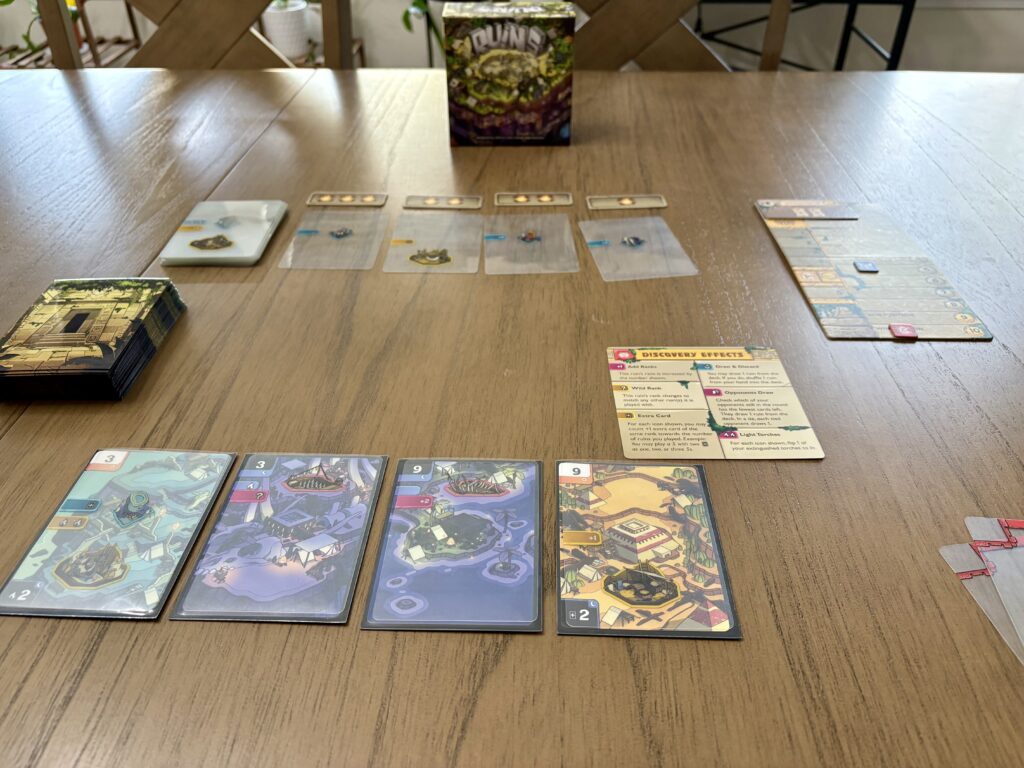
Overall, I found Ruins to be a bit of mixed bag. The card-crafting mechanism is interesting, and I like how the deck of cards evolves over the course of the game. However, since I’ll likely only opt to play the game at four players, and there’s a fair amount of luck, I’m not sure how often it will hit the table. Ruins will be staying in the collection for now (the small box helps), but it will be interesting to see how often it will get played.
With that, I’ll wrap up this week’s review! If you’ve played Ruins, I’d love to hear your thoughts on the games? And do you enjoy any other card-crafting or card-shedding games? I’d love to hear your thoughts on any of the games I’ve mentioned or future content suggestions in the comments below. Happy gaming!
If you liked this post and want to be notified when new content is released, then follow me on Instagram @themeepledigest.